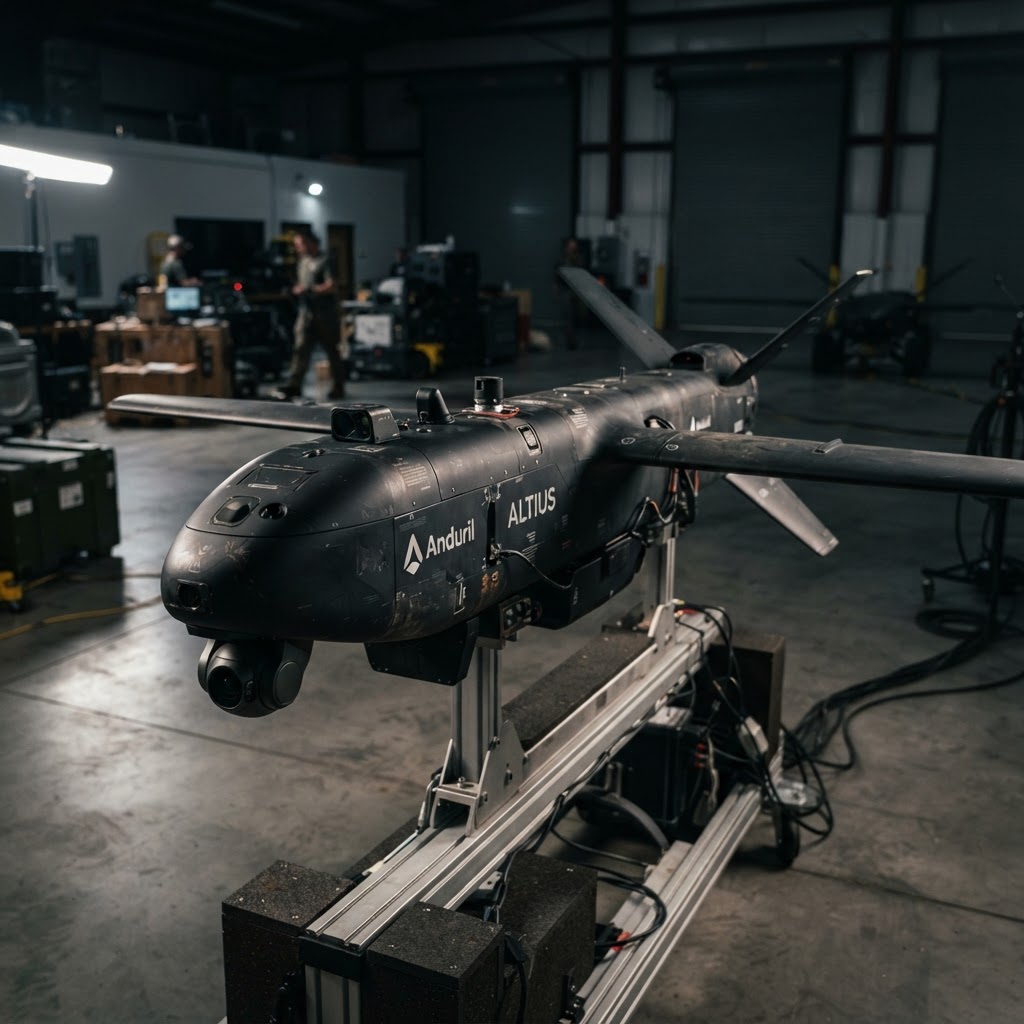
The Defense Industry's Most Disruptive Factory Floor
Something extraordinary is happening in the autonomous weapons sector, and it's being driven not by a legacy defense contractor but by a Silicon Valley-born startup that thinks like a tech company and builds like a manufacturer. Anduril Industries has become one of the most closely watched companies in the defense space, drawing attention from Pentagon procurement officials, allied governments, and industrial manufacturers worldwide.
The company's approach to autonomous combat drone manufacturing is fundamentally different from how defense hardware has been produced for decades. Rather than relying on cost-plus government contracts and slow iteration cycles, Anduril is treating autonomous drones like consumer electronics — designing for speed, scale, and software-defined upgrades.
For B2B manufacturers and industrial companies, Anduril's rise offers a rare case study in what happens when software-first thinking collides with hard manufacturing realities. The lessons extend far beyond defense and into any industry grappling with automation, smart production, and rapid go-to-market timelines.
Inside the Arsenal: Anduril's Manufacturing Scale and Operations
Anduril's most significant infrastructure bet is its Arsenal-1 facility, a massive manufacturing campus that the company announced plans to build in Columbus, Ohio. The facility is projected to span over 5 million square feet — making it one of the largest advanced manufacturing sites in the United States — with a capital investment exceeding $1 billion and a commitment to create more than 4,000 direct jobs in the region.
The Arsenal-1 facility is designed to produce autonomous systems at what Anduril calls "defense-industrial scale," a phrase that underscores the company's explicit goal of outpacing traditional defense suppliers in production velocity. The facility is purpose-built to manufacture a range of autonomous platforms, including the Roadrunner-M interceptor drone, the Fury combat drone, and future systems not yet publicly disclosed.
Anduril's revenue trajectory reflects how seriously the market is taking this manufacturing buildout. The company reportedly surpassed $1 billion in annualized revenue in 2024 and raised a $1.5 billion funding round that year, pushing its valuation to approximately $14 billion. These figures represent extraordinary growth for a company founded in 2017 that has compressed a decade of defense contractor development into a fraction of the time.
Contracts are flowing in to match the production ambition. In 2024 and into 2025, Anduril secured major agreements with the U.S. Air Force, the U.S.
Marine Corps, and the Australian Defence Force, with the total value of awarded contracts reaching several billion dollars across multi-year programs. The company's manufacturing pipeline is no longer theoretical — it is being funded and accelerated by government demand signals.
Lattice OS and the Technology Stack Behind the Machines
What separates Anduril from traditional drone manufacturers is not just the hardware — it is the operating system. Lattice OS, Anduril's proprietary AI-powered command and control platform, serves as the nervous system connecting autonomous drones, sensors, and human operators across a battlefield environment. This software layer gives Anduril a compounding advantage: every new drone produced becomes more capable through software updates rather than hardware redesigns.
The Roadrunner and Roadrunner-M platforms exemplify this philosophy. These jet-powered, vertically launched autonomous interceptors are designed to identify, track, and engage aerial threats without requiring constant human input. The Roadrunner-M variant, unveiled publicly in 2024, is built specifically for kinetic intercept missions and is designed to be recoverable and reusable — a cost-efficiency innovation that directly addresses the economics of attritable drone warfare.
Anduril's Fury platform, a larger autonomous combat aircraft designed to fly alongside crewed jets, is being developed under the U.S. Air Force's Collaborative Combat Aircraft (CCA) program. In 2024, Anduril was awarded a contract to compete in the CCA program alongside General Atomics, positioning the company at the very forefront of next-generation air combat manufacturing.
Analysts estimate the CCA program could be worth more than $6 billion in initial contracts, with the potential to scale significantly over the program's lifecycle.
On the production technology side, Anduril is investing heavily in digital-twin manufacturing processes, where virtual replicas of production lines and drone systems allow engineers to simulate failures, optimize assembly sequences, and validate design changes before a single physical component is altered. This approach dramatically compresses the iteration cycle, a capability that legacy manufacturers still struggle to replicate at scale.
What Industrial and Manufacturing Companies Can Learn From Anduril's Growth Playbook
Anduril's ascent contains a masterclass in repositioning within a mature, incumbent-heavy industry. Rather than trying to win on the traditional defense procurement battlefield — where relationships, lobbying, and compliance history dominate — Anduril competed on technology differentiation and speed of delivery. This is a model any industrial company can study when entering a sector dominated by slower, larger incumbents.
The company's brand strategy is also instructive. Anduril publicly released technical details about its platforms — publishing videos, spec sheets, and even live demonstrations — at a cadence that more resembles a consumer tech launch than a classified defense program. This transparency built credibility with procurement officers and created a media narrative that attracted top engineering talent, a critical input for any advanced manufacturer.
Anduril's partnership model provides another lesson. Rather than acquiring customers one contract at a time, the company pursued "anchor relationships" with high-profile government customers whose endorsement opened doors to allied nations. The Australian partnership, which includes a commitment to build autonomous underwater vessels and surface drones, is a prime example of using one flagship deal to establish international manufacturing credibility.
For B2B marketing teams at industrial companies, the takeaway is clear: technical content, transparent capability demonstrations, and strategic anchor partnerships can replace years of slow relationship-building when your product genuinely solves a problem that existing suppliers cannot. If your company is developing advanced manufacturing capabilities — whether in robotics, automation, or precision fabrication — Anduril's playbook offers a replicable framework for accelerating market adoption. Consider auditing your own go-to-market strategy to identify where speed and transparency could unlock new opportunities in your sector.
Future Outlook: Autonomous Manufacturing at the Intersection of AI and Industrial Scale
The autonomous combat drone market is projected to reach $47 billion globally by 2030, according to recent defense industry analyses, with demand accelerating sharply in response to geopolitical pressures across Europe, the Indo-Pacific, and the Middle East. Anduril is positioning itself to capture a disproportionate share of that growth by being the first company to solve both the technology and the manufacturing scale challenges simultaneously.
The Arsenal-1 facility, expected to reach full operational capability by the late 2020s, is designed with modularity in mind — allowing Anduril to rapidly reconfigure production lines as new platforms are developed. This is a critical competitive advantage in a market where threat environments evolve faster than traditional procurement cycles allow. The ability to pivot manufacturing without retooling from scratch is the industrial equivalent of a software over-the-air update.
Beyond the U.S. market, Anduril is building a global manufacturing and integration footprint. In 2025, the company announced expanded operations in the United Kingdom as part of efforts to serve NATO allies with locally manufactured and maintained autonomous systems. This multinational production strategy mirrors the playbook of top-tier industrial equipment manufacturers who achieve resilience and market access by distributing production across allied nations.
For industrial executives watching from the sidelines, the message is urgent: the convergence of AI, autonomy, and advanced manufacturing is no longer a future scenario — it is a present-tense competitive reality. Companies that begin integrating these capabilities into their own operations today will define the supply chains, platforms, and standards that govern industrial production through the next decade.
Key Takeaways
- Anduril surpassed $1 billion in annualized revenue in 2024 and raised a $1.5 billion funding round, reaching a $14 billion valuation — demonstrating how fast a hardware-software hybrid manufacturer can scale in defense
- The Arsenal-1 facility in Columbus, Ohio will exceed 5 million square feet and represent over $1 billion in capital investment, setting a new benchmark for autonomous systems manufacturing infrastructure
- Anduril was awarded a contract under the U.S. Air Force's Collaborative Combat Aircraft program in 2024, competing for a program potentially worth more than $6 billion in initial contracts
- The global autonomous combat drone market is projected to reach $47 billion by 2030, with Anduril's combined technology and manufacturing scale positioning it as a primary market share beneficiary
Key Quotes
"We are building the defense industrial base that the United States actually needs — one that can produce autonomous systems at the speed and scale modern threats demand." — Palmer Luckey, Founder, Anduril Industries
"Anduril is demonstrating that you do not have to choose between cutting-edge software and serious hardware manufacturing. They are doing both, and doing it faster than anyone expected." — Will Roper, Former Assistant Secretary of the Air Force for Acquisition
References
- Anduril Industries Official Newsroom — covers Arsenal-1 announcements, platform launches, and contract awards including Roadrunner-M and Fury CCA program details
- Defense News – Anduril Coverage — in-depth reporting on Anduril's manufacturing expansion, funding rounds, and U.S. Air Force CCA program participation
- Reuters – Anduril $1.5 Billion Funding Round — reporting on Anduril's 2024 funding milestone and valuation growth to $14 billion