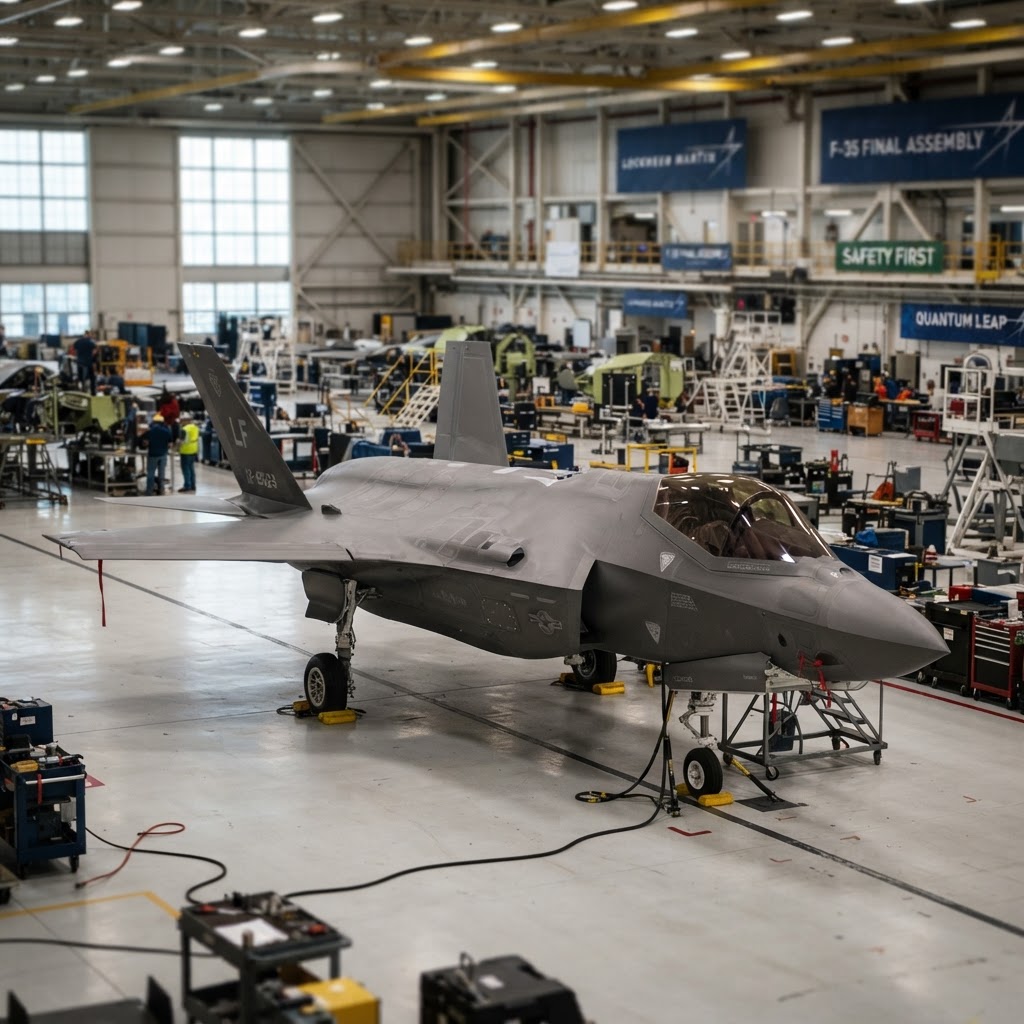
When Defense Meets Industrial Dominance
Few companies on earth operate at the intersection of cutting-edge engineering and industrial scale quite like Lockheed Martin. As the world's largest defense contractor by revenue, Lockheed Martin has built a production ecosystem that turns raw aerospace materials into some of the most sophisticated weapons platforms ever conceived. For manufacturing and industrial leaders, the company represents a masterclass in how complex, high-stakes production can be structured, optimized, and scaled.
The F-35 Lightning II alone has redefined what modern fighter jet manufacturing looks like. With thousands of suppliers spanning dozens of countries, Lockheed Martin's production model is as much a supply chain achievement as it is an engineering one. Understanding how this machine works offers profound lessons for any industrial company looking to tighten operations, build strategic partnerships, and position for long-term growth.
This report examines Lockheed Martin's fighter jet and weapons systems production operations, breaking down the data, the technology, and the strategic moves that keep the company ahead of its competition — and what B2B manufacturers can learn from it.
The Scale of Production: Numbers That Define an Industry
Lockheed Martin reported net sales of approximately $71 billion in its 2024 annual results, with its Aeronautics segment — home to the F-35 and F-22 programs — contributing roughly $28 billion of that total. The Aeronautics division remains the single largest revenue-generating segment within the company, underscoring how central fighter jet production is to Lockheed Martin's overall industrial identity. These figures place the company in a category of its own among global defense manufacturers.
F-35 production has reached a critical milestone in recent years, with Lockheed Martin delivering over 180 aircraft annually at its Fort Worth, Texas facility as of 2025 reporting. The program has now delivered well over 1,000 aircraft to customers across the United States and allied nations, making it the most widely deployed fifth-generation fighter in history. The production line in Fort Worth spans more than 1.5 million square feet and employs tens of thousands of workers directly and indirectly.
Beyond the F-35, Lockheed Martin's Missiles and Fire Control segment generated approximately $12 billion in 2024 revenue, driven by surging demand for precision strike systems, hypersonic weapons development, and integrated air and missile defense products. Programs like HIMARS, JASSM, and PAC-3 have seen accelerated production schedules in response to global defense demand. This segment's growth rate exceeded 8% year-over-year in 2024, signaling that weapons systems beyond aircraft are becoming an increasingly critical pillar of the company's industrial output.
Lockheed Martin's global supply chain includes more than 1,800 suppliers across the United States alone, with the F-35 program supporting an estimated 300,000 jobs throughout the broader industrial base. This level of supplier integration is not accidental — it reflects a deliberate strategy to distribute manufacturing capability, manage geopolitical risk, and ensure production continuity at scale. For B2B manufacturers operating in tiered supply chains, Lockheed Martin's supplier network architecture is a case study in strategic dependency management.
Advanced Manufacturing and Process Innovation on the Production Floor
Lockheed Martin has aggressively adopted digital manufacturing technologies to maintain production velocity on complex programs. The company's use of Model-Based Definition (MBD) and Digital Thread technology allows engineers and production teams to share a single, authoritative digital model of each aircraft component from design through final assembly. This approach has reduced engineering change cycles and minimized costly rework, with Lockheed Martin reporting measurable reductions in F-35 production costs as the program matures through its Learning Curve.
Additive manufacturing, or 3D printing, plays an increasingly significant role in weapons systems production at Lockheed Martin. As of 2025, the company has qualified hundreds of additively manufactured parts for use in flight systems, significantly shortening lead times for certain components from weeks to days. These capabilities are particularly valuable for low-volume, high-complexity parts that would otherwise require expensive traditional tooling.
The company's investment in advanced manufacturing centers in Palmdale, California and Owego, New York has accelerated this capability buildout.
Automation and robotics integration across the Fort Worth production line has also driven meaningful efficiency gains. Lockheed Martin has deployed automated fastening systems, robotic drilling platforms, and computer-vision-enabled quality inspection tools that reduce human error and increase throughput. These investments align with the company's stated goal of driving F-35 production costs below $80 million per unit, a target driven by international customer demand and long-term program sustainability.
Achieving that cost milestone requires relentless process discipline at every stage of manufacturing.
Hypersonic weapons development represents another frontier where Lockheed Martin is pushing manufacturing boundaries. Programs under the Skunk Works advanced development division are producing test vehicles that require novel materials capable of withstanding extreme thermal loads at speeds exceeding Mach 5. Manufacturing these components demands entirely new metallurgical processes and precision tolerances that challenge even the most capable industrial suppliers.
Lockheed Martin's ongoing investment in hypersonic manufacturing infrastructure signals where the next generation of weapons production complexity will reside.
Marketing and Growth Lessons for Industrial Manufacturers
Lockheed Martin's market position was not built on advertising alone — it was built on deep, multi-decade relationships with government procurement agencies and allied defense ministries. For B2B manufacturers, this highlights a fundamental truth: in high-complexity industrial markets, trust and demonstrated performance are the most powerful marketing assets a company can hold. Every successful F-35 delivery is itself a marketing event, reinforcing Lockheed Martin's credibility with existing and prospective customers.
The company's use of economic impact data as a strategic communication tool is particularly instructive. By publishing detailed reports showing how many jobs and how much economic activity the F-35 program generates in each customer's country, Lockheed Martin transforms a procurement decision into a domestic economic argument. Industrial manufacturers can apply this same logic — quantifying the downstream economic value your product or service creates for a customer strengthens the business case far beyond a simple cost-benefit analysis.
Lockheed Martin also leverages international air shows, defense expos, and government briefings as high-value demand generation channels. Events like the Paris Air Show and the Singapore Airshow serve as critical touchpoints where decision-makers from allied governments, prime contractors, and tier-one suppliers convene. For B2B manufacturers, investing in the right industry events — where your target buyers are already congregated — remains one of the highest-ROI marketing activities available, especially when combined with live capability demonstrations.
Finally, Lockheed Martin's investment in thought leadership through government relations, industry white papers, and policy engagement builds long-term brand equity in ways that traditional advertising cannot replicate. The company consistently positions its executives and engineers as authoritative voices on national security technology, supply chain resilience, and industrial base health. Manufacturers looking to grow their influence in complex B2B markets should consider how publishing substantive, data-backed content can establish their own organizations as indispensable expert partners.
Future Outlook and What Industrial Leaders Must Do Next
The global defense market is projected to grow substantially through 2026 and beyond, driven by persistent geopolitical instability, NATO member states accelerating defense spending commitments, and the increasing technological complexity of modern warfare. Lockheed Martin is strategically positioned to capture a disproportionate share of this growth, with a backlog that exceeded $165 billion as of the end of 2024. That backlog represents years of guaranteed production activity and provides financial visibility that most industrial manufacturers can only dream of achieving.
Next-generation fighter programs, including the Next Generation Air Dominance (NGAD) platform and international collaborative fighter programs, represent the pipeline that will sustain Lockheed Martin's Aeronautics segment well into the 2030s. Investment in digital design tools, advanced materials science, and AI-assisted mission systems development is accelerating to meet the design requirements of these future platforms. Industrial suppliers in the aerospace and defense ecosystem are already being evaluated for their ability to meet next-generation manufacturing standards.
For weapons systems specifically, the integration of artificial intelligence into targeting, logistics, and autonomous systems is creating entirely new production categories. Lockheed Martin's Rotary and Mission Systems segment, which generated over $16 billion in 2024 revenue, is increasingly embedding software-defined capabilities into hardware platforms — a shift that requires manufacturers to think about their products as ongoing services rather than one-time deliveries. This services-and-upgrades model changes the revenue structure and the customer relationship simultaneously.
The strategic implication for industrial manufacturers across all sectors is clear: the companies that win the next decade of growth will be those that invest now in digital manufacturing capabilities, supplier relationship depth, and a clear articulation of their unique value in complex production ecosystems. If your company is not actively benchmarking against the production and operational standards set by contractors like Lockheed Martin, you risk falling behind customers whose expectations are being shaped by exactly this level of industrial excellence. The time to assess your readiness and accelerate your investment is now — not when the next contract cycle opens.
Key Takeaways
- Lockheed Martin's Aeronautics segment generated approximately $28 billion in 2024 revenue, making F-35 and fighter jet production the single largest contributor to its $71 billion total net sales.
- The F-35 program has delivered over 1,000 aircraft globally and supports an estimated 300,000 jobs across more than 1,800 U.S.-based suppliers, illustrating the industrial scale of modern defense manufacturing.
- Lockheed Martin's Missiles and Fire Control segment grew over 8% year-over-year in 2024, reaching approximately $12 billion in revenue, driven by global demand for precision strike and air defense systems.
- With a contract backlog exceeding $165 billion at the close of 2024, Lockheed Martin has secured years of guaranteed production volume — a model built on long-cycle government relationships and demonstrated program performance.
Key Quotes
"The F-35 is not just a platform — it is an enterprise. It connects our workforce, our supply chain, and our allies in ways that no previous program has." — James Taiclet, Chairman, President and CEO, Lockheed Martin
"We are investing in the digital thread, advanced manufacturing, and hypersonics because the warfighter's requirements demand it, and our industrial base must be ready to deliver." — Frank St. John, Executive Vice President, Lockheed Martin Rotary and Mission Systems
References
- Lockheed Martin 2024 Annual Report — Official annual financial results covering segment revenues, backlog, and production milestones
- F-35 Lightning II Program Office — Official program site with delivery data, international partner information, and production updates
- Defense News: Lockheed Martin Production Coverage — Industry reporting on F-35 production rates, cost targets, and program developments through 2025