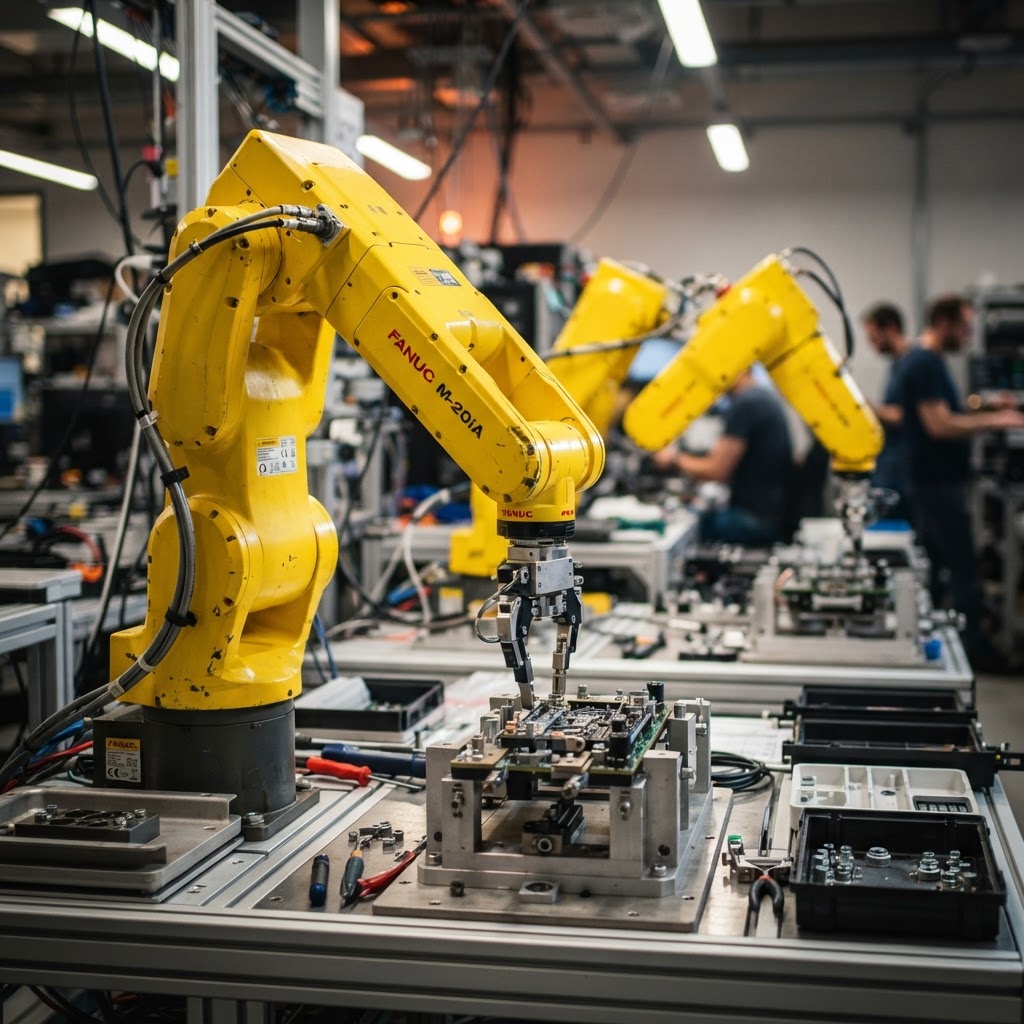
The Factory That Builds Its Own Robots
Deep in the forests of Oshino, Japan, something extraordinary happens every day. FANUC Corporation's sprawling campus — painted in its signature canary yellow — hums with robotic arms assembling other robotic arms, with almost no human hands touching the process. This is not science fiction.
This is FANUC's operational reality in 2025, and it is reshaping what industrial automation means for B2B manufacturers worldwide.
FANUC is the world's largest manufacturer of industrial robots and CNC (Computer Numerical Control) systems. With a global installed base exceeding 4 million robots, CNC systems, and ROBOMACHINE units, the company's footprint spans automotive plants, electronics factories, and logistics hubs across more than 100 countries. Understanding how FANUC operates is not just an academic exercise — it is a masterclass in industrial B2B strategy.
For manufacturing and industrial companies looking to benchmark their own automation journeys, walking through FANUC's operational philosophy offers rare, actionable intelligence. This case study breaks down what happens inside a FANUC robotics lab, why it matters, and what lessons B2B marketers and operations leaders should carry back to their own organizations.
How FANUC's Manufacturing Operations Achieve Lights-Out Efficiency
FANUC's Oshino facility is often cited as one of the most automated manufacturing environments on earth. The company runs what it calls "lights-out" production — factories that operate 24 hours a day, 7 days a week, with minimal human supervision. In practice, this means robotic systems manufacture servo motors, circuit boards, and complete robot assemblies while human workers focus on quality oversight and engineering tasks during daytime hours only.
In its fiscal year 2025 annual results, FANUC reported consolidated revenues of approximately ¥755 billion (roughly USD $5 billion), reflecting a recovery in orders driven by renewed demand from semiconductor equipment manufacturers and electric vehicle production lines. The company's operating margin, historically among the highest in the industrial machinery sector, hovered near 18% — a figure that reflects the dramatic cost efficiencies enabled by its own automation technology.
FANUC's global production capacity supports an installed base of over 4 million units across its three core product segments: ROBOT, ROBOMACHINE (precision machining centers and wire-cut EDMs), and ROBODRILL. Each segment feeds into a broader ecosystem of industrial customers who rely on FANUC not just for equipment but for an integrated automation architecture. The company ships thousands of robot units per month from its Oshino complex, with lead times that have become a key competitive differentiator in an era of supply chain volatility.
Perhaps most striking is FANUC's workforce-to-output ratio. With approximately 8,700 employees globally as of 2025, the company generates revenue per employee that dwarfs most industrial machinery peers. This ratio is a direct product of deploying its own robotic systems throughout every stage of production — a living proof-of-concept that the company actively markets to prospective B2B customers.
Inside the Lab: Technology and Process Innovation Driving FANUC Forward
A visit to FANUC's research and development labs reveals a company that treats its own factory floor as a continuous test environment. Engineers deploy new robot models, AI-assisted vision systems, and collaborative robot (cobot) configurations inside live production lines before those products ever reach a customer. This "eat your own cooking" philosophy accelerates product refinement in ways that lab-only testing cannot replicate.
FANUC's AI-powered vision systems — part of its iRVision product line — have become a focal point of recent innovation. In 2025, the company demonstrated vision-guided robotic cells capable of handling bin-picking tasks with an accuracy rate exceeding 99.5%, even with randomly oriented, reflective, or irregularly shaped parts. This level of precision addresses one of the most persistent pain points in automotive and electronics assembly: the inability of older robotic systems to adapt to part variation without expensive re-programming.
The company's FIELD (FANUC Intelligent Edge Link and Drive) system platform continues to evolve as a central pillar of its industrial IoT strategy. FIELD connects FANUC machines, robots, and third-party devices into a unified data ecosystem, enabling real-time monitoring, predictive maintenance, and production analytics. By 2025, FIELD deployments had expanded to include direct integrations with major MES (Manufacturing Execution System) and ERP platforms, lowering the barrier for mid-market manufacturers to achieve enterprise-grade visibility across their shop floors.
FANUC's collaborative robot lineup — the CR series — has also seen accelerating adoption. The CR-35iB, capable of handling payloads up to 35 kilograms while working safely alongside human operators without safety fencing, has found particular traction in heavy-component assembly for aerospace and energy sectors. The global cobot market is projected to reach $12.3 billion by 2026, and FANUC's combination of payload range, safety certification breadth, and software ecosystem positions it strongly within that growth curve.
Marketing and Growth Lessons Every Industrial B2B Company Should Steal
FANUC's marketing approach is deliberate, almost counterintuitively understated for a company of its scale. Rather than relying on splashy advertising campaigns, FANUC has built its brand equity almost entirely through demonstration-led selling. Its global network of certified system integrators — numbering over 2,000 partners worldwide — serves as a distributed sales force that delivers proof-of-concept deployments directly inside customer facilities.
This integrator-first go-to-market model carries significant lessons for B2B industrial marketers. When the product is complex, capital-intensive, and deeply integrated into a customer's core operations, the most persuasive marketing asset is a working installation that a prospect can visit, touch, and measure. FANUC's network effectively turns every customer site into a reference account — a strategy that scales trust far more efficiently than any digital ad spend.
FANUC also invests heavily in technical education as a demand-generation mechanism. The FANUC Academy, which operates training centers across North America, Europe, and Asia, trains tens of thousands of engineers and technicians annually on robot programming, maintenance, and system integration. This investment creates a talent pipeline of professionals who are credentialed in — and therefore predisposed toward — FANUC systems when they influence purchasing decisions at their employers.
For industrial B2B companies watching FANUC's playbook, the core lesson is this: the boundary between product, service, and marketing has dissolved. In high-complexity industrial categories, the ability to train, certify, and support a customer's workforce is not a post-sale cost center. It is one of the most powerful demand-generation and retention engines available.
The Road Ahead: Strategic Implications for Industrial Automation Buyers and Sellers
The industrial automation market is entering a period of structural acceleration. The twin forces of labor scarcity and the global push to re-shore manufacturing — particularly in North America and Europe — are driving capital expenditure toward robotic automation at rates not seen in prior cycles. Industry analysts project that the global industrial robotics market will surpass $35 billion in annual revenues by 2026, with FANUC positioned to capture a disproportionate share through its breadth of product categories and geographic reach.
FANUC's recent strategic emphasis on software and data services signals a shift in how the company intends to grow its revenue per installed unit. The FIELD platform and expanded AI capabilities represent a deliberate move toward recurring revenue streams — a significant evolution for a company historically known as a hardware manufacturer. For B2B buyers evaluating automation platforms, this shift means that selecting a robot vendor is increasingly a decision about long-term software partnership, not just equipment procurement.
The expansion of FANUC's cobot and human-robot collaboration portfolio also reflects a strategic bet on the mid-market. Small and medium-sized manufacturers — historically underserved by industrial robotics due to high deployment complexity and cost — are now a primary growth vector. FANUC's investments in simplified programming interfaces, plug-and-play integration kits, and flexible financing structures are all designed to lower the barrier to entry for this segment.
For industrial companies and their marketing, sales, and operations leaders: the automation window is open, but it will not stay open indefinitely. Early adopters are already compounding efficiency advantages that late movers will struggle to close. If your organization has not yet developed a formal automation roadmap with defined ROI metrics and vendor evaluation criteria, now is the moment to start.
FANUC's own story — a company that used its technology on itself before selling it to the world — is the clearest possible argument for moving from strategy to action.
Key Takeaways
- FANUC operates a global installed base of over 4 million robots, CNC systems, and ROBOMACHINE units across more than 100 countries, making it the world's largest industrial robot manufacturer by installed units.
- In fiscal year 2025, FANUC reported consolidated revenues of approximately ¥755 billion (USD ~$5 billion), with an operating margin near 18% — among the highest in the industrial machinery sector.
- FANUC's iRVision AI-powered vision systems achieved bin-picking accuracy rates exceeding 99.5% in 2025 demonstrations, directly addressing part-variation challenges in automotive and electronics assembly.
- The global industrial robotics market is projected to surpass $35 billion in annual revenues by 2026, with cobot segment growth alone expected to reach $12.3 billion — markets where FANUC holds leading product positions.
Key Quotes
"Our robots build our robots. That is the most honest demonstration we can offer any customer considering automation." — Kenji Yamaguchi, Senior Executive Officer, FANUC Corporation
"FANUC's edge has always been reliability. In a production environment, downtime is the enemy, and that is the problem we have engineered our entire company to solve." — Mike Cicco, President and CEO, FANUC America Corporation
References
- FANUC Corporation Investor Relations — Official source for FANUC annual reports, revenue figures, and financial disclosures including fiscal year 2025 results
- International Federation of Robotics — World Robotics Report — Covers global industrial robot installation data, market size projections, and segment-level growth forecasts through 2026
- FANUC America — FANUC Academy Training — Details FANUC's technical training and certification programs across North American training centers