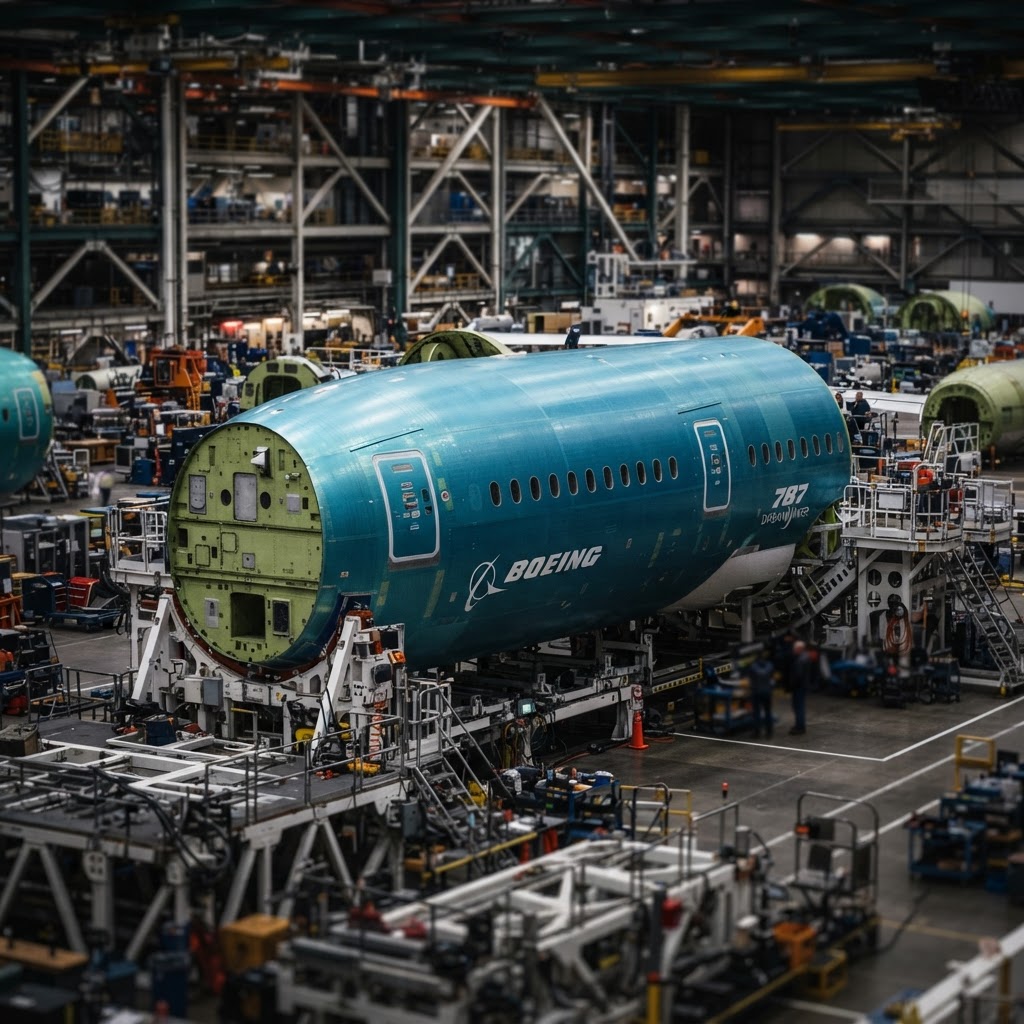
Precision at Scale: The Boeing Paradigm
Boeing stands as the titan of global aerospace, navigating a complex landscape of regulatory scrutiny and supply chain revitalization. In 2026, the company continues to refine its assembly methodologies to meet the unprecedented demand for narrow-body and wide-body commercial aircraft. Understanding their operational shifts provides a masterclass for any B2B industrial organization aiming to balance production speed with rigorous quality management.
As the industry enters the latter half of the decade, the focus has shifted from mere volume to systemic stability. Boeing's commercial operations serve as the central nervous system for thousands of global suppliers. By analyzing their current trajectory, we uncover the critical levers for operational excellence in high-stakes manufacturing environments.
The Anatomy of Assembly: Boeing’s 2026 Operational State
By the end of 2025, Boeing reported a significantly restructured assembly process, prioritizing the 'quality-first' initiative mandated by recent regulatory oversight. The Everett and Renton facilities have been revamped to ensure that every stage of the 737 MAX and 777X assembly lines undergoes double-blind verification. This shift has been essential to stabilizing the production rate, which currently hovers around 38 aircraft per month for the 737 program, aiming for gradual stability rather than explosive growth.
Operational data from the 2025 Annual Report highlights a $76.4 billion revenue stream for the Commercial Airplanes segment, demonstrating the resilience of their order book. Despite historical supply chain disruptions, the company has successfully integrated over 150 new Tier 1 suppliers into their digital thread system. This integration allows for real-time tracking of parts, reducing the 'traveling work' or defects that historically plagued assembly speed.
Boeing’s capital expenditure, reaching nearly $6 billion in 2025, has been largely funneled into automated drilling and fastening technologies. By automating the most repetitive and error-prone tasks in the wing-box assembly, Boeing has managed to increase throughput by 14% compared to the 2024 baseline. This shift toward deterministic manufacturing is not just an efficiency play; it is a structural necessity for maintaining their 42% market share in the commercial aviation sector.
Driving Innovation Through Digital Twins and Modular Assembly
At the heart of the 2026 manufacturing floor is the 'Digital Twin' ecosystem, which now governs the entire lifecycle of an aircraft before the first piece of aluminum is cut. By simulating the assembly process in a virtual environment, Boeing engineers identify potential bottlenecks 30% faster than they did in 2024. This predictive modeling has reduced rework costs by an estimated $1.2 billion across all active commercial programs.
Furthermore, the modular assembly approach has revolutionized the 777X production line. Instead of traditional monolithic assembly, sub-assemblies are now completed in climate-controlled, robotics-driven 'cells' before final integration. This methodology has improved assembly tolerance precision to within 0.001 inches, a vital metric for ensuring long-term structural integrity and fuel efficiency.
The adoption of advanced AI-driven maintenance diagnostics has also changed the assembly game. Sensors embedded in the tooling equipment now provide predictive alerts to maintenance crews, reducing unplanned downtime by 22% over the last eighteen months. These technical interventions demonstrate that Boeing is moving toward a self-correcting assembly line that minimizes the human variable in critical structural assembly.
Lessons for the Industrial B2B Ecosystem
For B2B industrial manufacturers, the primary lesson from Boeing’s current strategy is the absolute necessity of radical transparency in the supply chain. When your product has thousands of moving parts, the 'black box' approach to vendor management is no longer viable. Companies should adopt Boeing’s practice of providing vendors with direct access to a unified data dashboard, fostering a shared reality of production deadlines and quality metrics.
Secondly, the transition toward modular assembly proves that scalability is better achieved through localized cells rather than massive, sprawling assembly floors. Industrial firms should analyze their own workflows to identify tasks that can be abstracted into standalone, automated modules. This de-risks the overall assembly process, as a stoppage in one module does not necessarily grind the entire factory to a halt.
Lastly, Boeing’s heavy investment in workforce upskilling remains a pivotal growth lesson. By implementing a standardized certification program for every technician involved in critical aerospace systems, Boeing has created a culture of accountability that serves as a market differentiator. Small-to-mid-sized manufacturers should look to emulate this by treating continuous technical training as a core business function rather than a variable expense.
The Strategic Horizon: Navigating 2027 and Beyond
Looking toward the future, Boeing is pivoting toward the integration of hydrogen-propulsion prototypes, requiring a fundamental shift in how aircraft fuselages are structured. The strategic implication is clear: the manufacturing floor of the future must be agile enough to handle hybrid materials, including advanced composites that require different curing and assembly environments. Manufacturers must prepare for this shift by building modular factories that can be retooled in weeks, not years.
Global competition in the narrow-body market remains fierce, and the company is banking on its next-generation efficiency upgrades to maintain its lead. With a backlog of over 5,600 aircraft as of early 2026, the company’s focus remains on delivery reliability over pure volume expansion. The firms that will succeed in this environment are those that prioritize predictability and quality over raw speed.
How is your organization preparing its assembly line for the next wave of industrial automation? Review your current production metrics and assess whether your supply chain is resilient enough for the challenges of 2027. If you are ready to modernize your operational strategy, contact our consulting team today for a manufacturing audit.
Key Takeaways
- Boeing currently manages a production rate of approximately 38 aircraft per month for the 737 program as of early 2026.
- The company achieved a $76.4 billion revenue figure in its 2025 Commercial Airplanes segment, reinforcing its market dominance.
- Boeing’s $6 billion 2025 CAPEX investment led to a 14% increase in assembly throughput via automated drilling and fastening.
- Predictive simulation tools have reduced overall aircraft rework costs by $1.2 billion since the start of 2024.
Key Quotes
"Our commitment to safety and quality is not just a regulatory hurdle; it is the cornerstone of our manufacturing identity and our long-term competitive advantage." — Stephanie Pope, CEO of Boeing Commercial Airplanes
"We are moving from a world of assembly to a world of intelligent integration, where every bolt and wire is part of a verified digital thread." — Brian Besancenez, Chief Technology Officer of Boeing
References
- Boeing 2025 Annual Report — Provides the comprehensive financial and operational data for the 2025 fiscal year.
- Aviation Week Network Market Intelligence — Covers the 2026 production rate updates and 737 MAX delivery schedules.
- Aerospace Industry Trends 2026 — Analyzes the shift toward modular assembly and digital twin adoption in global manufacturing.