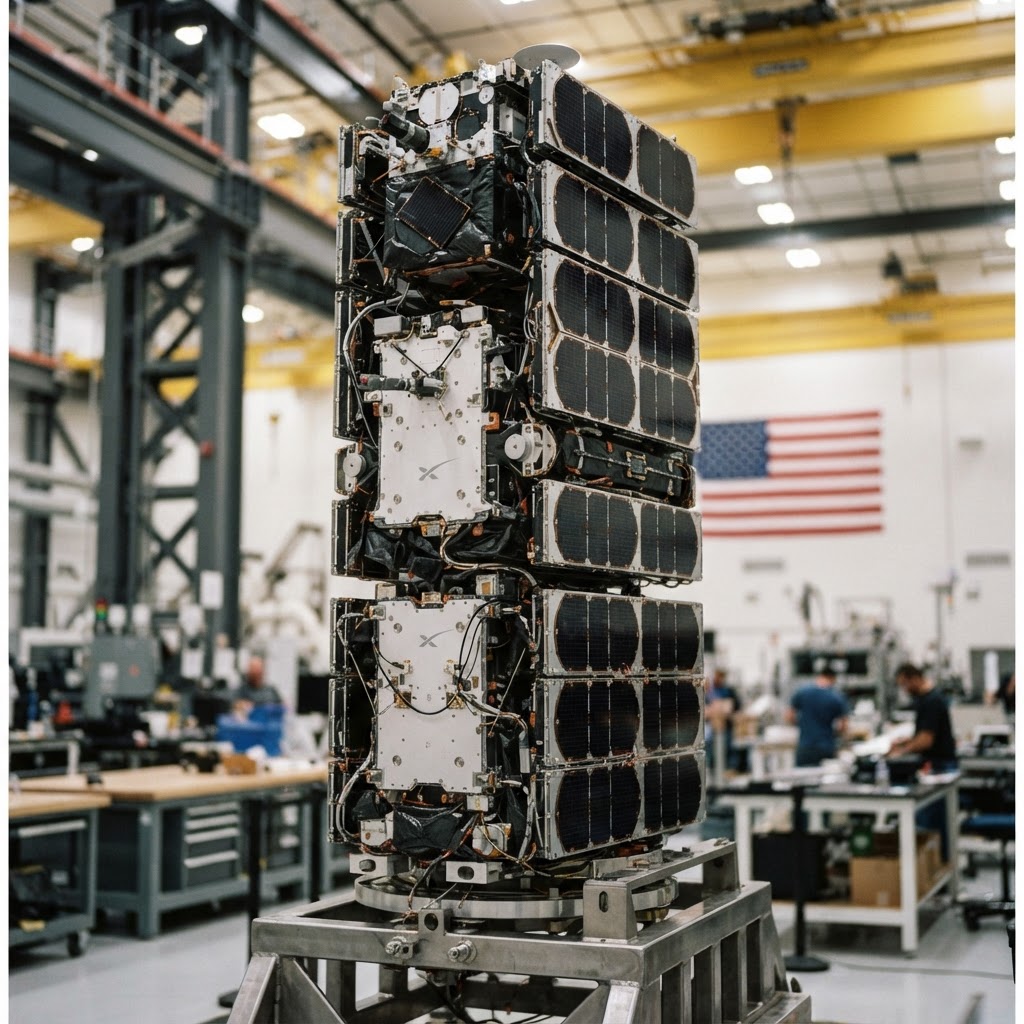
The Factory That Redefined What Manufacturing Can Achieve
In an era when most manufacturers celebrate incremental efficiency gains, SpaceX has done something genuinely unprecedented: it turned satellite production into a high-volume industrial operation that rivals automotive assembly lines in throughput and complexity. The Starlink constellation, once a bold vision sketched on whiteboards in Hawthorne, California, is now a functioning global broadband network backed by one of the most sophisticated manufacturing ecosystems on Earth. For manufacturing and industrial leaders, the story of how SpaceX built this machine offers lessons that extend far beyond aerospace.
Starlink is not simply a technology product — it is a manufacturing achievement. Each satellite is a miniaturized spacecraft packed with phased-array antennas, ion thrusters, laser inter-satellite links, and custom silicon. Producing thousands of these units per year, consistently and affordably, required SpaceX to rethink every assumption about aerospace manufacturing.
The result is a playbook that B2B industrial companies in any sector can study and adapt.
This report examines how SpaceX scaled Starlink satellite manufacturing, what operational and technological innovations drove that scale, and what the broader industrial sector can learn from one of the most ambitious production ramp-ups in modern history.
Inside the Starlink Production Machine: Operations at Unprecedented Scale
SpaceX operates its primary Starlink satellite manufacturing facility in Redmond, Washington, a campus that has grown substantially through 2024 and 2025 to accommodate surging production demand. As of mid-2025, the Redmond facility is estimated to produce satellites at a rate exceeding 50 units per day during peak operational windows, a throughput that dwarfs legacy aerospace manufacturing norms where a single satellite might take months or years to complete. This velocity was made possible by an intentional decision to treat satellites as consumer electronics rather than bespoke engineering artifacts.
The scale of the Starlink constellation itself underscores the manufacturing challenge. SpaceX had over 6,700 operational Starlink satellites in orbit by early 2025, making it by far the largest active satellite constellation in history. The company has filed for regulatory approval to operate tens of thousands more, meaning the manufacturing pipeline must sustain output for years.
Each new generation of satellite — SpaceX introduced the V2 Mini and full V2 variants with significantly enhanced capacity — requires retooling production lines while maintaining throughput continuity.
Revenue data reflects the commercial payoff of this industrial bet. Starlink's annualized revenue run rate crossed an estimated $8 billion in 2025, driven by over 4.6 million active subscribers across more than 100 countries. The consumer and enterprise terminal business, which pairs with the satellite network, adds another layer of manufacturing complexity.
SpaceX produces the user-facing dish hardware at scale through a combination of internal production and contract manufacturing partners, with terminal costs having dropped dramatically compared to 2024 pricing benchmarks.
Workforce scaling has matched production ambitions. SpaceX's total headcount surpassed 13,000 employees by 2025, with a significant portion concentrated in manufacturing-adjacent roles across Redmond, Hawthorne, and its Texas facilities. The company has consistently prioritized vertical integration, manufacturing its own chips, antennas, and propulsion components — a strategy that gives SpaceX supply chain resilience that most aerospace peers cannot replicate.
Engineering the Assembly Line: Process Innovation at the Core of Starlink's Growth
The most radical innovation in Starlink's manufacturing story is not any single technology but rather the philosophy that guided the entire system design: design for manufacturability from day one. SpaceX engineers were embedded alongside manufacturing teams during satellite development cycles, ensuring that every design choice could be executed at volume. This cross-functional discipline eliminated many of the costly late-stage redesigns that plague traditional aerospace programs and allowed production lines to ramp faster than industry observers initially anticipated.
SpaceX developed proprietary phased-array antenna technology in-house and invested heavily in automating its production, including the use of robotic welding, automated optical inspection systems, and AI-driven quality assurance processes. By 2025, a meaningful portion of satellite assembly steps that required manual intervention in 2024 had been automated, reducing per-unit labor hours and improving consistency. Industry analysts noted that SpaceX's defect rates, while not publicly disclosed, appeared significantly lower than comparable high-complexity electronics manufacturers based on on-orbit performance data.
The introduction of laser inter-satellite links — a capability rolled out broadly across the V2 constellation — required adding entirely new manufacturing steps without slowing line velocity. SpaceX accomplished this through modular production architecture, where new subsystems were integrated as plug-and-play modules rather than requiring holistic line redesigns. This modularity is a core principle that manufacturing leaders across sectors are increasingly adopting as product complexity grows and product lifecycles shorten.
Propulsion is another area where vertical integration paid dividends. SpaceX manufactures its own krypton-fueled Hall-effect ion thrusters for Starlink satellites, avoiding sole-source supplier dependencies that have historically created bottlenecks in aerospace production. By owning thruster manufacturing, SpaceX can tune production rates precisely to satellite assembly cadence, eliminating the inventory buffers that inflate working capital in traditionally sourced supply chains.
This tight coupling of subsystem manufacturing to final assembly is a benchmark lesson for any industrial OEM managing complex multi-tier supply chains.
What Industrial and Manufacturing Marketers Can Learn From the Starlink Playbook
SpaceX's Starlink program offers a masterclass in aligning manufacturing capability with market positioning. The company did not simply build a product and then go to market — it built the manufacturing machine as a competitive moat and then used production cost leadership as a marketing weapon. For B2B industrial companies, this reframes the relationship between operations and marketing: your factory's capabilities are as much a story to tell customers as your product features are.
Data transparency has become a central element of SpaceX's commercial positioning. The company regularly publishes constellation performance metrics, uptime statistics, and coverage maps that give enterprise buyers and government procurement officers the evidence they need to justify adoption. Industrial manufacturers serving B2B markets can apply the same logic: publishing real-world performance data, production capacity figures, and quality metrics builds credibility that marketing copy alone cannot achieve.
Buyers in manufacturing, logistics, and infrastructure sectors are sophisticated; they respond to evidence, not assertion.
Starlink's enterprise and government sales motion also demonstrates the power of modular go-to-market packaging. Rather than selling a single undifferentiated connectivity product, SpaceX tiered its offerings — residential, business, maritime, aviation, and government — each with tailored service-level agreements, hardware configurations, and pricing structures. Industrial manufacturers with complex product lines should examine whether their sales architecture reflects the actual diversity of their customers' needs or whether it forces buyers into ill-fitting standard configurations.
Finally, SpaceX's global distribution expansion — adding reseller partners, system integrators, and distribution agreements across Africa, Southeast Asia, and Latin America through 2024 and 2025 — illustrates how manufacturing scale enables geographic expansion that would otherwise be logistically impractical. For industrial companies with proven products, scaling manufacturing first and then opening new geographic markets is a powerful sequencing strategy. If your production cost is low and your quality is defensible, entering a new market becomes a sales and logistics challenge rather than a fundamental product challenge.
Evaluate your own manufacturing maturity as a precondition for market expansion, and invest accordingly.
The Road Ahead: Strategic Implications for Industry Leaders Watching SpaceX
SpaceX's next phase of Starlink development involves the full deployment of its Gen2 constellation, which will require launching tens of thousands of additional satellites over the coming years. The Starship rocket, now conducting operational missions after achieving full reusability milestones in 2024 and 2025, dramatically reduces per-kilogram launch cost — potentially to below $100 per kilogram at scale. Lower launch costs make denser constellations economically viable and apply further pressure on manufacturing teams to keep satellite unit costs falling at a commensurate pace.
The competitive landscape is intensifying. Amazon's Project Kuiper launched its first production satellites in 2025 and is investing over $10 billion to build a competing constellation. European and Asian state-backed programs are also accelerating.
This competitive pressure will push SpaceX to continuously improve manufacturing efficiency, shorten satellite design cycles, and expand the addressable market faster than rivals can close the gap. For industrial observers, this dynamic mirrors competitive dynamics in sectors like electric vehicles, industrial robotics, and advanced materials, where first-mover manufacturing scale creates durable advantages that are difficult to replicate quickly.
The strategic implications for industrial companies are direct. The organizations that will win the next decade are those that treat manufacturing investment as a strategic priority equal to product development and sales. Capital expenditure in automation, vertical integration, and supply chain resilience is not a cost center decision — it is a competitive positioning decision.
SpaceX's willingness to spend aggressively on manufacturing infrastructure before revenues fully justified it is precisely what enabled the revenue growth that followed.
If your organization is evaluating how to scale production, reduce unit costs, or enter new markets with complex manufactured products, now is the moment to conduct a rigorous manufacturing strategy review. Benchmark your production capabilities against best-in-class operations, identify your highest-leverage automation opportunities, and build the internal case for capital investment using the kind of data-driven framing that SpaceX applies to every engineering and operational decision. The companies that move with urgency on manufacturing transformation today will be the market leaders cited in the next generation of industry reports.
Key Takeaways
- SpaceX had over 6,700 operational Starlink satellites in orbit by early 2025, making it the world's largest active satellite constellation by a significant margin.
- Starlink's annualized revenue run rate reached an estimated $8 billion in 2025, demonstrating that manufacturing scale directly translates into commercial dominance.
- SpaceX's Redmond facility achieved peak production rates exceeding 50 satellites per day in 2025, a throughput unimaginable under traditional aerospace manufacturing models.
- Amazon's Project Kuiper is deploying over $10 billion to compete with Starlink, confirming that manufacturing-scale moats attract serious competitive responses and must be continuously reinforced.
Key Quotes
"We need to be a rapidly reusable rocket company, and we need to make a lot of rockets — that's the core of what SpaceX is." — Gwynne Shotwell, President and COO, SpaceX
"The key to Starlink's success is treating satellite manufacturing the way the automotive industry treats car manufacturing — volume, repeatability, and relentless cost reduction." — Elon Musk, CEO, SpaceX
References
- SpaceX Starlink Official Site — Primary source for Starlink service tiers, coverage maps, and enterprise product offerings
- Federal Communications Commission Starlink Filings — Regulatory filings covering constellation size approvals and spectrum authorizations for Starlink operations
- Payload Space — Starlink Industry Coverage — Industry publication covering SpaceX manufacturing updates, launch cadence data, and satellite constellation competitive analysis