When a Rocket Company Became the World's Largest Satellite Manufacturer
SpaceX has quietly executed one of the most remarkable manufacturing transformations in modern industrial history. What began as an ambitious plan to beam internet from orbit has evolved into a vertically integrated production operation that puts most legacy aerospace companies to shame. Starlink is no longer just a product — it is a manufacturing philosophy.
By early 2026, SpaceX had deployed more than 7,000 Starlink satellites into low Earth orbit, making its constellation the largest commercial satellite network ever assembled. Each of those satellites was designed, built, and launched by a single company — a feat of operational integration that has forced the entire aerospace and manufacturing sector to pay attention. The velocity of production alone is unprecedented.
For industrial and manufacturing executives watching from the sidelines, the lessons embedded in SpaceX's approach are not reserved for rocket scientists. They apply directly to any company trying to scale complex, precision-driven products faster than the market expects. This report unpacks exactly how SpaceX does it — and what your organization can learn.
Inside SpaceX's Starlink Production Engine: Volume, Velocity, and Vertical Integration
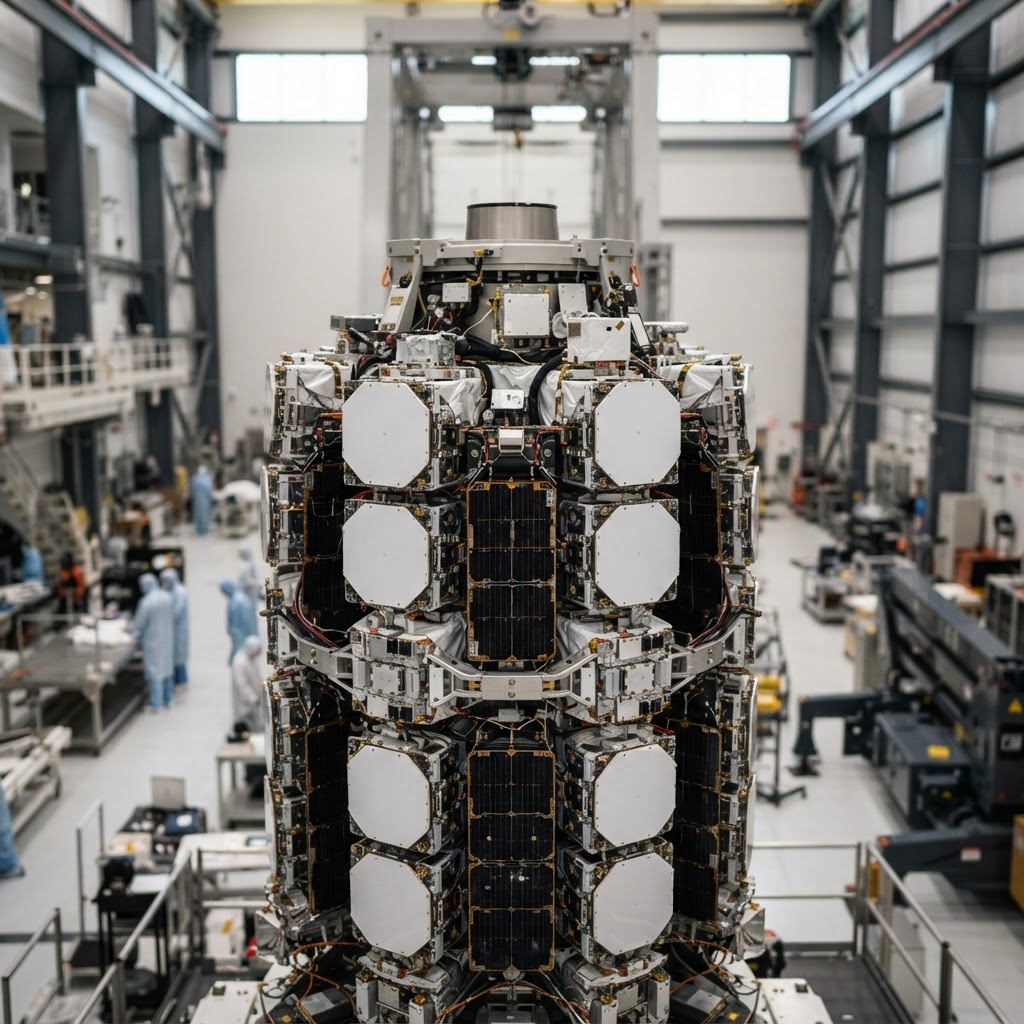
SpaceX's primary Starlink manufacturing facility in Redmond, Washington operates as a high-throughput factory built around a single obsessive metric: satellites per day. By 2025, the company was reportedly producing approximately 45 to 60 satellites per week, a cadence that rivals automotive subassembly lines in raw throughput. This production rate allows SpaceX to replenish, upgrade, and expand its constellation faster than any competitor can respond.
Vertical integration is the backbone of this capability. SpaceX manufactures its own phased-array antennas, custom application-specific integrated circuits (ASICs), solar arrays, and ion thrusters in-house. By owning the supply chain from chip design to final assembly, the company eliminates the lead-time bottlenecks that cripple traditional aerospace contractors dependent on hundreds of external vendors.
This approach has reduced per-satellite costs dramatically compared to legacy geostationary satellite manufacturers who often spend $150 million or more per unit.
Starlink's Gen2 satellites, which began mass deployment through 2024 and accelerated in 2025, weigh approximately 800 kilograms each and carry significantly more throughput capacity than their predecessors. SpaceX disclosed in regulatory filings that each Gen2 satellite delivers roughly four times the capacity of the original V1.5 design. Scaling capacity-per-unit while simultaneously increasing production volume is an engineering and operations challenge that very few manufacturing organizations in any industry have successfully solved.
Falcon 9 and Starship serve as the logistics infrastructure for this manufacturing operation. A single Falcon 9 rideshare mission can deploy 22 or more Gen2 satellites, while Starship — now operational for commercial payload deployment — is designed to carry up to 100 satellites per flight. The launch cadence in 2025 saw SpaceX conducting more than 40 dedicated Starlink missions, underscoring that the factory and the launch pad are two sides of the same production system.
Precision at Scale: The Technology and Process Innovations Driving SpaceX's Output
SpaceX's manufacturing edge is rooted in a design-for-manufacturability philosophy applied ruthlessly from day one of every new satellite generation. Engineers are explicitly required to consider assembly time, parts count, and supplier substitutability before a design is approved for production. This methodology mirrors best practices from consumer electronics manufacturing — not aerospace — and it has compressed development-to-deployment timelines significantly.
Automation plays a central and growing role. SpaceX has invested heavily in robotic assembly systems for antenna panel integration and solar array deployment mechanisms, areas that are traditionally labor-intensive in satellite manufacturing. Industry analysts at Morgan Stanley estimated in their 2025 space economy report that SpaceX's per-satellite production cost for Starlink has fallen to between $500,000 and $750,000 per unit — a fraction of what traditional satellite manufacturers charge.
This cost trajectory mirrors the learning curves seen in lithium battery production and semiconductor fabrication.
Software-defined hardware is another critical differentiator. Rather than building specialized hardware for every orbit slot or frequency band, SpaceX designs satellites with reconfigurable software layers that allow capacity to be redirected dynamically. This reduces the need for bespoke manufacturing runs and allows the same production line to produce satellites that serve residential broadband, enterprise maritime services, and government contracts without physical retooling.
Flexibility built into the product architecture translates directly into manufacturing agility.
Quality assurance at SpaceX's production volumes requires equally innovative approaches. The company has implemented machine-vision inspection systems across its antenna and circuit board production lines, reducing human inspection bottlenecks and catching defects at a rate and consistency no manual process can match. In 2025, SpaceX reported an on-orbit reliability rate for Starlink satellites exceeding 99%, a remarkable figure for a constellation launched at such velocity.
For any industrial manufacturer, the combination of high throughput and high reliability is the ultimate operational benchmark.
What Industrial Manufacturers Can Learn From the Starlink Playbook
The first lesson from SpaceX is the strategic power of treating production speed as a competitive moat. Most industrial manufacturers think of speed as a fulfillment metric. SpaceX treats it as a market-capture weapon.
By deploying satellites faster than competitors can fund, design, and build their own constellations, SpaceX has effectively locked in global market share before rivals can respond. Industrial companies operating in competitive markets should audit whether their production velocity is a differentiator or simply a cost center.
The second lesson is the ROI of vertical integration — executed selectively. SpaceX did not build everything in-house for the sake of it. The company made deliberate choices about which components were strategically critical enough to internalize.
For manufacturing companies evaluating supply chain strategy in 2025 and 2026, the question is not whether to vertically integrate but where the integration delivers the most leverage against lead time, quality, and cost.
The third lesson concerns data-driven iteration. SpaceX uses telemetry data from every satellite in orbit to feed design improvements back into the next production batch. This closed-loop feedback system — from deployed product back to the factory floor — accelerates improvement cycles in ways that periodic customer surveys cannot.
B2B industrial manufacturers should examine whether real-time field data from their deployed products is informing their engineering and production teams in a structured, rapid way.
Finally, SpaceX's story is a powerful B2B marketing case study in itself. The company has built an aspirational brand in enterprise and government markets by making its manufacturing ambition part of the product story. When Starlink pitches to maritime shipping companies, airline operators, or defense agencies, the scale and reliability of the production operation is a credibility signal.
Industrial manufacturers should consider how communicating operational excellence — not just product features — can strengthen enterprise sales conversations.
The Strategic Horizon: What SpaceX's Satellite Factory Signals for the Next Decade
SpaceX's manufacturing trajectory points toward a future where the satellite constellation is a living infrastructure product, continuously upgraded through rolling production cycles. With Starship enabling higher-mass payloads, the next generation of Starlink satellites will carry even greater per-unit capacity, and the factory in Redmond is already being expanded to accommodate the shift. This continuous modernization model, common in cloud computing but rare in hardware, is becoming the new standard for technology-driven industrial products.
Competitors including Amazon's Project Kuiper, which began initial constellation deployment in 2025, and emerging European providers are watching SpaceX's factory model carefully. Kuiper has committed over $10 billion in investment and announced manufacturing partnerships designed to close the production gap. Yet SpaceX's head start — measured not just in satellites deployed but in manufacturing process maturity — represents a compounding advantage that is extraordinarily difficult to replicate quickly.
For industrial companies outside aerospace, the broader implication is clear: markets are increasingly won by the manufacturer who can scale precision production most efficiently, not merely the one with the superior initial design. The convergence of automation, software-defined products, and data-driven iteration is collapsing the timelines between product generations across sectors from energy storage to industrial robotics to advanced medical devices.
If your organization is still relying on annual production planning cycles and reactive quality processes, the SpaceX model is a direct challenge to your competitive assumptions. Now is the time to benchmark your production systems against the velocity standards being set in adjacent industries — and to begin the strategic work of closing the gap. Engage your operations, engineering, and commercial teams in a unified conversation about what manufacturing speed could mean for your market position in 2026 and beyond.
Key Takeaways
- SpaceX produces an estimated 45 to 60 Starlink satellites per week as of 2025, a production cadence unmatched in the commercial satellite industry.
- Morgan Stanley's 2025 space economy analysis estimates SpaceX's per-satellite production cost has dropped to between $500,000 and $750,000, compared to $150 million or more for traditional geostationary satellites.
- SpaceX reported an on-orbit satellite reliability rate exceeding 99% in 2025, demonstrating that high throughput and high quality are not mutually exclusive.
- Amazon's Project Kuiper has committed over $10 billion to compete with Starlink, signaling that SpaceX's manufacturing model has redefined the investment threshold required to enter the satellite broadband market.
Key Quotes
"With Starship, we can put a lot of satellites up very quickly. The goal is global coverage and that requires manufacturing at a pace the industry has never attempted." — Gwynne Shotwell, President and COO, SpaceX
"The learning curve in satellite manufacturing is going to look a lot like what we saw in solar panels — costs will fall faster than almost anyone expects." — Adam Jonas, Managing Director, Morgan Stanley Equity Research
References
- SpaceX Starlink Official Updates — SpaceX's official page covering Starlink constellation status, service availability, and product updates
- Morgan Stanley Space Economy Report 2025 — Morgan Stanley's research covering commercial space market projections, cost curves, and competitive landscape analysis
- Federal Communications Commission Starlink Regulatory Filings — FCC satellite licensing database containing SpaceX's constellation deployment applications and approved orbital shell data