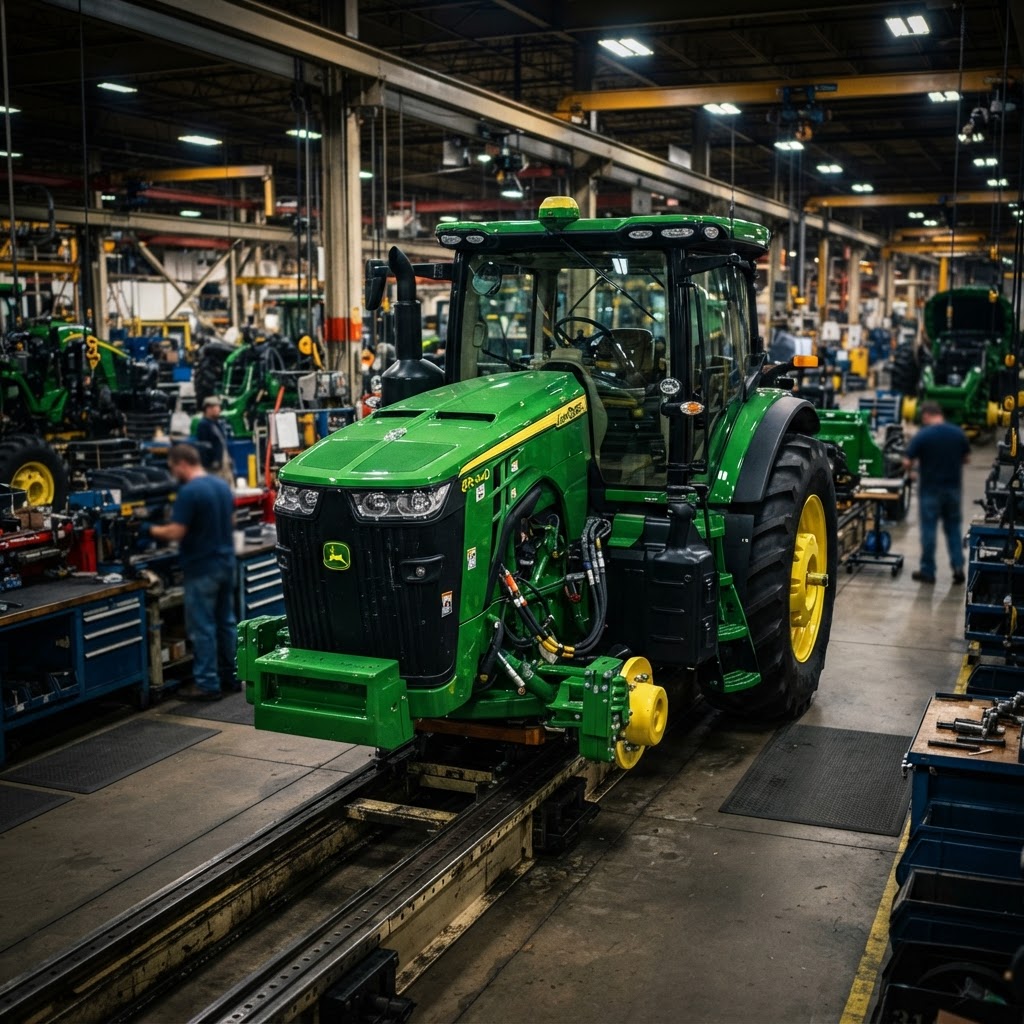
From Farmland to Fortune 100: The John Deere Manufacturing Story
Few industrial brands command the loyalty and recognition that John Deere has built over nearly two centuries of operation. With its iconic green-and-yellow color scheme and a reputation for engineering durability, Deere & Company has evolved from a small blacksmith shop into one of the most sophisticated manufacturing enterprises on the planet. For B2B decision-makers in manufacturing and industrial sectors, John Deere represents more than a legacy brand — it is a living case study in operational excellence.
The agricultural machinery market is undergoing seismic shifts driven by climate pressure, labor shortages, and the global demand for food security. John Deere sits at the epicenter of these forces, deploying cutting-edge production strategies that are reshaping how large-scale manufacturers compete. Understanding how Deere navigates complexity at scale offers actionable intelligence for any industrial company looking to grow.
This report examines John Deere's manufacturing operations, technology investments, marketing positioning, and forward-looking strategy. Whether you lead procurement, operations, or business development, the lessons here are directly transferable to your own industrial growth agenda.
Inside the Engine Room: John Deere's Global Manufacturing Operations
John Deere operates more than 60 manufacturing facilities across the globe, with major production hubs in the United States, Brazil, Germany, India, and China. Its Waterloo, Iowa plant — one of the largest tractor manufacturing facilities in North America — produces over 70,000 units annually and employs more than 4,000 workers. This scale of vertical integration is a deliberate competitive strategy, allowing Deere to control quality from raw material sourcing through final assembly.
In fiscal year 2024, Deere & Company reported net revenues of approximately $51.7 billion, with the Production & Precision Agriculture segment contributing the largest share at roughly $20 billion. The company's equipment operations generated operating profit margins in the range of 20–22%, figures that rival top-tier technology companies and significantly outpace the industrial manufacturing average of 8–12%. These margins reflect the efficiency gains Deere has made through lean manufacturing and supply chain optimization.
Deere's supply chain spans over 600 direct suppliers globally, and the company has invested heavily in nearshoring critical component production following supply disruptions that affected the broader industrial sector in recent years. By 2025, Deere had relocated or diversified sourcing for more than 35% of its most vulnerable component categories, dramatically reducing lead-time risk. This supply chain resilience is now a core element of its manufacturing competitive advantage.
The company's workforce strategy is equally deliberate. Deere employs over 75,000 people worldwide, and it has formalized apprenticeship and technical skills pipelines with over 50 community colleges and trade schools in the United States alone. Investment in human capital at this level is a signal to the market that manufacturing excellence is not purely a technology story — it requires skilled hands at every stage of production.
Precision Agriculture and Smart Manufacturing: Technology at the Core
John Deere's most transformative investment in recent years has been its aggressive push into precision agriculture technology and smart factory infrastructure. The company's John Deere Operations Center — a cloud-based farm management platform — now manages data from more than 400 million connected acres worldwide as of 2025. This platform integrates machine telemetry, agronomic data, and field analytics to help farmers optimize inputs and yields, while simultaneously providing Deere with a massive proprietary dataset to improve its own product development cycles.
On the factory floor, Deere has deployed advanced robotics and AI-driven quality control systems across its flagship facilities. In 2024, the company announced a $500 million investment in automation upgrades across its North American plants, targeting a 15% reduction in per-unit labor costs by 2026. Automated welding cells, vision-guided assembly systems, and digital twin modeling are now standard practice at Deere's most advanced sites, dramatically reducing defect rates and rework cycles.
The company's autonomous machinery lineup has gained significant commercial traction. The See & Spray Ultimate system, which uses computer vision to reduce herbicide usage by up to 77%, and the fully autonomous 8R tractor have moved from pilot programs to commercial availability at scale. In 2025, Deere reported that precision agriculture product lines grew at a rate of 18% year-over-year, far outpacing the broader equipment segment.
This growth signals a fundamental shift in how agricultural OEMs monetize their products — moving from one-time hardware sales toward recurring software and data service revenues.
Deere's technology investment is not limited to the field. The company has established dedicated innovation labs in San Francisco and Berlin, partnering with AI startups and university research programs to accelerate its digital roadmap. With over 1,500 software engineers now on staff — a figure that has doubled since 2024 — Deere is increasingly positioning itself as a technology company that manufactures equipment, rather than a manufacturer that uses technology.
This reframing has profound implications for how B2B industrial companies should think about their own digital transformation strategies.
Growth Lessons for Industrial Manufacturers: What B2B Companies Can Learn
One of the most instructive aspects of John Deere's commercial strategy is its mastery of value-based selling in a traditionally price-sensitive market. Rather than competing on sticker price, Deere educates customers on total cost of ownership, uptime guarantees, and productivity gains enabled by its technology ecosystem. This approach allows Deere to command a 15–25% price premium over comparable equipment from competitors, a gap that would be unsustainable without a robust proof-of-value narrative.
Deere's dealer network — comprising over 5,000 independent dealerships worldwide — functions as both a distribution channel and a B2B marketing asset. These dealers are equipped with sophisticated CRM tools, product configurators, and demo programs that allow prospective buyers to experience the technology before committing. For B2B industrial manufacturers, this model illustrates the power of investing in channel partner enablement as a revenue multiplier rather than treating distribution as a passive cost center.
Content and thought leadership also play a significant role in Deere's marketing strategy. The company produces a substantial volume of agronomic research, sustainability reports, and technology whitepapers that speak directly to the operational challenges its customers face. This positions Deere as a trusted advisor rather than just a vendor — a distinction that dramatically shortens sales cycles and increases customer lifetime value in B2B contexts.
For industrial companies looking to replicate Deere's growth model, the key lesson is integration: integrate your technology roadmap with your sales narrative, integrate your channel partners into your product feedback loop, and integrate your content marketing with your customer success programs. Siloed functions produce siloed results. Deere's growth is a direct outcome of breaking those silos and aligning the entire commercial engine around a unified customer value proposition.
If your organization is not yet mapping its marketing investment to measurable operational outcomes for buyers, now is the time to start.
The Road Ahead: Strategic Implications for 2025 and Beyond
Looking forward, John Deere has articulated a clear strategic vision anchored in three pillars: autonomy, sustainability, and connectivity. The company has committed to achieving net-zero greenhouse gas emissions across its own operations by 2030, with a broader Scope 3 emissions target for its full value chain by 2040. These commitments are not merely reputational — they are increasingly tied to procurement requirements from large agribusiness customers and governmental subsidy programs in the EU and North America.
The electrification of agricultural machinery represents both a challenge and an opportunity for Deere. The company has already introduced battery-electric compact utility tractors and is developing high-capacity electric powertrain solutions for larger row-crop equipment. Battery energy density and charging infrastructure remain constraints, but Deere's R&D budget — which topped $2.1 billion in fiscal 2024 — positions it to solve these challenges ahead of most competitors.
Strategic acquisitions in the battery management and energy storage space are widely anticipated by industry analysts.
Geopolitical dynamics are also shaping Deere's manufacturing footprint decisions. With tariff environments in flux and food security becoming a national priority in multiple regions, Deere is expanding localized production capacity in India and Brazil — two of the world's fastest-growing agricultural markets. India's tractor market alone is projected to exceed 1.2 million units annually by 2026, and Deere's joint ventures and wholly-owned facilities in Pune and Dewas position the company to capture a meaningful share of that demand.
For B2B industrial companies watching Deere's trajectory, the strategic imperative is clear: the companies that will lead their categories over the next decade are those that invest now in the intersection of physical products and digital intelligence. John Deere's example shows that manufacturing leadership in the modern era is earned not just on the factory floor, but in the software lab, the sustainability report, and the data center. Evaluate your own strategic roadmap against this benchmark and identify where you need to accelerate.
Key Takeaways
- John Deere generated approximately $51.7 billion in net revenue in fiscal year 2024, with equipment operating margins of 20–22% — well above the industrial manufacturing sector average.
- The company's connected agriculture platform now manages data from over 400 million acres globally as of 2025, making it one of the largest agricultural data ecosystems in the world.
- Deere committed $500 million in 2024 to North American plant automation, targeting a 15% reduction in per-unit labor costs by 2026 through robotics and AI-driven quality systems.
- Precision agriculture product lines grew 18% year-over-year in 2025, signaling a structural shift from hardware-only revenue to recurring software and data service monetization.
Key Quotes
"We are a technology company that happens to make equipment. The hardware is the platform; the intelligence is the product." — John C. May, Chairman and CEO, Deere & Company
"Precision agriculture is not a feature — it is the foundation of how we think about the next generation of farming and the machinery that supports it." — Jahmy Hindman, Chief Technology Officer, Deere & Company
References
- Deere & Company 2024 Annual Report — Official financial and operational performance data for fiscal year 2024, including segment revenues and R&D investment figures.
- John Deere Operations Center Overview — Details on the connected agriculture platform, including acreage under management and integration capabilities.
- Forbes: John Deere's Precision Agriculture Strategy — Analysis of Deere's technology pivot and its implications for the broader agricultural equipment sector.