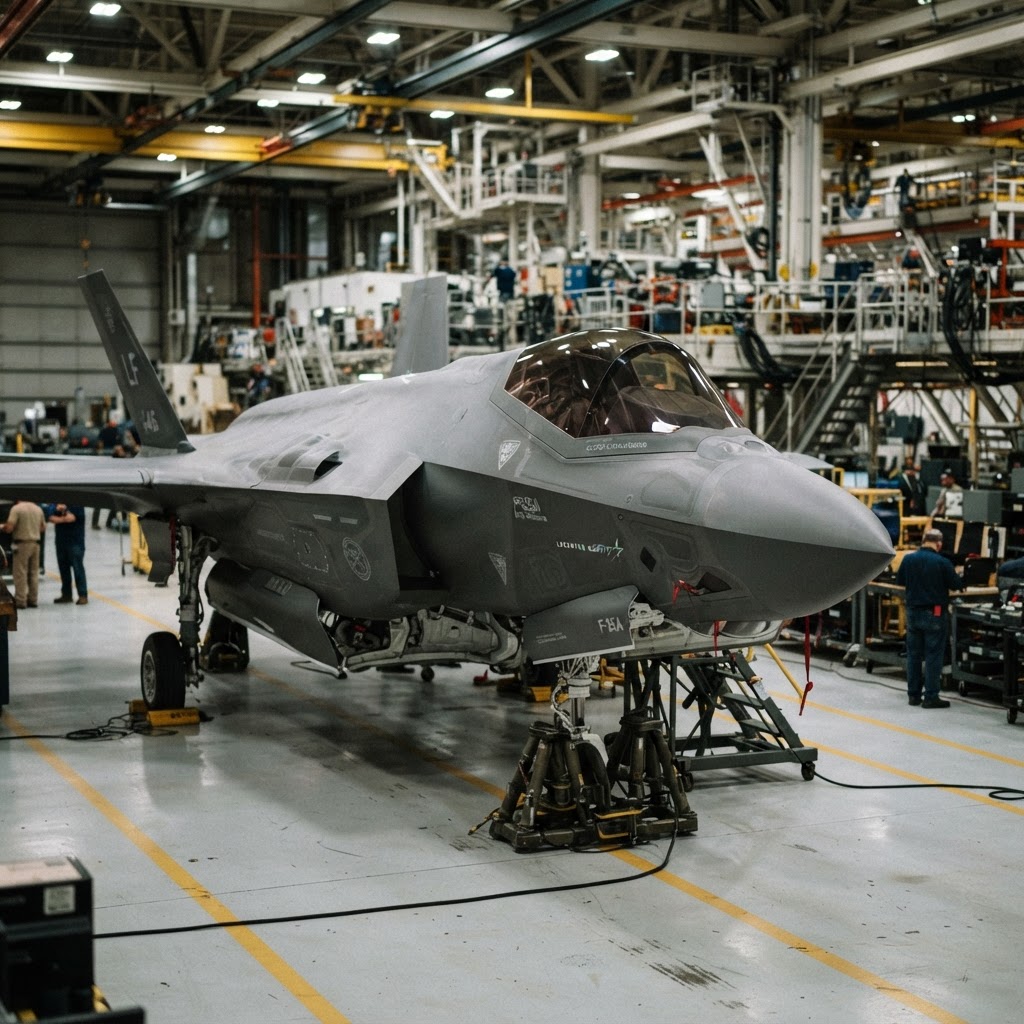
The Arsenal of the Future Is Already Being Built
In an era where geopolitical tensions are reshaping defense budgets worldwide, one company stands at the center of the most sophisticated manufacturing ecosystem on the planet. Lockheed Martin — the world's largest defense contractor by revenue — is not merely assembling aircraft and weapons systems. It is engineering the future of national security at industrial scale.
The company's flagship programs, from the F-35 Lightning II to the PAC-3 Patriot missile systems, represent the bleeding edge of what modern manufacturing can achieve. These are not products assembled on a single factory floor. They are the result of global supply chains, precision robotics, advanced materials science, and decades of institutional knowledge working in concert.
For B2B manufacturers and industrial leaders, Lockheed Martin offers a masterclass in how to build, scale, and sustain complex production operations in a high-stakes environment. Understanding how this company operates is not just an academic exercise — it is a strategic blueprint.
Inside the Machine: Lockheed Martin's Production Scale and Financial Muscle
Lockheed Martin reported net sales of approximately $71.0 billion in its 2024 annual results, representing a meaningful year-over-year increase driven by sustained demand across its Aeronautics, Missiles and Fire Control, and Rotary and Mission Systems segments. The Aeronautics segment alone — home to the F-35 program — generated roughly $28 billion in 2024 revenues, underscoring the financial weight that fighter jet production carries within the broader enterprise.
The F-35 program remains the single largest defense acquisition program in history, with a total program value exceeding $400 billion across all variants and international partners. In 2024, Lockheed Martin delivered approximately 98 F-35 aircraft to customers across the United States and allied nations, continuing to ramp toward its target production rates despite supply chain complexity involving over 1,700 suppliers globally.
The company's Missiles and Fire Control segment posted revenues of approximately $13 billion in 2024, propelled by heightened demand for PAC-3 interceptors, HIMARS rocket artillery systems, and Javelin anti-tank missiles. Global security commitments have placed these systems in extraordinarily high demand, pushing production rates to levels not seen in decades.
Lockheed Martin's workforce of approximately 122,000 employees operates across more than 50 major facilities in the United States and internationally. Its Fort Worth, Texas facility — the primary F-35 final assembly and checkout location — spans 6 million square feet and is widely regarded as one of the most advanced aerospace manufacturing sites in the world.
Engineering at the Edge: Technology and Process Innovation Driving Production
Lockheed Martin has invested heavily in digital transformation across its manufacturing operations. The company has deployed a model-based systems engineering approach across the F-35 program, using digital twin technology to simulate production processes, reduce rework rates, and accelerate design iteration. These investments contributed to measurable reductions in F-35 unit production costs, which dropped from over $100 million per aircraft to below $80 million for the most recent lot agreements announced in 2024.
The company's Skunk Works division — the legendary advanced development programs unit — continues to serve as a critical R&D engine. In 2024 and into 2025, Skunk Works has been central to Next Generation Air Dominance programs and hypersonic weapons development, including work on the ARRW (Air-launched Rapid Response Weapon) and related classified programs. These investments signal where Lockheed's manufacturing complexity and innovation investment will be concentrated in the coming decade.
Additive manufacturing, or 3D printing, has become a practical production tool rather than a novelty at Lockheed facilities. The company has qualified hundreds of additively manufactured components for flight, particularly in missile and satellite systems, reducing lead times by as much as 40% on certain parts while enabling geometries impossible with traditional machining.
Robotic assembly and automated fiber placement for composite structures are now standard in F-35 production. The use of automated drilling and fastening systems has reduced manual touch labor on specific airframe sections by over 30%, improving consistency and enabling higher throughput as demand from international customers — including Finland, Germany, and Canada — accelerates through 2025 and 2026.
Lessons from the Flight Line: What Industrial Companies Can Learn from Lockheed Martin's Marketing and Growth Strategy
Lockheed Martin does not sell products the way most B2B companies do. It builds long-term relationships with sovereign governments, prime contractors, and allied defense ministries through a process of deep technical partnership, co-development, and lifecycle commitment. The F-35 program, for example, began as a cooperative development with eight partner nations, creating an international customer base before a single aircraft entered serial production.
This model — sometimes called a "platform partnership strategy" — has enormous implications for industrial manufacturers outside of defense. Rather than selling a discrete product, Lockheed creates ecosystems of dependency, training, spare parts, sustainment services, and upgrade pathways that lock in customers for generations. The F-35's sustainment contract portfolio is projected to generate revenues exceeding $650 billion over the aircraft's operational lifetime.
Lockheed Martin's marketing and business development operations are built around technical credibility above all else. The company employs thousands of engineers in customer-facing roles, and its sales cycles are measured in years, not quarters. For any B2B industrial manufacturer, this approach underscores a vital lesson: in complex markets, the best marketing asset is demonstrated engineering excellence and an unimpeachable record of delivery.
For manufacturing companies looking to grow in their own markets, the Lockheed model offers three actionable principles: invest relentlessly in technical differentiation, structure offerings as long-term partnerships rather than transactions, and use proven performance data as the cornerstone of every customer conversation. Companies that adopt this posture consistently win larger contracts, retain customers longer, and build defensible competitive moats.
Horizons of Steel: The Strategic Outlook for Lockheed Martin and the Industrial Defense Sector
Global defense spending reached record levels in 2025, with NATO member nations collectively surpassing the 2% GDP spending benchmark for the first time in the alliance's history. This structural increase in defense budgets is not a short-term surge — it reflects a generational recalibration of threat environments across Europe, the Indo-Pacific, and the Middle East. For Lockheed Martin, this creates a multi-year tailwind of extraordinary magnitude.
The company's backlog as of its most recent 2025 reporting stood at approximately $173 billion, providing exceptional revenue visibility and production planning certainty. This backlog includes significant F-35 orders from new international customers, expanded HIMARS production contracts, and next-generation missile defense programs. A backlog of this scale is a testament to decades of product development investment and relationship-building with allied governments.
Lockheed Martin is also positioning itself aggressively in the space and hypersonics domains, which represent the next frontier of high-margin, high-complexity manufacturing. Its Space segment grew revenues in 2025, driven by next-generation satellite programs and classified national security space work. Hypersonic weapons development, now a declared national priority across the United States and allied nations, will require entirely new manufacturing competencies in materials, propulsion, and precision fabrication.
For industrial manufacturers watching these developments, the message is clear: the companies that will lead the next decade are those investing today in advanced manufacturing capabilities, digital production infrastructure, and workforce development. The window to build these competencies is open — but it will not remain so indefinitely. If your organization is ready to elevate its manufacturing strategy to the next level, now is the time to assess your technology gaps, supply chain resilience, and innovation roadmap with the same rigor Lockheed Martin brings to building a fighter jet.
Key Takeaways
- Lockheed Martin reported approximately $71.0 billion in net sales in 2024, making it the world's largest defense contractor and a benchmark for large-scale complex manufacturing.
- The F-35 program has reduced per-aircraft unit costs to below $80 million in recent lot agreements, demonstrating that sustained investment in digital manufacturing and process improvement delivers measurable cost outcomes.
- Lockheed Martin's 2025 backlog of approximately $173 billion provides exceptional production planning visibility and reflects the power of long-term platform partnership strategies.
- Additive manufacturing adoption across Lockheed's missile and satellite programs has reduced lead times by as much as 40% on qualified components, proving that advanced manufacturing technology delivers real operational advantages.
Key Quotes
"We are focused on delivering the most capable, affordable, and sustainable platforms in the world — and that means continuously pushing the boundaries of how we design and manufacture our products." — James Taiclet, Chairman, President and CEO, Lockheed Martin
"The F-35 is not just an aircraft program. It is a global industrial ecosystem that links the manufacturing capabilities of multiple allied nations in service of a common security mission." — Greg Ulmer, Executive Vice President, Aeronautics, Lockheed Martin
References
- Lockheed Martin 2024 Annual Report — Official financial performance data, segment revenues, backlog figures, and strategic priorities for fiscal year 2024
- Defense News: F-35 Program Update 2025 — Coverage of F-35 delivery rates, international customer orders, and unit cost trajectory through 2025
- NATO Defense Expenditure Report 2025 — Official NATO data on member nation defense spending benchmarks and 2025 GDP commitment milestones