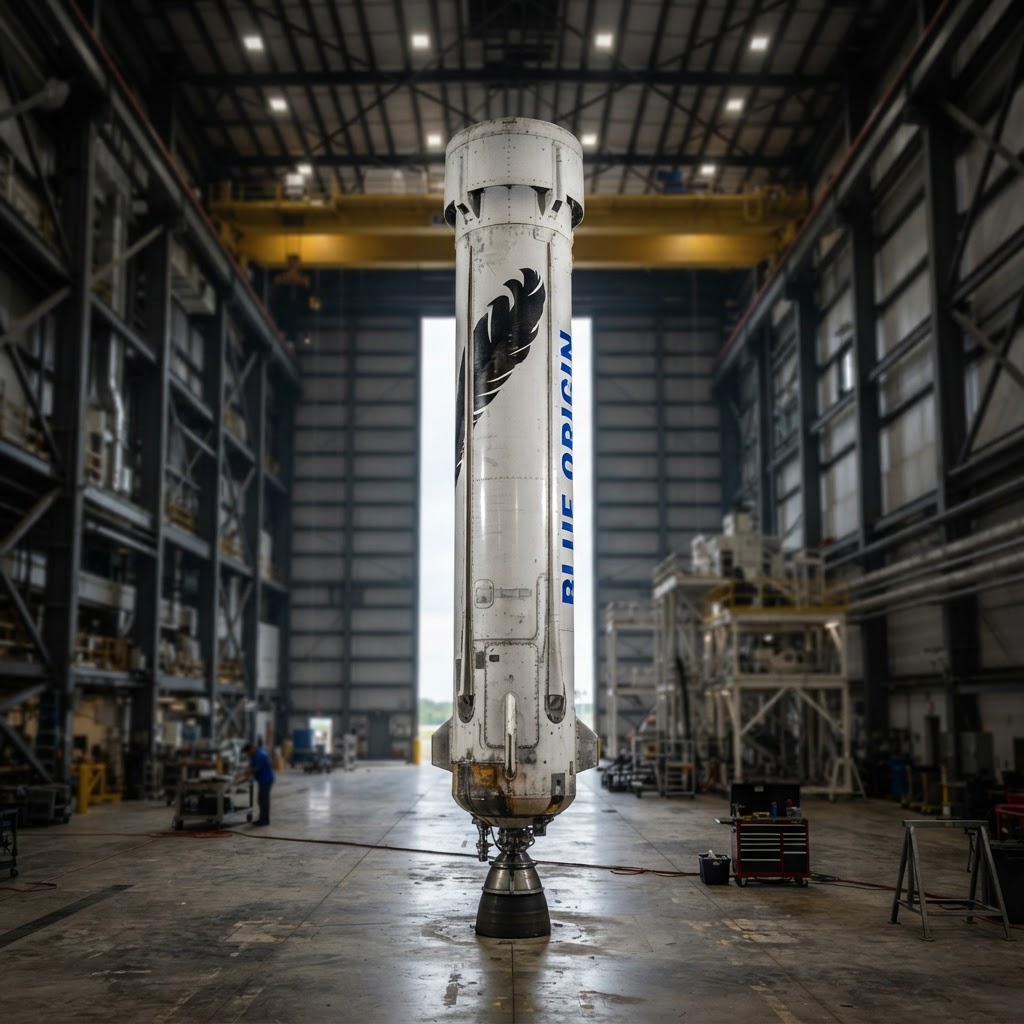
The Factory That's Redefining What Space Manufacturing Looks Like
Blue Origin's Kent, Washington facility isn't just a rocket factory — it's a masterclass in advanced industrial production at scale. As demand for commercial space launch accelerates in 2025, Blue Origin has positioned its manufacturing operations as a core competitive differentiator. The company isn't simply building engines; it's engineering an entirely new industrial paradigm.
For manufacturing and industrial executives watching the aerospace sector, Blue Origin offers a rare case study in how a vertically integrated factory model can compress development cycles, reduce unit costs, and expand output simultaneously. The company's BE-4 engine program, which powers both the New Glenn orbital rocket and United Launch Alliance's Vulcan Centaur, has moved from prototype to high-rate production in a compressed timeline that would be difficult to replicate without deliberate process investment.
This report breaks down Blue Origin's factory operations, technology stack, and growth trajectory — and extracts actionable lessons for B2B manufacturers and industrial firms looking to scale their own production capabilities in an era of increasing complexity.
Inside Blue Origin's Kent Facility: Scale, Output, and Operations
Blue Origin's primary manufacturing campus in Kent, Washington spans over 750,000 square feet of production and engineering space. The facility houses end-to-end rocket engine manufacturing, from raw material machining to final assembly and acceptance testing. This vertical integration means Blue Origin controls quality, lead time, and cost at nearly every stage of the production process.
The BE-4 engine is the flagship product of this operation. Generating 550,000 pounds of thrust and running on liquid oxygen and liquefied natural gas, the BE-4 represents one of the most powerful American-made rocket engines currently in active production. As of 2025, Blue Origin has delivered multiple BE-4 engines to United Launch Alliance for the Vulcan Centaur program, which achieved its inaugural successful launch in early 2024.
Each engine delivery represents a significant manufacturing milestone, with production rates scaling to meet dual-customer demand.
Blue Origin also operates a large engine test facility in Huntsville, Alabama, which supports BE-4 acceptance testing and development testing for the BE-3U engine used in New Glenn's upper stage. The geographic distribution of manufacturing and testing reflects a mature industrial footprint. This dual-site model reduces bottlenecks by separating high-throughput assembly from specialized test operations.
The company's workforce in 2025 numbers in the thousands, with a significant portion dedicated to manufacturing, quality assurance, and supply chain management. Blue Origin has made targeted investments in skilled trades and advanced manufacturing roles, reflecting the labor intensity of rocket engine production. This workforce scaling mirrors what many industrial companies face when attempting to grow output without sacrificing quality.
Additive Manufacturing, Automation, and Process Innovation at Scale
Blue Origin has been an aggressive adopter of additive manufacturing — commonly known as 3D printing — across its engine programs. The company uses metal additive manufacturing to produce complex engine components that would be prohibitively expensive or geometrically impossible to machine using traditional subtractive methods. By integrating additive parts into the BE-4 production line, Blue Origin has reduced component lead times and part counts on critical assemblies.
The BE-4's turbopump and injector systems benefit significantly from additive manufacturing techniques. Components that previously required multi-part welded assemblies can now be produced as single integrated pieces, reducing potential failure points and inspection requirements. Industry analyses from 2024 and 2025 consistently point to additive manufacturing as one of the primary drivers of cost reduction in next-generation rocket engine programs, with part consolidation rates of 30–60% reported across comparable aerospace programs.
Blue Origin has also invested heavily in automated assembly and robotic welding systems within its Kent facility. Automated orbital welding, used extensively in propellant system fabrication, delivers consistent weld quality at speeds that human welders cannot sustain across high-volume production. These investments reflect a broader trend in industrial manufacturing where automation is being deployed not to eliminate skilled workers but to augment them — handling repetitive, precision-critical tasks while human technicians focus on higher-order assembly and inspection work.
Digital thread technology — the continuous flow of digital data from design through manufacturing, testing, and delivery — is deeply embedded in Blue Origin's production model. Every engine that leaves the Kent facility carries a comprehensive digital record of its manufacturing history, test data, and configuration. This level of data traceability is increasingly becoming a baseline requirement across defense and aerospace supply chains, and it's a capability gap that many traditional industrial manufacturers are still working to close.
What B2B Industrial Companies Can Learn from Blue Origin's Growth Model
Blue Origin's manufacturing strategy offers several transferable lessons for industrial companies operating in capital-intensive, precision-driven markets. The first lesson is the power of vertical integration as a margin and quality lever. By bringing critical subcomponents in-house rather than relying on a fragmented supplier base, Blue Origin gains direct control over cost, quality, and schedule.
For industrial manufacturers facing supply chain volatility, selective vertical integration into high-risk components is worth serious evaluation.
The second lesson is the role of manufacturing capability as a market differentiator. Blue Origin's ability to produce the BE-4 at scale — and to do so for multiple customers simultaneously — is itself a competitive moat. In B2B markets, production reliability and ramp-up speed are increasingly as important as product specifications.
Industrial companies that can credibly demonstrate high-rate production capacity, backed by data and facility investment, are better positioned to win long-term contracts with large buyers.
Third, Blue Origin's investment in digital manufacturing infrastructure pays dividends beyond the factory floor. Digital traceability, real-time production monitoring, and model-based quality inspection are not just operational tools — they're sales enablers. Customers in aerospace, defense, and energy increasingly require digital manufacturing data as part of contract compliance.
Industrial companies that build these capabilities now will find themselves at the front of the qualification queue when major procurement cycles open.
Finally, Blue Origin's approach to workforce development — investing in specialized training programs and recruiting from technical schools — reflects a recognition that manufacturing talent is a strategic asset. Industrial firms that treat workforce development as a capital investment rather than an operating cost will build the institutional knowledge needed to sustain quality at scale. If your organization is evaluating its own production capabilities, now is the time to audit your digital readiness, workforce pipeline, and vertical integration strategy before your competitors do.
The Road Ahead: New Glenn, BE-7, and What Blue Origin's Pipeline Signals
New Glenn, Blue Origin's heavy-lift orbital launch vehicle, completed its first successful orbital mission in early 2025. This milestone validated years of manufacturing investment and positions Blue Origin as a serious competitor in the commercial launch market alongside SpaceX's Falcon 9 and Falcon Heavy. The commercial launch market is projected to exceed $30 billion globally by 2026, making manufacturing throughput a direct revenue driver.
The BE-7 engine, designed for lunar lander propulsion and intended to power the Human Landing System under NASA's Artemis program, represents Blue Origin's next major manufacturing challenge. The BE-7 uses a dual-expander cycle burning liquid hydrogen and liquid oxygen — a technically demanding configuration that requires precision manufacturing tolerances tighter than those of the BE-4. Blue Origin's investment in advanced machining and inspection capabilities in Kent and Huntsville will be directly tested as BE-7 production scales through 2025 and 2026.
Blue Origin has also signaled plans to expand its manufacturing footprint, with additional facility investments tied to growing launch cadence targets. A higher New Glenn flight rate in 2026 will require a corresponding increase in BE-4 production output, creating downstream demand throughout Blue Origin's supplier network. For Tier 1 and Tier 2 manufacturers in the aerospace supply chain, this represents a significant business development opportunity.
For industrial companies watching this trajectory, the strategic implication is clear: space manufacturing is no longer a niche sector. It is becoming a volume manufacturing industry with procurement cycles, supplier qualification requirements, and cost-reduction pressures that mirror automotive or energy sector dynamics. Companies that build the right capabilities, certifications, and digital infrastructure today will be positioned to capture a meaningful share of this growth.
Key Takeaways
- Blue Origin's BE-4 engine, producing 550,000 pounds of thrust, is now in active multi-customer production as of 2025, powering both New Glenn and ULA's Vulcan Centaur launch vehicles.
- Additive manufacturing adoption in comparable aerospace programs has driven part consolidation rates of 30–60%, reducing lead times and assembly complexity significantly.
- The global commercial launch market is projected to exceed $30 billion by 2026, creating substantial volume manufacturing demand across the aerospace supply chain.
- Blue Origin's Kent, Washington facility spans over 750,000 square feet, supporting end-to-end vertical integration from component machining through final engine acceptance testing.
Key Quotes
"We are building the road to space so our children can build the future." — Jeff Bezos, Founder, Blue Origin
"New Glenn's first flight is the beginning of a new era of access to space for our customers and for the world." — Dave Limp, CEO, Blue Origin
References
- Blue Origin Official Newsroom — covers New Glenn mission updates, BE-4 engine milestones, and company announcements through 2025
- United Launch Alliance Vulcan Centaur — details BE-4 engine integration, Vulcan launch history, and ULA's manifest for 2024–2026
- NASA Artemis Human Landing System — covers Blue Origin's role in the Artemis program and BE-7 engine development for lunar surface operations