The Factory That Builds Itself
Deep in the mountains of Yamanashi Prefecture, Japan, FANUC Corporation operates something that most manufacturers only dream about: a factory where robots build other robots, lights-out, around the clock. This isn't a concept demo or a pilot program — it is the operational backbone of the company that controls an estimated 65% of the global CNC machine controller market and ships more than 25 million CNC systems worldwide.
For industrial and manufacturing decision-makers, FANUC is more than a supplier. It is a living proof-of-concept for what fully integrated automation looks like at scale. Walking through a FANUC robotics lab means confronting a radical question: if a company can manufacture complex six-axis robots with virtually zero human intervention, what does that mean for your production floor?
This case study goes inside that operation — examining FANUC's manufacturing philosophy, its technology stack, its go-to-market approach, and the lessons every industrial company can extract from its relentless pursuit of autonomous production.
How FANUC's Manufacturing Operations Achieve Unmatched Scale
FANUC's Yamanashi campus spans more than 870,000 square meters and houses dozens of interconnected production facilities. In its fiscal year 2024 earnings report, FANUC posted net sales of approximately ¥801 billion (roughly $5.3 billion USD), even as global capital expenditure cycles tightened. That resilience speaks directly to the efficiency of its manufacturing model.
The company's lights-out manufacturing approach allows its robotic assembly lines to run unsupervised for up to 30 days at a time. Each FANUC robot on the line is guided by FANUC's own CNC controllers, servo motors, and vision systems — a fully vertical integration that eliminates third-party dependencies. This closed-loop model reduces procurement risk and accelerates quality iteration in ways that outsourced manufacturing simply cannot match.
FANUC's production capacity spans industrial robots, collaborative robots (CRX series), CNC systems, and ROBOMACHINE precision machining centers. In fiscal year 2024, the Robots segment alone accounted for roughly 30% of total revenue, with the FA (factory automation) segment contributing another 35%. These aren't vanity metrics — they represent real demand from automotive, electronics, and semiconductor manufacturers globally.
Perhaps most telling is FANUC's inventory philosophy. The company maintains strategic component stockpiles capable of sustaining production through extended supply chain disruptions — a lesson the broader manufacturing world had to learn the hard way during the supply volatility of 2024 and into 2025.
Technology Innovation Inside the FANUC Robotics Lab
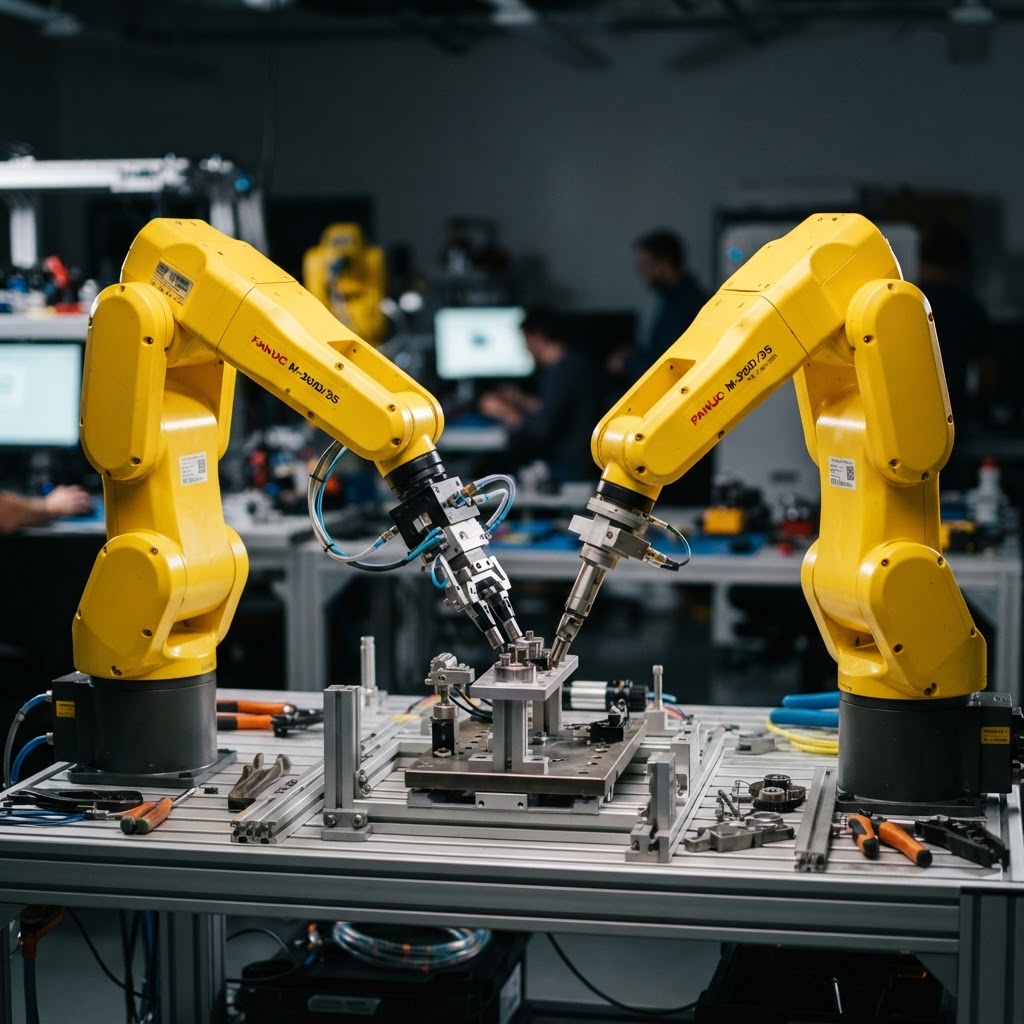
Step inside a FANUC robotics integration lab and the first thing you notice is the density of yellow. Every robot, every arm, every controller is FANUC's signature canary yellow — a visual reminder that the company controls the entire technology stack it deploys. This vertical integration extends to software: FANUC's FIELD system (FANUC Intelligent Edge Link and Drive) connects machines, robots, and sensors on a unified IoT platform.
FANUC's CRX collaborative robot series, introduced to address the growing demand for human-robot collaboration in smaller production cells, now supports payloads from 5 kg to 25 kg. In 2025, FANUC expanded CRX capabilities with enhanced force-torque sensing and AI-assisted path learning, reducing typical robot programming time by up to 50% compared to traditional teach-pendant methods. For manufacturers facing skilled labor shortages, this is a transformative capability.
The company's machine vision division, powered by its iRVision platform, processes thousands of visual recognition tasks per second on the production floor. In high-mix, low-volume manufacturing environments — a growing reality across electronics and medical device sectors in 2025 — iRVision allows robots to adapt to part variation without manual reprogramming. FANUC reported double-digit growth in vision-integrated robot deployments during fiscal year 2024.
FANUC also invested heavily in digital twin capabilities throughout 2024 and 2025. Its ROBOGUIDE simulation software allows engineers to model, test, and optimize entire robot cells virtually before a single physical component is installed. Early adopters in the automotive sector reported 30–40% reductions in system commissioning time, a metric that directly compresses time-to-production for new model launches.
B2B Marketing Lessons Industrial Companies Can Learn from FANUC
FANUC's commercial success is not accidental — it is the product of a disciplined B2B marketing and sales strategy that manufacturing companies of all sizes can study. At its core, FANUC sells outcomes, not hardware. When a tier-one automotive supplier evaluates a FANUC welding robot, the conversation centers on cycle time, uptime SLAs, and total cost of ownership over a ten-year horizon — not unit price.
This outcome-based positioning is reinforced by FANUC's global network of more than 260 authorized system integrators across over 100 countries. Rather than attempting to own every customer relationship directly, FANUC empowers local integrators with deep technical training, certification programs, and co-marketing resources. This channel strategy gives FANUC massive geographic reach while maintaining brand consistency and technical quality standards.
FANUC also leverages long-term service contracts as a revenue stabilization mechanism and a customer retention tool simultaneously. Its FANUC ZERO DOWN TIME (ZDT) program, which uses IoT sensor data to predict and prevent robot failures before they occur, creates an ongoing data relationship with every connected machine in the field. By 2025, ZDT had expanded to cover hundreds of thousands of connected robot installations globally — creating a recurring revenue stream and a competitive moat that is extremely difficult to replicate.
The marketing lesson here for industrial companies is clear: the highest-value B2B relationships are built on data continuity, not transactional sales cycles. Companies that embed themselves into their customers' operational data streams become infrastructure, not vendors.
Future Outlook: Automation's Next Frontier and What It Means for Manufacturers
FANUC's strategic roadmap through 2026 centers on three converging trends: AI-enhanced robot autonomy, collaborative human-machine workflows, and sustainable manufacturing. In early 2025, FANUC announced expanded AI integration across its robot controller lineup, enabling adaptive motion control that allows robots to self-correct trajectory deviations in real time without operator input. This capability is particularly significant for precision applications in semiconductor and aerospace manufacturing.
The global industrial robot market is projected to reach $47 billion by 2026, according to recent International Federation of Robotics estimates, with Asia-Pacific continuing to dominate installation volumes. FANUC is uniquely positioned to capture disproportionate share of this growth, given its manufacturing base in Japan, its dominant position in China through partnerships and direct sales, and its accelerating penetration of North American reshoring projects.
Sustainability is also emerging as a genuine competitive differentiator in industrial automation procurement. FANUC's energy-saving servo technology, which recovers and redistributes braking energy within robot cells, has demonstrated up to 20% reductions in factory energy consumption in documented customer deployments during 2024 and 2025. As industrial buyers increasingly face Scope 3 emissions reporting requirements, this kind of embedded efficiency becomes a procurement criterion, not just a marketing claim.
For manufacturing and industrial leaders reading this, the strategic implication is urgent: the gap between automation leaders and laggards is widening faster than at any previous point in industrial history. Companies that begin integrating AI-assisted automation, digital twins, and connected service ecosystems now will define the competitive baseline for the next decade. The question is not whether to automate — it is how quickly you can build the organizational capability to do it well.
Start by auditing your current production floor against the FANUC benchmark, and identify the three highest-impact automation opportunities you can pilot within the next 12 months.
Key Takeaways
- FANUC controls approximately 65% of the global CNC machine controller market and has shipped more than 25 million CNC systems, making it the dominant automation infrastructure provider worldwide.
- In fiscal year 2024, FANUC posted net sales of approximately ¥801 billion (~$5.3 billion USD), demonstrating revenue resilience even amid global capex cycle pressures.
- FANUC's CRX collaborative robot AI path-learning capabilities reduced programming time by up to 50% in 2025 deployments, directly addressing the skilled labor shortage facing manufacturers globally.
- FANUC's ZERO DOWN TIME (ZDT) IoT program covered hundreds of thousands of connected robot installations globally by 2025, creating a recurring-revenue service model that competitors struggle to replicate.
Key Quotes
"Our robots are made by robots. That is not a slogan — it is the only way to guarantee the precision and consistency our customers depend on at global scale." — Kenji Yamaguchi, Senior Executive Officer, FANUC Corporation
"The integration of AI into robot motion control is not an upgrade — it is a fundamental shift in what industrial automation can promise a manufacturer in terms of adaptability and uptime." — Dr. Hiroshi Wakabayashi, General Manager, Robotics Research Division, FANUC Corporation
References
- FANUC Corporation Investor Relations — Fiscal Year 2024 Annual Report — Official FANUC financial data, segment revenue breakdowns, and strategic commentary from fiscal year 2024.
- International Federation of Robotics — World Robotics 2025 Report — Global industrial robot installation data, market size projections, and regional growth analysis through 2026.
- FANUC FIELD System and ZDT Platform Overview — Technical documentation and deployment details for FANUC's IoT-connected manufacturing and predictive maintenance ecosystem.