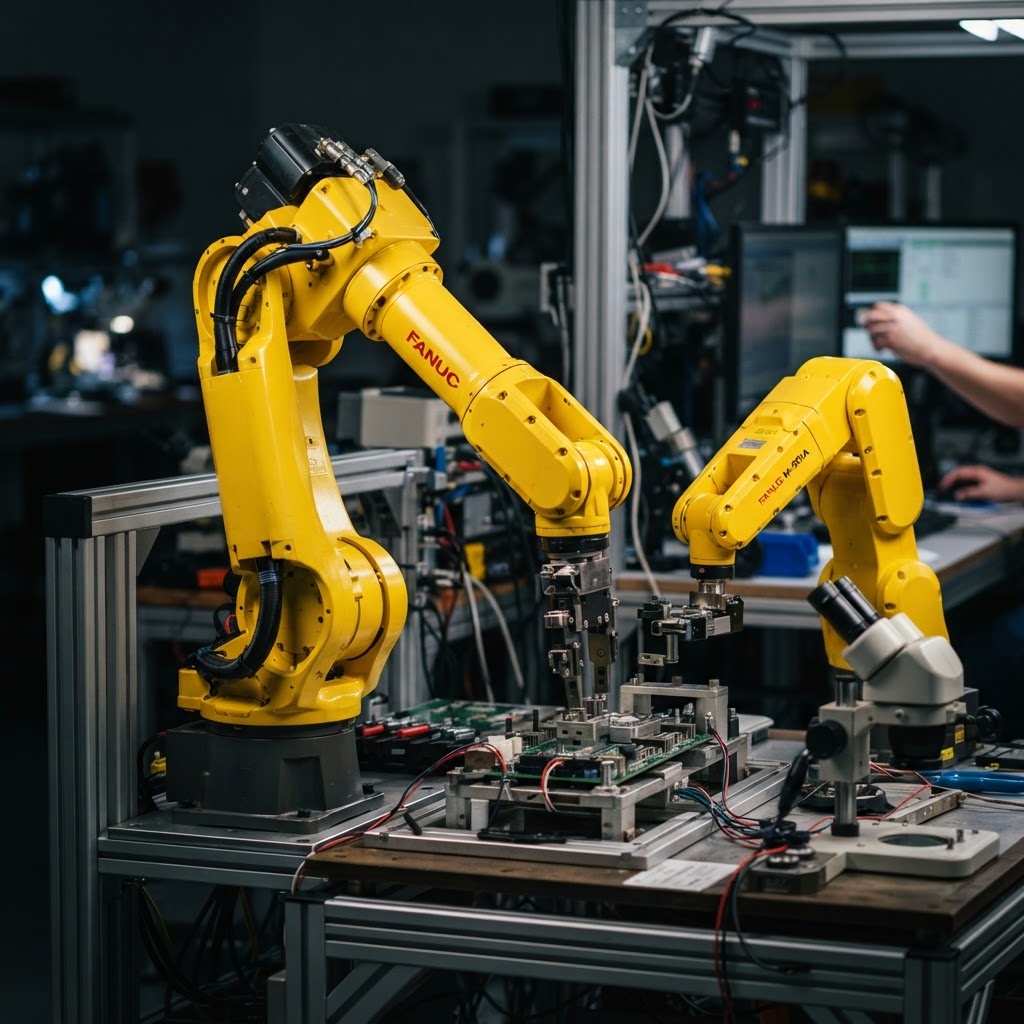
The Silent Symphony of Oshino: A Peek Behind the Curtain
Deep within the specialized laboratories at FANUC’s headquarters in Oshino, Japan, a silent revolution occurs every millisecond. While most of the world perceives manufacturing as a physical assembly line, the reality at FANUC is a digital orchestra where robots literally build other robots. This cyclical automation is the beating heart of an industrial giant that has sustained its position as the global leader in factory automation for decades.
Stepping into a FANUC lab feels like walking into a high-tech hive where precision is the only currency that matters. The environment is optimized for what the company calls 'autonomous production,' a method where machines operate unattended for weeks on end. It is a masterclass in B2B efficiency that proves the viability of lights-out manufacturing in a volatile global economy.
For industrial leaders looking to scale, FANUC represents more than just a hardware vendor. It serves as a blueprint for the modern factory floor where software and iron mesh to drive throughput. Understanding their internal methodology is the key to unlocking the next level of your own operational maturity.
Scaling Through Self-Replication and Robotic Velocity
FANUC’s internal manufacturing ecosystem is defined by a massive scale that is almost impossible to replicate without decades of experience. As of the 2025 fiscal data, the company maintains a production capacity of roughly 11,000 robots per month across its global facilities. This volume allows them to maintain a tight grip on a market share that continues to hover near 20% in the highly competitive global robotics sector.
The secret to this massive output lies in the utilization of their own CNC machines and robots to perform the assembly of new units. By 2025, over 80% of the internal assembly processes within their Japan-based factories are handled by FANUC-manufactured equipment. This vertical integration drastically reduces the lead time from design to shipment, often keeping internal equipment costs lower than competitors who rely on external supply chains.
Operational density is the metric that matters most to the leadership at FANUC. They report that their facilities operate at an equipment utilization rate consistently exceeding 90% in 2026. This data point is not just a vanity metric; it is the fundamental reason why the company can absorb global supply chain shocks while maintaining a stable margin profile.
The Digital Architecture of Precision Engineering
Innovation at FANUC is no longer confined to the physical motion of an arm or the speed of a spindle. The company shifted its focus toward the 'FIELD system'—their proprietary industrial IoT platform—to create a unified data fabric across all their machines. By early 2026, the company successfully migrated over 500,000 active robots into their cloud-based monitoring environment, enabling predictive maintenance at an unprecedented scale.
The real power of this data lies in the reduction of unplanned downtime for their end-users. FANUC reported in their 2025 annual review that facilities leveraging their AI-driven predictive diagnostics reduced maintenance-related interruptions by 28% compared to traditional preventative schedules. This shift from reactive to proactive service models is the primary driver of their high customer retention rates in the automotive and electronics sectors.
Furthermore, the integration of generative AI into their programming interface has lowered the barrier to entry for factory floor operators. Instead of needing specialized coding knowledge, staff can now refine robot trajectories using natural language processing tools released in late 2025. This democratization of automation is set to become the standard for the next decade of industrial growth.
Growth Lessons for the Modern Industrial Enterprise
FANUC’s success provides a clear road map for B2B industrial companies striving to grow in a saturated market. The most vital lesson is the commitment to modularity. By building robots that can be easily reconfigured or repurposed for different tasks, FANUC ensures that their clients' capital investments remain relevant even when product lines change.
Another critical lesson is the strategic balance between human expertise and machine speed. While the assembly is largely automated, the human capital at FANUC is deployed exclusively for R&D and high-level systems optimization. They maintain an lean workforce in their production facilities, focusing on upskilling technicians to manage complex systems rather than performing manual tasks.
Finally, the company prioritizes the 'Made in Japan' brand promise of reliability, which resonates strongly with manufacturers facing global supply chain instability. By keeping core manufacturing close to the source of innovation, they minimize the risk of quality variance. Industrial firms should replicate this by auditing their supply chains for critical failure points where proximity to the source could improve performance.
The Future Landscape of Autonomous Manufacturing
Looking toward the remainder of 2026 and into 2027, the focus for FANUC will be on the 'Human-Robot Collaboration' (HRC) segment. As labor shortages persist across North America and Europe, the demand for cobots that can work safely alongside humans will likely surge. FANUC’s R&D budget for 2026, which remains substantial, is heavily weighted toward advanced sensors that improve the spatial awareness of their robotic units.
Strategic implications for competitors include a race to match these safety and sensory standards. Companies that fail to integrate AI-driven safety protocols into their robotics offerings will find themselves losing ground to firms that prioritize seamless human-robot synergy. The future is not just about faster movement, but smarter, more empathetic interaction between the worker and the machine.
If your organization is ready to modernize its production capacity, look to the FANUC model of total integration. We invite you to contact your regional automation consultant today to review our latest 2026 case study catalog and see how these lessons can be tailored to your factory floor. Stop settling for manual bottlenecks and start building your future with scalable, autonomous solutions today.
Key Takeaways
- FANUC maintains a production capacity of 11,000 robots per month as of 2025, underscoring their massive industrial scale.
- Over 80% of FANUC's internal assembly processes are performed by their own equipment, proving the power of vertical integration.
- Facilities utilizing FANUC’s predictive diagnostics observed a 28% decrease in unplanned downtime throughout 2025.
- By early 2026, FANUC successfully onboarded over 500,000 robots into their proprietary IIoT environment to optimize fleet performance.
Key Quotes
"Our goal is to build machines that are as predictable as they are powerful, turning the factory floor into a reliable source of continuous profit." — Yoshiharu Inaba, Chairman of FANUC
"The fusion of AI with industrial robotics is not just an upgrade; it is a total transformation of how we define manufacturing efficiency in 2026." — Kenji Yamaguchi, President and CEO of FANUC
References
- FANUC Annual Report 2025 — Details on production volumes, R&D strategy, and financial performance.
- Industrial Automation Market Trends 2026 — International Federation of Robotics report on the growth of collaborative robots and AI integration.
- Manufacturing Executive Leadership Brief 2026 — Insights on operational trends, IoT adoption, and the future of lights-out manufacturing.