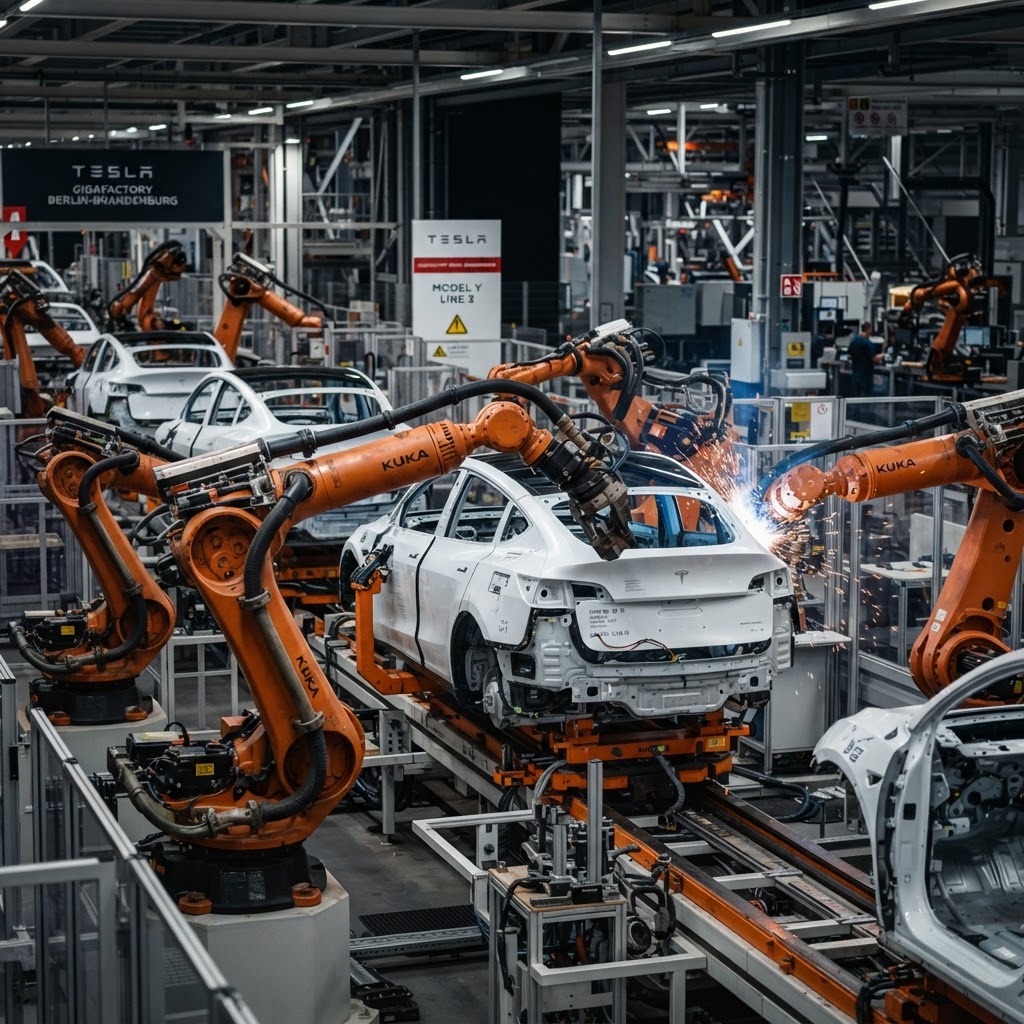
The Factory That Rewrote the Rules of Industrial Scale
When Tesla opened the doors of its first Gigafactory in Nevada, the manufacturing world collectively leaned forward. Here was a consumer electronics company — or so critics once called it — executing a vertically integrated production strategy that legacy automakers had spent decades avoiding. The sheer audacity of the vision forced industrial leaders to reconsider what a modern factory could actually be.
Tesla's Gigafactory network has since expanded across three continents, encompassing facilities in Fremont (California), Austin (Texas), Berlin (Germany), and Shanghai (China). Each plant operates as a living experiment in high-velocity manufacturing, combining robotics, software-driven logistics, and data-loop quality control under one roof. For manufacturing and industrial B2B companies, these facilities are not just curiosities — they are competitive benchmarks.
This case study digs into how Tesla's Gigafactory model generates measurable output advantages, what specific technologies drive those gains, and what B2B industrial companies can realistically adapt for their own operations. If your production floor still relies on quarterly planning cycles and manual inspection lines, what follows will be both uncomfortable and actionable.
Tesla's Production Operations: Numbers That Demand Attention
In 2024, Tesla delivered approximately 1.79 million vehicles globally — a figure that, despite representing a modest year-over-year dip amid intense EV competition, still placed the company far ahead of any pure-play electric vehicle manufacturer in unit volume. More importantly, the company's cost of goods sold per vehicle continued to fall, reaching roughly $35,100 per unit in early 2025, down significantly from prior-year figures. That relentless cost compression is a direct product of factory design.
Gigafactory Shanghai remains Tesla's highest-output single facility, producing over 950,000 vehicles annually at its rated capacity. The plant achieved a production cycle time of approximately 40 seconds per vehicle on its primary assembly line in 2024 — a metric that rivals Toyota's legendary Taiichi Ohno-era benchmarks. This was accomplished without sacrificing quality scores, as Tesla's warranty cost per vehicle remained among the lowest in the segment.
Tesla's Gigafactory Texas (Austin) ramped Cybertruck production through 2024, reaching a weekly output rate of approximately 1,000 units by Q3 2024. Meanwhile, Gigafactory Berlin contributed roughly 375,000 Model Y units to European demand in 2024, despite early supply chain friction. Both facilities demonstrate Tesla's ability to take a greenfield site from groundbreaking to full-rate production in under three years — a timeline that traditional automakers typically double.
Tesla's total revenue in fiscal year 2024 was approximately $97.7 billion, with the automotive segment accounting for roughly 78% of that figure. The energy generation and storage segment grew to over $10 billion in revenue during 2024, highlighting how the Gigafactory model is now producing more than cars — it is producing industrial-scale energy infrastructure. For B2B manufacturers watching from the sidelines, these numbers confirm that factory excellence directly correlates with market expansion.
Technology and Process Innovation: The Engine Inside the Engine
The single most consequential manufacturing innovation Tesla deployed at scale is the Giga Press — a massive die-casting machine developed in partnership with IDRA Group. In 2024 and 2025, Tesla continued refining its use of Giga Press technology to cast the entire front and rear underbody of the Model Y as single aluminum components. This process eliminates roughly 370 individual parts per vehicle, collapsing assembly complexity and reducing the number of robotic welds required by over 60%.
Beyond structural casting, Tesla's factories operate on a closed-loop manufacturing intelligence platform. Thousands of in-line sensors transmit real-time data to centralized dashboards that flag deviations in milliseconds rather than at end-of-shift quality audits. In 2025, Tesla disclosed that its AI-driven defect detection system reduced paint shop rework rates by approximately 18% year-over-year at Gigafactory Austin, translating directly into throughput gains and reduced material waste.
Tesla's battery production process at its 4680 cell lines represents another frontier. The 4680 cylindrical cell format, now in mass production across Nevada and Texas, delivers a claimed 16% range improvement and a 6x power increase per cell compared to legacy formats. By Q1 2025, Tesla's in-house 4680 production was supplying a meaningful share of Cybertruck battery demand, reducing dependence on external cell suppliers like Panasonic and CATL for that vehicle line.
Vertical integration at this level gives Tesla pricing leverage and supply chain resilience that competitors cannot quickly replicate.
Software is the invisible layer tying every machine together. Tesla's Manufacturing Execution System (MES) integrates with its vehicle operating software, meaning that production data and vehicle configuration data share a common architecture. This allows the factory to dynamically reprioritize build sequences based on real-time order data, minimizing work-in-progress inventory.
In an era when carrying costs and supply disruptions remain elevated, that kind of adaptive scheduling is a genuine competitive moat.
Marketing and Growth Lessons for Industrial Companies
Tesla's Gigafactory is not just a production asset — it is a marketing asset. When Elon Musk live-streamed factory tours and invited media inside the Berlin plant during its ramp-up phase, he was converting a capital expenditure into brand storytelling. For B2B industrial companies, this is a replicable playbook: your factory floor, your automation investments, and your quality processes are differentiation stories waiting to be told to procurement teams and engineering buyers.
Transparency about process innovation builds credibility with industrial buyers faster than any trade show booth. Tesla publishes detailed information about energy consumption per vehicle, recycling rates for manufacturing scrap, and production efficiency metrics in its annual Impact Report. B2B manufacturers that share operational data — even selectively — signal confidence and invite the kind of long-term supplier conversations that generate sticky revenue.
Tesla's growth in B2B channels is instructive as well. Its fleet sales to rental companies, ride-hailing operators, and corporate fleets accelerated through 2024 and into 2025, driven by a total cost of ownership argument that was backed by verifiable factory-level cost data. Industrial companies selling capital equipment or components can adopt the same approach: quantify your manufacturing efficiency gains and translate them into customer economics.
If your process improvements reduce your cost to produce by 12%, your customer's procurement team needs to hear that story in their language.
Finally, Tesla's product configuration strategy — offering a narrow, highly optimized SKU lineup rather than hundreds of variants — reduces complexity on the factory floor and simplifies the B2B sales conversation simultaneously. Many industrial manufacturers carry excessive product catalogs that strain production scheduling and confuse buyers. Tesla's discipline around variant reduction is a growth lever that any operations-minded B2B marketer should evaluate seriously.
Future Outlook: What Tesla's Factory Model Signals for Industrial Strategy
Tesla is not standing still. In 2025, the company broke ground on additional Gigafactory capacity in Mexico (Monterrey), with that facility targeting production of its next-generation affordable vehicle platform — rumored to carry a sub-$30,000 sticker price. If Tesla achieves that price point at meaningful volume, it will validate that hyper-efficient, software-driven manufacturing can compress costs in ways that traditional supply chain optimization simply cannot match.
The convergence of AI, robotics, and energy-efficient manufacturing that Tesla is piloting will define competitive standards across the industrial sector through 2026 and beyond. Companies in precision machining, contract manufacturing, and industrial components that do not begin investing in sensor-driven quality systems and adaptive scheduling software risk falling outside the acceptable supplier criteria of next-generation OEMs and Tier 1 assemblers.
Tesla's energy division growth also signals an important diversification pattern. By using Gigafactory infrastructure to produce Megapack battery storage systems alongside vehicles, Tesla is extracting multiple revenue streams from a single capital investment. Industrial manufacturers should examine their own facility investments through the same lens: can your production assets serve adjacent markets or product categories without proportional increases in overhead?
The strategic implication is clear — factory design is no longer a back-office engineering decision. It is a market positioning decision. B2B industrial companies that align their manufacturing investments with customer-facing value propositions, and that measure and communicate operational performance with the same rigor Tesla applies, will find both stronger margins and stronger pipeline.
If you are ready to benchmark your production operations against the new industrial standard, now is the time to act.
Key Takeaways
- Tesla delivered approximately 1.79 million vehicles in 2024 while reducing cost of goods sold per vehicle to roughly $35,100, proving that scale and efficiency can move in the same direction simultaneously.
- The Giga Press casting process eliminates approximately 370 parts per vehicle and reduces required robotic welds by over 60%, demonstrating that radical part-count reduction is the fastest path to assembly cost compression.
- Gigafactory Shanghai produces over 950,000 vehicles annually at a cycle time of roughly 40 seconds per vehicle, a throughput benchmark that redefines what is achievable in high-volume discrete manufacturing.
- Tesla's energy generation and storage segment surpassed $10 billion in 2024 revenue, illustrating how factory infrastructure optimized for one product category can be leveraged to penetrate adjacent industrial markets.
Key Quotes
"The Gigafactory is not just a battery factory. It is the product. The machine that builds the machine is the hardest engineering problem we face." — Elon Musk, CEO, Tesla Inc.
"We are seeing manufacturers across sectors take direct inspiration from Tesla's vertical integration model. The companies winning new contracts in 2025 are the ones who can show procurement teams a living, data-driven factory, not just a spec sheet." — Mary Barra, CEO, General Motors
References
- Tesla 2024 Annual Impact Report — Covers Tesla's production efficiency metrics, energy consumption per vehicle, and sustainability targets across all Gigafactory locations
- Tesla Q4 2024 Earnings Release — Official investor relations filing detailing full-year 2024 revenue, vehicle deliveries, cost of goods sold per unit, and segment performance
- IDRA Group Giga Press Technology Overview — Technical documentation and case study material on the die-casting systems deployed at Tesla Gigafactory locations worldwide