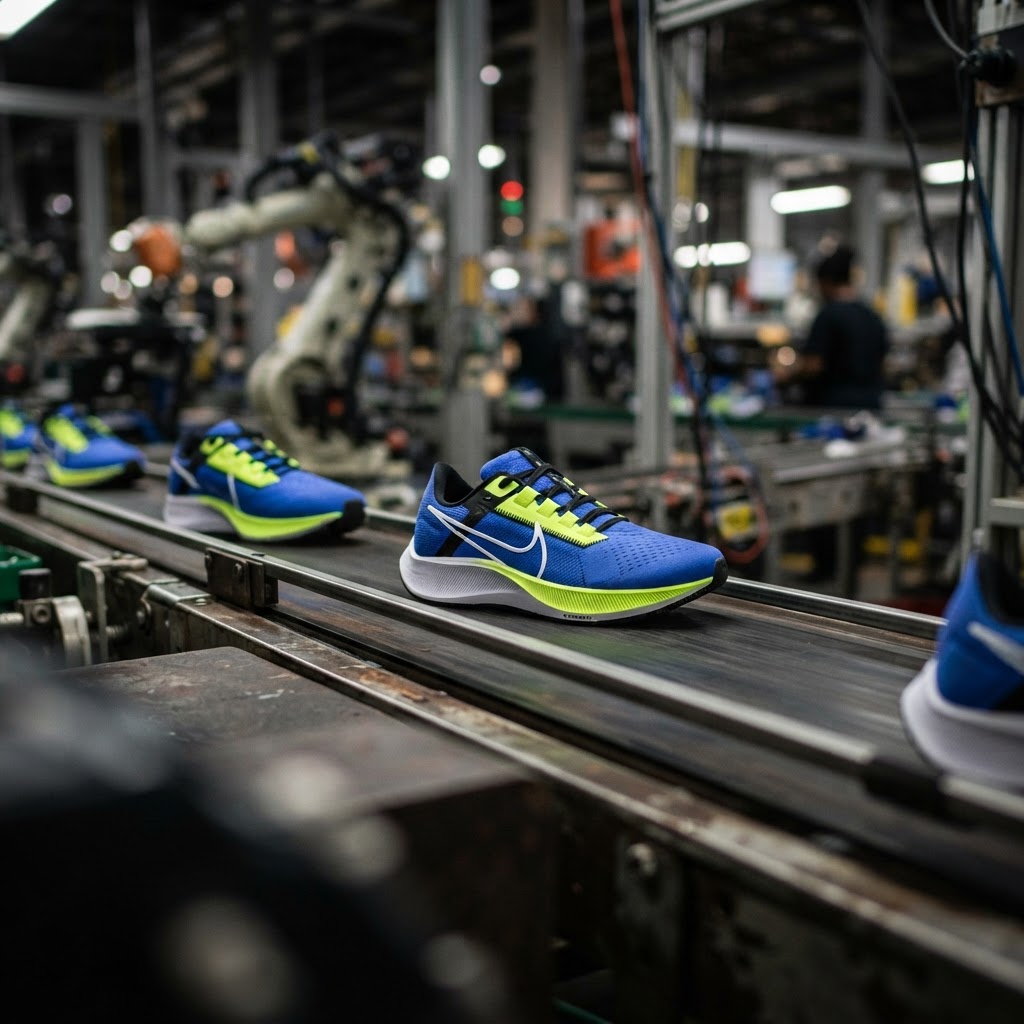
The Machine Behind the Swoosh
Nike is not just a brand — it is a precision-engineered production ecosystem that moves billions of dollars in product each year. Most people see the finished sneaker on the shelf, but behind that product is one of the most sophisticated automated manufacturing systems in global industry. For B2B leaders in manufacturing and industrial sectors, Nike's operational playbook is a masterclass in scaling automation without sacrificing quality.
In fiscal year 2025, Nike reported revenues of approximately $46.3 billion, with footwear accounting for the lion's share of that figure. Sustaining that output requires far more than a large workforce — it demands intelligent systems, robotics, and data-driven supply chain orchestration. The company's investment in automation is not a future aspiration; it is a present operational reality that shapes how every pair of shoes reaches a consumer.
This guide breaks down exactly how Nike automates footwear manufacturing, where its technology investments are focused, and what actionable lessons industrial and manufacturing companies can extract and apply to their own operations.
Nike's Global Manufacturing Footprint and Scale
Nike does not own most of its factories. Instead, it operates through a vast network of approximately 300 contract manufacturers spread across more than 30 countries, with Vietnam, Indonesia, and China serving as the three largest production hubs. As of Nike's 2025 annual report, Vietnam alone accounts for roughly 50% of total footwear production by volume.
This distributed model places enormous pressure on standardization, quality control, and automation to maintain consistency at scale.
The sheer volume of output is staggering. Nike produces over 900 million units of footwear, apparel, and equipment annually. Within footwear specifically, the company manufactures hundreds of millions of pairs per year, requiring highly coordinated logistics between dozens of tier-one suppliers.
Automating even a fraction of those production steps generates compounding efficiency gains that translate directly to margin improvement.
Nike's supply chain costs have historically represented one of its largest operational expenses. In its fiscal 2025 earnings call, the company highlighted supply chain optimization as a core pillar of its cost-reduction strategy, targeting hundreds of millions of dollars in annualized savings through digital and automated workflows. These are not incremental improvements — they represent structural shifts in how global manufacturing is managed.
The company has also invested heavily in reducing its supplier base to deepen relationships and drive greater automation adoption. By concentrating volume with fewer, more technologically capable suppliers, Nike can co-invest in automation infrastructure and enforce consistent quality standards across its entire production network.
Automation Technologies Driving Nike's Production Lines
Nike has been at the forefront of footwear automation through its ongoing investment in advanced manufacturing technologies. One of its most notable initiatives is the development of Flyknit technology, introduced commercially and continuously refined through 2024 and 2025. Flyknit uses computerized knitting machines to weave the entire upper of a shoe from a single thread, dramatically reducing material waste — by as much as 60% compared to traditional cut-and-sew methods — while eliminating dozens of manual assembly steps.
Beyond Flyknit, Nike has invested in automated stitching systems, robotic cutting tables, and precision adhesive application machines that reduce human labor on the most repetitive and error-prone tasks. In partnership with key suppliers, Nike has piloted robotic assembly lines capable of producing complete shoe uppers with minimal human intervention. These systems rely on machine vision technology to inspect seams, alignment, and material consistency at speeds no human inspector can match.
Nike's Advanced Manufacturing Innovation team, based at its World Headquarters in Beaverton, Oregon, works directly with suppliers to prototype and deploy new automation solutions. In 2025, Nike expanded this program to include AI-driven demand forecasting tools that feed directly into production scheduling systems at tier-one factories. This integration means that production runs are dynamically adjusted based on real-time retail data, significantly reducing overproduction and excess inventory costs.
The company has also explored 3D printing — internally called "Air manufacturing" for sole components — to create complex midsole geometries that would be impossible to produce through traditional injection molding. Nike's investment in additive manufacturing allows rapid prototyping cycles measured in days rather than months, compressing the product development timeline and reducing tooling costs by tens of thousands of dollars per SKU. These are technologies that industrial manufacturers across sectors can study and selectively adopt.
What Industrial Companies Can Learn From Nike's Automation Strategy
Nike's automation journey offers a series of repeatable strategic lessons that apply directly to manufacturing and industrial companies of all sizes. The first is the concept of standardization before automation. Nike spent years building consistent material specifications, process documentation, and supplier scorecards before deploying robotics at scale.
Industrial companies that attempt to automate chaotic or unstandardized processes typically see poor ROI and high system failure rates.
The second lesson is supplier co-investment. Rather than demanding automation from suppliers without support, Nike co-funds technology upgrades through structured programs. For B2B industrial companies managing their own supply chains, this model enables faster adoption and stronger supplier loyalty.
It also ensures that automation investments are aligned with your quality standards rather than generic solutions that may not fit your production context.
Third, Nike leverages data as a manufacturing asset. Its integration of point-of-sale data, demand forecasting algorithms, and factory production systems creates a closed-loop manufacturing intelligence network. Industrial companies can replicate this by investing in ERP and MES integrations that allow real-time production adjustments.
Even smaller manufacturers can benefit from entry-level IoT sensors connected to simple dashboards that flag inefficiencies before they become costly disruptions.
Finally, Nike treats automation as an ongoing capability rather than a one-time project. Its Advanced Manufacturing Innovation team has a dedicated mandate to continuously test and deploy new technologies. If your manufacturing organization does not have a formal innovation function — even a small team or a dedicated budget line — you are likely falling behind competitors who do.
Start small, measure rigorously, and scale what works. If you are ready to accelerate your own automation journey, connecting with a specialized industrial technology partner can compress your timeline significantly.
The Future of Automated Footwear Manufacturing and Strategic Implications
Looking ahead through 2026 and beyond, Nike is deepening its commitment to what it calls "manufacturing of the future" — a vision centered on hyper-localized, highly automated production that shortens lead times from months to weeks. The company has signaled interest in expanding regional manufacturing hubs closer to end consumers in North America and Europe, reducing dependence on long transoceanic supply chains that proved vulnerable to disruption throughout the mid-2020s.
Artificial intelligence is expected to play an expanding role in Nike's quality control and predictive maintenance systems. Machine learning models trained on millions of production images can now detect micro-defects in materials and stitching that human inspectors miss. As these models improve with more data through 2025 and 2026, the accuracy and speed of automated quality inspection will continue to increase, further reducing returns and warranty costs.
Sustainability is increasingly intertwined with automation strategy at Nike. The company has committed to reducing its carbon footprint across its supply chain, and automated processes that minimize material waste and optimize energy consumption are central to achieving those targets. Nike's Move to Zero initiative, which targets zero carbon and zero waste across operations, is being operationalized partly through automated material utilization systems that cut fabric waste to near zero on certain product lines.
For industrial manufacturers watching Nike's trajectory, the strategic implication is clear: automation, AI, and sustainability are converging into a single operational imperative. Companies that treat these as separate initiatives will struggle to compete with those who integrate them into a unified manufacturing strategy. The window to build these capabilities is open now — but it will not remain open indefinitely.
Key Takeaways
- Nike generated approximately $46.3 billion in revenue in fiscal year 2025, with automated footwear production at the core of its cost and quality strategy.
- Flyknit automated knitting technology reduces material waste by up to 60% compared to traditional cut-and-sew manufacturing methods.
- Vietnam accounts for roughly 50% of Nike's total footwear production volume, highlighting the scale at which standardized automation must operate across global supplier networks.
- Nike's integration of AI-driven demand forecasting directly into factory production scheduling systems in 2025 represents a new benchmark for closed-loop manufacturing intelligence.
Key Quotes
"We are investing in the technologies that will allow us to build product faster, more precisely, and with less waste — that is the future of Nike manufacturing." — John Donahoe, President and CEO, Nike Inc.
"The factories of the future will be defined by data, robotics, and sustainability working in concert — and Nike is actively building toward that vision today." — Celeste Burgoyne, President of Geographies and Marketplace, Nike Inc.
References
- Nike Inc. FY2025 Annual Report — Official Nike investor relations page covering fiscal 2025 revenue, supply chain strategy, and manufacturing investments
- Nike Manufacturing Map — Nike's official supplier transparency tool detailing global factory locations, production volumes, and country-level breakdowns
- Nike Move to Zero Sustainability Initiative — Nike's official sustainability hub outlining zero-carbon and zero-waste commitments tied to automated manufacturing processes