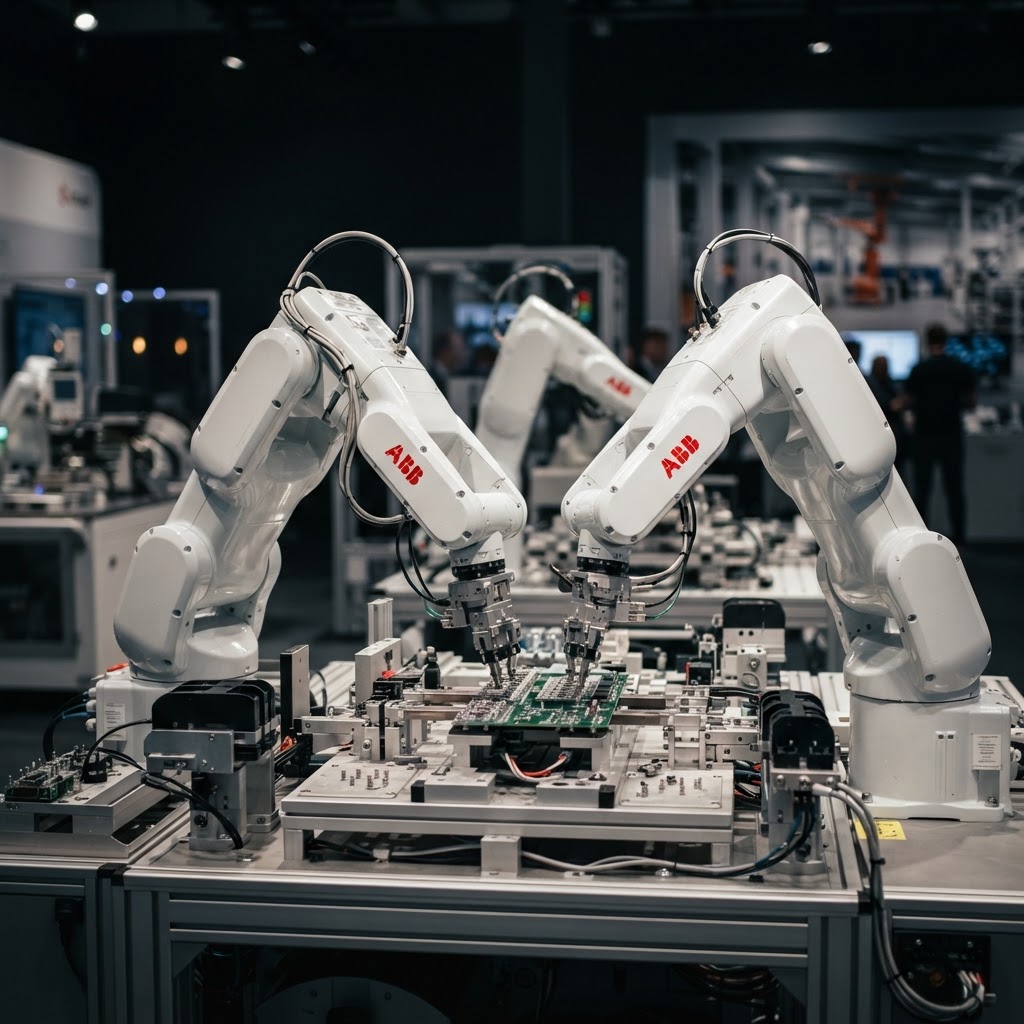
The Factory Floor Is Being Rewritten — And ABB Robotics Is Holding the Pen
The global manufacturing landscape is undergoing a transformation unlike anything seen in the past century. Automation is no longer a competitive advantage reserved for the world's largest corporations — it is rapidly becoming the baseline expectation for any manufacturer that wants to survive the decade. At the center of this shift stands ABB Robotics, a division of ABB Ltd that has quietly become one of the most consequential forces in modern industrial production.
Founded on a legacy of Swiss-Swedish engineering excellence, ABB Robotics operates at the intersection of precision mechanics, artificial intelligence, and real-time industrial software. Their portfolio spans collaborative robots (cobots), autonomous mobile robots (AMRs), robot controllers, and end-to-end automation software suites. For B2B decision-makers in manufacturing, understanding how ABB Robotics operates is not merely academic — it is strategically essential.
This guide breaks down ABB Robotics's manufacturing operations, technology stack, go-to-market approach, and future trajectory. Whether you are a plant manager evaluating your first robotic cell or a C-suite executive mapping a five-year automation roadmap, the insights here are designed to sharpen your thinking and accelerate your decisions.
Inside ABB Robotics's Global Manufacturing and Operational Footprint
ABB Robotics is one of the most geographically diversified robotics manufacturers in the world, with production facilities across Europe, Asia, and the Americas. In 2024, ABB Ltd reported total revenues of approximately $32 billion USD, with the Robotics & Discrete Automation division contributing a significant share of that output. The division's order backlog remained robust through 2024 and into 2025, driven by surging demand from automotive, electronics, logistics, and food and beverage sectors.
ABB's flagship robotics campus in Västerås, Sweden, serves as a global R&D and manufacturing hub, producing thousands of industrial robot units annually. The company's Shanghai facility, one of the largest robotics factories in the world, has been expanded significantly since 2024 to meet accelerating demand from Asia-Pacific markets. ABB has also invested heavily in its Auburn Hills, Michigan plant to serve North American automotive and EV battery manufacturing customers.
The company's installed base now exceeds 1 million robots deployed worldwide — a milestone that underscores both its manufacturing scale and the depth of its customer relationships. ABB Robotics supports these deployments through a global service network of over 100 countries, providing maintenance, software updates, and performance optimization. This global service capability is a critical differentiator when industrial buyers are evaluating total cost of ownership.
In 2025, ABB Robotics reported double-digit order growth in its AMR segment, reflecting the explosive adoption of autonomous mobile robots in warehouse and intralogistics applications. The company's strategic acquisition of additional software-centric automation firms in 2024 further broadened its ability to offer integrated, end-to-end automation solutions. These operational investments signal a company that is not coasting on legacy market share but actively expanding its addressable market.
Engineering the Future: ABB Robotics's Technology and Process Innovation
ABB Robotics has positioned its technology strategy around three pillars: AI-driven intelligence, human-robot collaboration, and open software ecosystems. The company's OmniCore controller platform, which launched and gained widespread adoption through 2024 and 2025, represents a generational leap in robot control architecture. OmniCore delivers motion accuracy down to 0.01mm, cycle-time improvements of up to 25% versus previous-generation controllers, and a unified software environment that simplifies multi-robot coordination.
On the collaborative robotics front, ABB's GoFa and SWIFTI cobot lines have seen accelerating adoption in small and mid-sized manufacturing environments. The GoFa CRB 15000 operates with a 5kg payload and 950mm reach, making it ideal for precision assembly, machine tending, and quality inspection tasks. ABB reported that cobot revenues grew at a rate significantly outpacing its traditional industrial robot lines in 2024, reflecting the broader market shift toward flexible, human-adjacent automation.
ABB's Autonomous Mobile Robot portfolio, anchored by its Autonomous Mobile Robots product line inherited from the ASTI Mobile Robotics acquisition, has been deeply integrated into ABB's robotics ecosystem. By 2025, ABB's AMR fleet management software could coordinate fleets of hundreds of robots across complex facility layouts, dynamically rerouting units in real time based on production priorities. This level of orchestration is increasingly attractive to manufacturers operating high-mix, low-volume production environments where rigid, fixed automation struggles to deliver ROI.
The company's ABB Ability platform — its industrial IoT and analytics layer — connects robot fleets to cloud-based performance dashboards, enabling predictive maintenance alerts that have been shown to reduce unplanned downtime by up to 30% in customer deployments. Integration with major MES and ERP platforms including SAP and Siemens Opcenter ensures that ABB robots generate actionable data that feeds directly into a manufacturer's operational intelligence stack. For industrial buyers, this interoperability is no longer a nice-to-have — it is a procurement requirement.
Go-to-Market Lessons Every Industrial Manufacturer Can Learn from ABB Robotics
ABB Robotics does not sell robots — it sells outcomes. This subtle but powerful reframe is visible across its marketing materials, sales methodology, and partner ecosystem strategy. Rather than leading with technical specifications, ABB's commercial teams lead with ROI calculators, Total Cost of Ownership models, and industry-specific case studies that speak directly to the pain points of plant managers and operations directors.
This outcome-first positioning is a masterclass in B2B industrial marketing.
ABB Robotics has also built one of the most sophisticated channel partner ecosystems in the automation industry. Its Authorized Value Provider (AVP) program certifies systems integrators across dozens of vertical markets, ensuring that customers receive deployment expertise that is tailored to their specific application. This partner-led model allows ABB to penetrate mid-market and SME accounts that its direct sales force cannot cost-effectively reach alone.
In 2024, ABB expanded its AVP program significantly in North America and Southeast Asia, targeting the rapidly growing food processing and electronics assembly sectors.
Content and education are central to ABB Robotics's demand generation strategy. The company's RobotStudio simulation software — available with a free version that allows engineers to design, program, and test robot cells virtually before any capital is committed — has been downloaded by hundreds of thousands of users globally. This freemium tool generates a qualified pipeline of engineers and decision-makers who are already deeply engaged with ABB's ecosystem by the time they enter a formal sales conversation.
It is a textbook example of product-led growth applied to industrial automation.
For manufacturing and industrial companies looking to sharpen their own go-to-market approach, the ABB Robotics playbook offers clear lessons: lead with customer outcomes, build a certified partner ecosystem, and invest in educational tools that pull customers into your orbit long before the first sales call. These principles are transferable regardless of whether your company sells robots, machine tools, process equipment, or industrial services.
Strategic Outlook: What ABB Robotics's Trajectory Means for Industrial Buyers
The global industrial robotics market was valued at approximately $23 billion in 2024 and is projected to exceed $40 billion by the end of the decade, according to multiple independent market research reports. ABB Robotics is well-positioned to capture an outsized share of this growth given its breadth of portfolio, geographic reach, and accelerating software capabilities. For industrial buyers, this growth trajectory matters because it signals sustained R&D investment and a vendor partner with the financial durability to support long-term automation programs.
Artificial intelligence is rapidly becoming embedded in every layer of the ABB Robotics stack. In 2025, ABB began integrating generative AI capabilities into its RobotStudio platform, enabling engineers to describe a task in natural language and receive a draft robot program as output. This dramatic reduction in programming complexity is expected to accelerate adoption in sectors where skilled robot programmers have traditionally been scarce, including small-scale manufacturing, food processing, and specialty chemicals.
Sustainability is also emerging as a key purchasing criterion in industrial automation, and ABB Robotics is actively responding. The company's robots are engineered to operate with significantly lower energy consumption than manual or semi-automated processes, and ABB publishes detailed lifecycle carbon data for its major product lines. As Scope 3 emissions reporting becomes a regulatory requirement for large manufacturers in the EU and increasingly in North America through 2025 and 2026, automation solutions that can demonstrably reduce energy intensity will carry a genuine procurement advantage.
For industrial decision-makers, the strategic implication is clear: the window to begin or accelerate automation investment is narrowing. Labor cost pressures, quality consistency demands, and competitive differentiation all point toward automation as a prerequisite for manufacturing competitiveness. We encourage you to engage directly with ABB Robotics's team or an Authorized Value Provider today to assess where automation can deliver the fastest and most durable ROI in your specific operations.
The manufacturers who move with urgency in 2025 and 2026 will define the competitive benchmarks that everyone else will be chasing for years to come.
Key Takeaways
- ABB Robotics's installed base surpassed 1 million deployed robots globally, reflecting unmatched scale and customer penetration across industrial sectors.
- ABB Ltd reported total group revenues of approximately $32 billion in 2024, with the Robotics & Discrete Automation division delivering sustained order growth amid strong global automation demand.
- ABB's OmniCore controller platform delivers cycle-time improvements of up to 25% and motion accuracy of 0.01mm, setting a new performance benchmark for industrial robot controllers.
- The global industrial robotics market is projected to grow from $23 billion in 2024 to over $40 billion by 2030, positioning early automation adopters for durable competitive advantage.
Key Quotes
"Our vision is a world where robots and humans work together to create a more sustainable and productive future — and we are engineering every product to make that vision real today." — Sami Atiya, President of ABB Robotics & Discrete Automation
"The integration of AI into robot programming is the single biggest unlock for adoption we have seen in two decades — it removes the technical barrier that has kept thousands of manufacturers on the sideline." — Marc Segura, President of ABB Robotics Division
References
- ABB Group Annual Report 2024 — Official ABB investor relations page covering full-year 2024 financial performance, segment revenues, and strategic priorities
- ABB Robotics OmniCore Platform — ABB's official product page detailing OmniCore controller specifications, performance benchmarks, and compatibility
- International Federation of Robotics — World Robotics Report — IFR press releases and reports covering global industrial robot market data, shipment volumes, and growth forecasts for 2024-2026