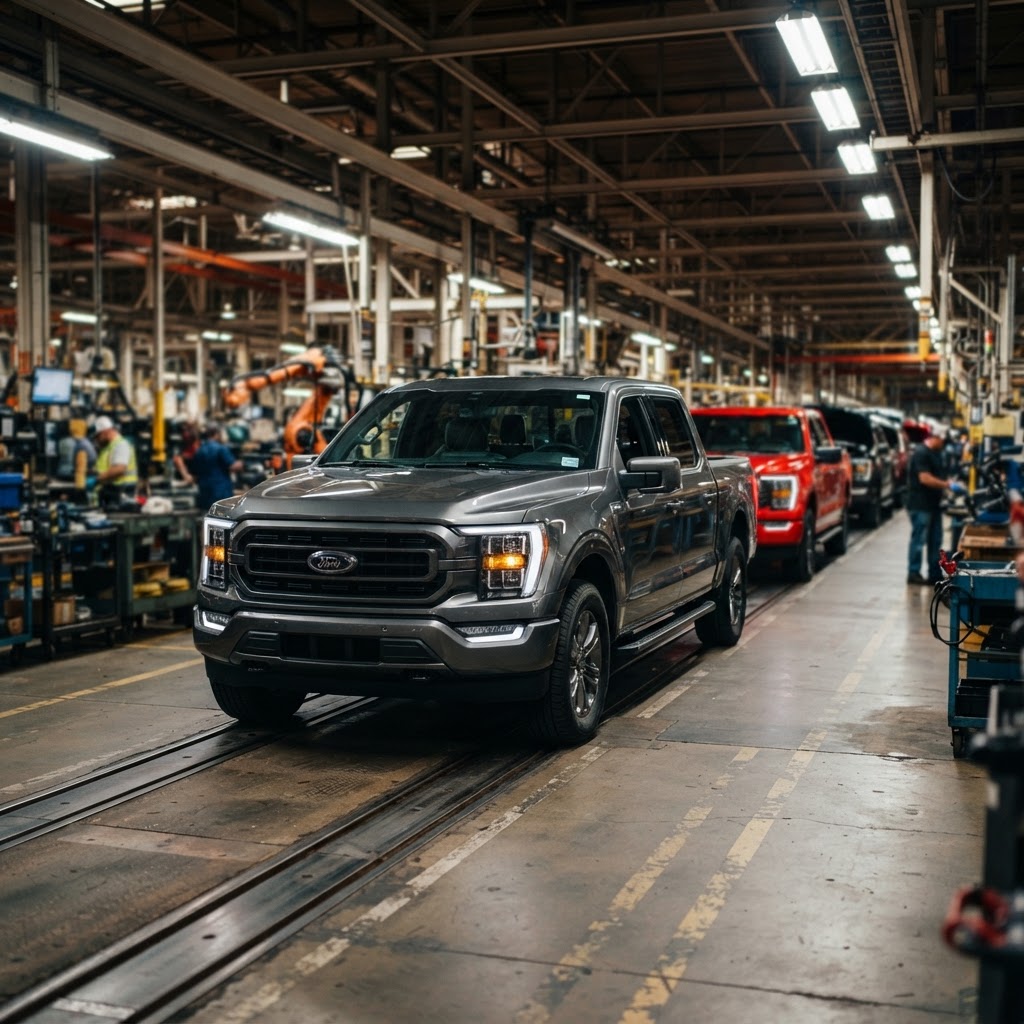
The Assembly Line Reimagined: Ford's Industrial Renaissance
For over a century, the assembly line has been synonymous with Ford Motor Company. From Henry Ford's revolutionary moving line in Highland Park to today's AI-assisted robotic welding stations, Ford has always treated manufacturing as a competitive weapon. But the pressure to electrify, digitize, and decarbonize has forced the automaker to rethink every bolt, sensor, and workflow on its factory floors.
What makes Ford's transformation remarkable is not just its scale — it is the deliberate, methodical way the company is blending legacy industrial knowledge with cutting-edge automation. For B2B manufacturing and industrial companies watching from the sidelines, Ford's playbook offers a masterclass in operational reinvention. The lessons here extend far beyond automotive; they apply to any company wrestling with aging infrastructure, workforce gaps, and rising customer expectations.
This case study unpacks Ford's assembly line modernization strategy, examines the technologies driving change, and extracts actionable insights for industrial leaders ready to accelerate their own transformations.
Ford's Manufacturing Operations: Scale, Complexity, and the Pressure to Evolve
Ford operates more than 50 manufacturing facilities worldwide, employing roughly 174,000 people globally as of its 2025 Annual Report. In North America alone, the company manages an intricate web of stamping plants, engine facilities, final assembly sites, and EV battery plants. That scale creates enormous operational inertia — but it also creates enormous opportunity when modernization efforts take hold.
In 2024, Ford reported total revenues of approximately $185 billion, with its Ford Pro commercial vehicle segment emerging as the highest-margin division. Ford Pro — which serves fleet operators, contractors, and industrial buyers — grew its EBIT margin to nearly 15% in 2024, underscoring how operational efficiency directly translates to profitability. The segment shipped over 560,000 Super Duty trucks in 2024, many of which rolled off lines that had been upgraded with new automation and quality-sensing technology.
Ford's BlueOval City complex in Tennessee, a $5.6 billion investment, represents the most visible symbol of this manufacturing overhaul. Designed as a fully integrated EV and battery production campus, it is expected to employ up to 6,000 workers and produce the next-generation F-Series electric truck at scale when full production ramps. The facility is being built from the ground up with Industry 4.0 principles embedded into its architecture.
Despite strong pockets of performance, Ford also faced a stark reminder of the cost of manufacturing complexity. In 2024, the company's warranty and quality costs exceeded $7 billion — a figure that CEO Jim Farley publicly cited as unacceptable and a direct driver of the assembly line modernization agenda. Reducing that number is not just a financial imperative; it is the strategic north star guiding Ford's investment in smarter manufacturing.
Technology and Process Innovation: AI, Cobots, and the Digital Thread
Ford's modernization strategy rests on three technological pillars: artificial intelligence-driven quality control, collaborative robotics (cobots), and a digital thread that connects every stage of the production process. Together, these tools are transforming the assembly line from a sequential, human-dependent process into an adaptive, data-driven system.
In 2024 and into 2025, Ford deployed AI-powered vision systems across multiple stamping and body-shop operations. These systems inspect parts at speeds and accuracy levels no human inspector can match — analyzing up to 1,000 data points per component in milliseconds. Ford reported that pilot programs using these systems at its Michigan Assembly Plant reduced surface defect escape rates by over 20% within the first six months of deployment, directly contributing to lower warranty exposure.
On the robotics front, Ford has expanded its cobot workforce significantly. Unlike traditional industrial robots that operate behind safety cages, cobots work side-by-side with human assemblers, handling repetitive or ergonomically stressful tasks such as torque application, wire harness routing, and adhesive dispensing. Ford's 2025 manufacturing operations report noted that cobot deployment in its Kansas City Assembly Plant improved line throughput by approximately 12% while reducing musculoskeletal injury rates among workers by 18% year-over-year — a win for both productivity and worker well-being.
Perhaps the most transformative initiative is Ford's digital thread program, which creates a continuous data link from product design through manufacturing execution and into field performance. By connecting CAD models, manufacturing execution systems (MES), and telematics data from vehicles already on the road, Ford's engineers can identify design-driven quality issues and push corrective actions back upstream to the assembly line within days rather than model-year cycles. This closed-loop feedback system is estimated to save Ford hundreds of millions of dollars annually by catching issues before they become recall events.
For industrial companies evaluating digital transformation investments, Ford's digital thread demonstrates that data integration — not just data collection — is where the real value lies.
Marketing and Growth Lessons for Industrial Companies
Ford's manufacturing transformation is not just an operational story — it is a marketing story. The company has been deliberate about communicating its factory modernization efforts to B2B customers, particularly fleet buyers and commercial operators who care deeply about product reliability and total cost of ownership. Ford Pro's dedicated sales and service ecosystem, including its FordPro.com platform and software tools for fleet telematics, signals that industrial buyers are willing to pay premium prices when they trust the underlying manufacturing quality.
For manufacturing and industrial companies, the lesson is clear: operational excellence is a marketable asset. If your production processes have improved — lower defect rates, faster lead times, better traceability — those improvements should be quantified and communicated to your customers. Too many industrial suppliers modernize their operations internally without ever translating those gains into customer-facing value propositions.
Ford's Ford Pro playbook shows that framing manufacturing quality as a service and reliability guarantee can command higher margins.
Ford also invested heavily in thought leadership around its EV and manufacturing transformation, publishing detailed progress updates on BlueOval City, hosting media days at upgraded facilities, and positioning its manufacturing engineers as industry voices at events like the Manufacturing Leadership Summit. This transparency built buyer confidence during a period when EV reliability concerns were widespread. Industrial companies launching new capabilities or technologies should consider similar transparency campaigns — letting prospects see inside your operations builds trust faster than any brochure.
Finally, Ford's Ford Pro segment demonstrates the power of vertical focus. Rather than marketing trucks generically, Ford built a dedicated B2B brand, sales force, software suite, and service network around commercial buyers. Industrial companies serving specific verticals — construction, logistics, energy — can apply the same logic: deep vertical specialization creates stickier customer relationships and higher switching costs than broad, horizontal positioning ever will.
Future Outlook and Strategic Implications for Industrial Leaders
Ford's assembly line modernization is not a one-time project — it is an ongoing capability-building program. Looking into 2025 and 2026, the company has signaled continued investment in generative AI for manufacturing process optimization, expanded use of digital twins across its global plant network, and deeper integration between its supply chain systems and factory floor execution tools. Ford's goal is to reduce vehicle launch complexity and compress the time from design freeze to full-rate production by 25% compared to 2024 launch benchmarks.
The competitive implications for Ford's supply base are significant. Tier-1 and Tier-2 suppliers are increasingly being evaluated not just on price and quality, but on their own digital maturity. Ford has rolled out supplier scorecards that include metrics around production transparency, data-sharing capability, and defect traceability.
Suppliers who cannot demonstrate connected manufacturing capabilities risk losing preferred-supplier status — a dynamic that is already reshaping the industrial supply chain landscape in 2025 and 2026.
For industrial companies outside the automotive sector, Ford's trajectory is a leading indicator of where all advanced manufacturing is heading. Whether you produce industrial pumps, aerospace components, medical devices, or packaging equipment, your customers will soon demand the same data transparency, quality traceability, and rapid response that Ford is building into its own supply chain expectations. The window to build those capabilities proactively — before customers demand them — is narrowing.
The bottom line is this: the companies that treat manufacturing modernization as a strategic growth lever, not just a cost-reduction exercise, will capture disproportionate market share over the next five years. If your organization has not yet mapped out a digital manufacturing roadmap, now is the time to start. Reach out to an industrial technology partner, audit your current production data infrastructure, and benchmark your capabilities against the leaders in your sector.
The assembly line of the future is being built today — and the companies building it are winning.
Key Takeaways
- Ford's warranty and quality costs exceeded $7 billion in 2024, making assembly line modernization a direct financial imperative — not just a technology trend.
- Ford Pro's commercial vehicle segment achieved nearly 15% EBIT margin in 2024, demonstrating that manufacturing excellence translates directly into premium pricing power.
- AI-powered vision systems at Ford's Michigan Assembly Plant reduced surface defect escape rates by over 20% within six months of deployment in 2024.
- Cobot deployment at Ford's Kansas City Assembly Plant improved throughput by approximately 12% and reduced musculoskeletal injuries by 18% year-over-year in 2025.
Key Quotes
"Our ambition is to be the best-built, highest-quality vehicles in our segment — and that starts on the factory floor, not in the showroom." — Jim Farley, President and CEO, Ford Motor Company
"The digital thread is not a nice-to-have anymore. It is the backbone of how we connect design, manufacturing, and the customer experience into a single continuous loop." — Lisa Drake, Vice President of EV Industrialization, Ford Motor Company
References
- Ford Motor Company 2024 Annual Report — covers full-year revenue, segment performance, warranty costs, and manufacturing investment priorities
- Ford BlueOval City Project Overview — details the $5.6 billion Tennessee EV campus including employment projections and production targets
- Manufacturing Leadership Network — Ford Digital Thread Coverage — industry analysis of Ford's digital manufacturing strategy and its implications for industrial suppliers