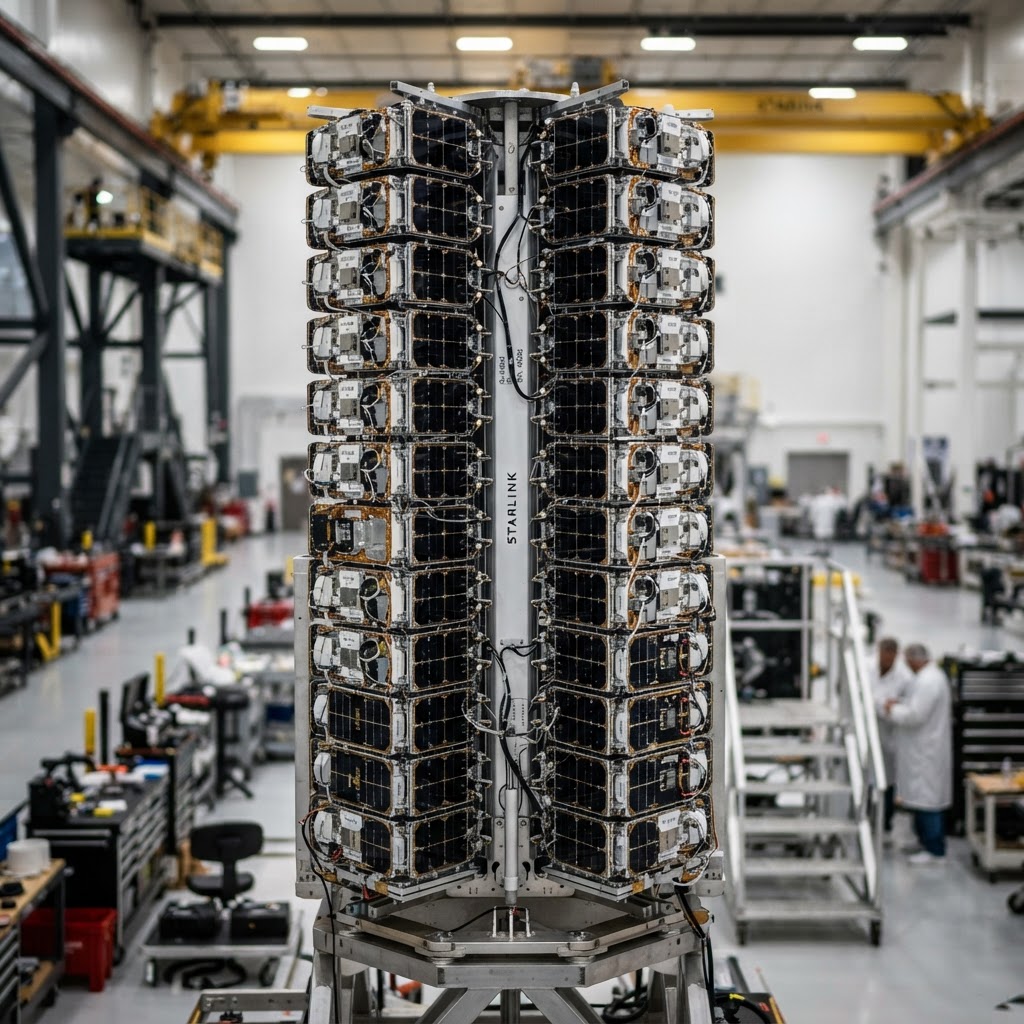
The Factory That Builds the Future One Satellite at a Time
In an era when most manufacturers celebrate producing hundreds of units per year, SpaceX is assembling satellites at a rate that makes traditional aerospace engineers question everything they know. The Starlink program has transformed what was once considered an impossible production challenge into a repeatable, scalable industrial process. For manufacturing and industrial companies watching from the sidelines, the lessons embedded in SpaceX's approach are too valuable to ignore.
Starlink is no longer just a broadband internet project — it is a living proof-of-concept for next-generation manufacturing at scale. With thousands of satellites already in low-Earth orbit and more launching every few weeks, SpaceX has built what many analysts now call the most ambitious production system in aerospace history. The company's Redmond, Washington facility and its Starbase complex in Texas serve as the twin engines of this industrial marvel.
What sets SpaceX apart is not just the technology inside each satellite — it is the philosophy governing how those satellites are designed, built, tested, and launched. This report breaks down how SpaceX scales Starlink satellite cluster manufacturing and what industrial and manufacturing companies can take away from this extraordinary operation.
Inside SpaceX's Starlink Production Machine: Numbers That Demand Attention
SpaceX has been producing Starlink satellites at a pace that surpasses most automotive component suppliers, let alone aerospace manufacturers. By late 2024, the company had launched more than 6,700 Starlink satellites into orbit, with its constellation expanding rapidly toward its licensed capacity of over 12,000 units under the current FCC authorization — and potentially 42,000 under future expansion plans. Production estimates from industry observers suggest SpaceX was manufacturing between 40 and 60 satellites per week at peak throughput in 2024.
The financial scale behind this output is equally striking. Starlink's revenue was estimated to exceed $8 billion annually by mid-2025, according to analyst projections cited by Bloomberg and Reuters, representing year-over-year growth of more than 35% compared to 2024 figures. This revenue trajectory has allowed SpaceX to reinvest aggressively in manufacturing capacity, automation tooling, and supply chain infrastructure.
The self-funding loop — where operational revenue fuels more production investment — is a textbook example of vertical integration done right.
Each generation of Starlink satellite has shrunk in cost and complexity while growing in capability. The Starlink v2 Mini satellites launched throughout 2024 and 2025 offer roughly four times the bandwidth capacity of earlier variants, yet the production line accommodating them was redesigned to reduce unit assembly time by an estimated 30%. SpaceX does not publicly disclose per-unit costs, but industry analysts at Quilty Space estimated in 2025 that production costs per satellite had dropped below $500,000, down significantly from earlier generations.
SpaceX's manufacturing footprint spans multiple facilities, with the Redmond campus focused on satellite electronics and payload integration, while Starbase in Boca Chica, Texas handles final assembly and launch operations. The tight geographic coupling between production and launch infrastructure eliminates costly logistics delays that plague traditional aerospace supply chains. This integrated campus model directly reduces lead time from build completion to orbital deployment.
Engineering the Assembly Line: Vertical Integration and Iterative Design
One of SpaceX's most powerful manufacturing strategies is its aggressive pursuit of vertical integration. Rather than outsourcing critical components to tier-one aerospace suppliers — as Boeing, Lockheed, or Northrop Grumman routinely do — SpaceX designs and manufactures most of Starlink's key subsystems in-house. This includes the phased-array antennas, the custom Starlink application-specific integrated circuits (ASICs), the Hall-effect ion thrusters, and the laser inter-satellite link hardware introduced in the v2 generation.
This vertical integration approach gives SpaceX complete control over its bill of materials, enabling rapid design iteration without waiting for external suppliers to retool. The company famously treats its products as software — releasing new hardware versions in rapid cycles rather than locking into multi-year procurement contracts. Between 2024 and 2025 alone, SpaceX refined the Starlink v2 design at least twice based on on-orbit performance telemetry fed back into the engineering and manufacturing teams in near real time.
Automation is another pillar of the SpaceX production model. The company invested heavily in custom robotic assembly cells throughout 2024, with automated optical inspection systems verifying solder joints and component placement at speeds no human team could match for quality consistency. Industry reports from the Manufacturing Leadership Council noted in 2025 that SpaceX's satellite assembly automation rate was among the highest in the aerospace sector, estimated at over 70% of repetitive assembly tasks.
The Falcon 9 rocket — the primary Starlink delivery vehicle — is itself a masterpiece of reuse economics that amplifies the manufacturing ROI. By 2025, individual Falcon 9 boosters were routinely completing 20 or more flights, with turnaround times between launches measured in days rather than months. Each reuse cycle dramatically reduces the cost per kilogram to orbit, making it economically viable to keep launching new and replacement satellites at the cadence Starlink demands.
What Industrial Companies Can Learn From SpaceX's Scaling Playbook
SpaceX's manufacturing model offers a set of transferable lessons that industrial companies in sectors ranging from heavy equipment to precision components can immediately begin applying. The first lesson is the compounding advantage of vertical integration. Companies that bring critical subcomponent manufacturing in-house gain design flexibility, supply chain resilience, and cost transparency that outsourced models simply cannot match.
In a post-2024 world still managing supply chain fragility, this matters enormously.
The second lesson is the value of treating hardware like software — designing for iteration rather than perfection at launch. Traditional manufacturing culture often demands that a product design be locked before tooling investment begins. SpaceX inverts this logic by designing modular, upgradeable assemblies and accepting that version 1.0 will be improved on the production floor within months.
For industrial manufacturers, adopting a modular design architecture can reduce retooling costs while accelerating time-to-improvement.
The third lesson is the strategic power of data-driven production feedback loops. SpaceX captures telemetry from every satellite in orbit and feeds anomalies directly to the engineering and manufacturing teams. Industrial manufacturers can replicate this model using Industrial IoT sensors, digital twin simulations, and real-time quality analytics on the production floor.
Companies that close the loop between field performance and factory process are consistently outperforming peers on quality metrics and warranty costs.
Finally, SpaceX demonstrates that marketing and operational excellence are inseparable. Starlink's subscriber growth — which surpassed 4.6 million users globally by mid-2025 — is a direct function of the company's ability to manufacture and deploy capacity faster than demand can saturate any given market. For B2B industrial companies, the message is clear: your production scalability is your market differentiation.
If your operations team can deliver at the speed your sales team promises, you own the relationship. Audit your production throughput today and identify the bottlenecks standing between your current capacity and your next growth milestone.
The Road Ahead: Strategic Implications for the Industrial Sector
Looking forward into 2026 and beyond, SpaceX is preparing to expand Starlink's second-generation constellation with the much larger Starlink v2 full-size satellites, designed for launch aboard the Starship vehicle. These satellites are significantly heavier and more capable than the v2 Mini variants, and their production will require SpaceX to further scale its manufacturing operations at Starbase. The company has signaled plans to co-locate expanded satellite production directly adjacent to the Starship launch facilities, further compressing the logistics chain.
The competitive landscape is also intensifying. Amazon's Project Kuiper launched its first production satellites in 2024 and accelerated deployment through 2025, while European operator Eutelsat OneWeb continued its own LEO buildout. This competitive pressure will force SpaceX to push manufacturing efficiency even harder, likely accelerating its automation investments and driving per-unit costs lower.
For industrial manufacturers tracking the sector, this dynamic mirrors competitive pressures in automotive, semiconductor, and industrial robotics markets — industries where manufacturing efficiency determines market survival.
For the broader manufacturing sector, the Starlink story illustrates that the line between a technology company and a manufacturing company is rapidly dissolving. The most competitive industrial firms of the next decade will operate with the data velocity of a software company and the physical precision of a tier-one manufacturer. Investments in digital twin technology, AI-assisted quality control, and advanced robotics are not optional upgrades — they are table stakes for companies aspiring to compete at the frontier.
The strategic implication for industrial leaders is direct: the companies that study and adapt the SpaceX manufacturing model — vertical integration, iterative design, automation, and closed-loop data feedback — will be the ones setting the pace in their respective markets over the next five years. The window to begin that transformation is now, not after your most aggressive competitor has already closed the gap.
Key Takeaways
- SpaceX was producing an estimated 40–60 Starlink satellites per week at peak 2024 throughput, a rate unmatched in commercial aerospace manufacturing history.
- Starlink revenue exceeded an estimated $8 billion annually by mid-2025, with year-over-year growth of more than 35% compared to 2024, funding continuous production reinvestment.
- Analyst estimates from Quilty Space in 2025 placed per-satellite production costs below $500,000, down significantly from earlier generations due to design iteration and automation.
- Individual Falcon 9 boosters were completing 20 or more flights by 2025, with turnaround times measured in days, reducing cost-per-kilogram to orbit and making high-cadence satellite deployment economically viable.
Key Quotes
"Starlink is not just a satellite constellation — it is the most sophisticated high-volume manufacturing and logistics operation ever attempted in the space industry." — Gwynne Shotwell, President and COO, SpaceX
"The way SpaceX has approached satellite manufacturing — treating it more like consumer electronics production than traditional aerospace — is genuinely reshaping what's possible in this industry." — Chad Anderson, Managing Partner, Space Capital
References
- Bloomberg Technology — SpaceX Starlink Revenue Projections 2025 — Covers analyst revenue estimates and Starlink subscriber growth data through early 2025.
- Quilty Space — Satellite Manufacturing Cost Analysis — Industry research firm covering per-unit satellite production cost trends and competitive LEO constellation economics.
- Manufacturing Leadership Council — Aerospace Automation Report 2025 — Covers automation adoption rates across aerospace and defense manufacturing sectors including SpaceX benchmarking data.