The Architecture of Industrial Velocity
In an era where industrial agility defines market dominance, Tesla has rewritten the playbook for large-scale hardware manufacturing. By treating the factory itself as a product, the company has achieved production benchmarks that were previously thought impossible in the automotive sector. For B2B manufacturing leaders, the Gigafactory model offers a masterclass in operational efficiency and vertical integration.
Moving beyond traditional lean manufacturing, Tesla has pioneered a 'first-principles' approach to the assembly line. This strategy prioritizes engineering simplicity, modular design, and aggressive automation to reduce lead times. As industrial companies face mounting pressure to accelerate time-to-market, the lessons from Tesla’s Giga-complexes provide a roadmap for scaling production in the mid-2020s.
Deciphering the Gigafactory Production Machine
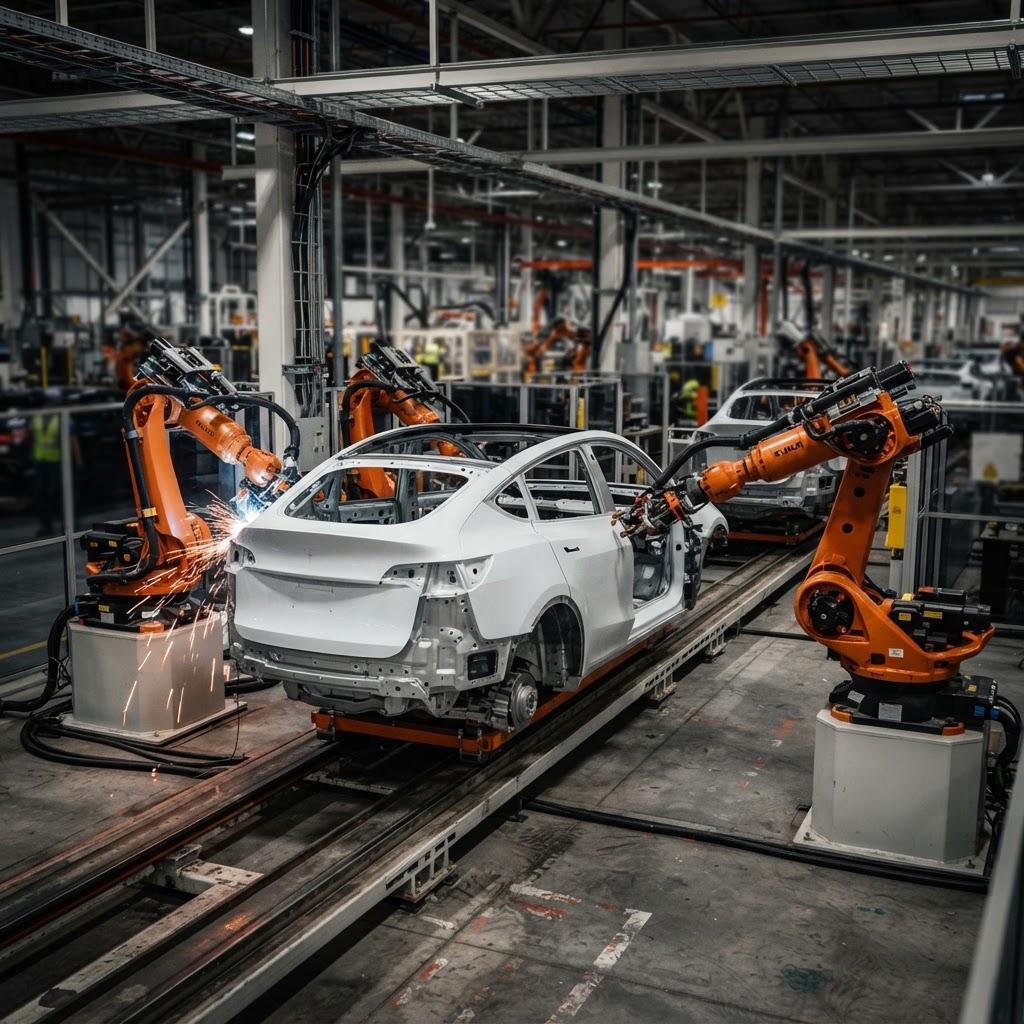
Tesla’s manufacturing footprint has expanded significantly, with Giga Texas and Giga Berlin serving as the focal points of its 2025-2026 production strategy. By 2025, Tesla reported an installed annual production capacity exceeding 2.35 million vehicles globally. This massive scale is supported by localized, high-speed automated lines that minimize the physical footprint of the production process while maximizing throughput.
The core of this machine lies in 'Giga-casting,' a process that replaces dozens of individual sub-assemblies with a single, massive die-cast component. By reducing the number of parts in a vehicle chassis by over 70%, Tesla has achieved substantial labor savings and reduced factory floor space requirements. For industrial B2B firms, this represents a shift toward component consolidation as a primary driver of cost reduction and quality control.
Furthermore, the integration of real-time telemetry across the factory floor allows for immediate identification of bottlenecks. Every robot and conveyor system is connected to a centralized data hub, enabling predictive maintenance that prevents costly downtime. As of late 2025, data indicates that these smart-factory initiatives have contributed to a 15% reduction in overall operating expenses per unit compared to industry averages for traditional legacy automakers.
Innovation through Advanced Systems Integration
Tesla’s commitment to innovation is not limited to the product itself but extends to the software orchestrating the manufacturing environment. By utilizing proprietary manufacturing execution systems (MES), Tesla ensures that every station on the production line is synchronized with supply chain availability. This level of coordination is critical for managing the complexity of electric vehicle assembly, where battery pack integration requires precise thermal and electrical testing at scale.
The company’s investment in artificial intelligence for quality inspection has also set a new standard for the industry. Advanced computer vision systems now inspect every weld and seal on the assembly line, identifying structural anomalies with a precision rate exceeding 99.8%. This level of automation reduces the reliance on manual rework, which is a major factor in improving final vehicle yield rates and ensuring consistent quality output across global sites.
Beyond inspection, Tesla has optimized its logistics through automated guided vehicles (AGVs) that manage material flow between warehouses and assembly cells. In 2026, internal reports highlighted that internal logistics automation has led to a 20% increase in inventory turnover rates. By reducing the idle time of components on the factory floor, Tesla maintains a leaner balance sheet while ensuring that high-demand parts are always available when needed.
Strategic Growth Lessons for the Industrial Sector
For B2B manufacturing leaders, the most vital lesson from Tesla is the necessity of radical vertical integration. While many industrial firms continue to rely on long, fragile global supply chains, Tesla has aggressively brought critical processes in-house, including battery chemistry research and sub-assembly fabrication. This strategy provides insulation against external supply chain volatility and grants the company full control over its production roadmap.
Another critical takeaway is the 'product-as-a-factory' philosophy, where the manufacturing process is iterated upon with the same frequency as the product design. Industrial companies often treat capital expenditures for factory equipment as fixed and static, but Tesla’s approach treats them as dynamic assets. By continuously tweaking assembly line hardware, companies can unlock incremental capacity gains without the need for massive new facility investments.
Finally, the emphasis on data-driven culture remains a cornerstone of Tesla’s growth. Every manager and engineer has access to the same live dashboards regarding yield, uptime, and energy consumption. This radical transparency eliminates silos and aligns the entire organization around a single set of key performance indicators (KPIs).
For any industrial firm looking to modernize, democratizing operational data is the first step toward significant performance improvement.
The Strategic Outlook for 2027 and Beyond
Looking toward the future, Tesla is doubling down on its 'Unboxed' manufacturing process, which aims to further reduce factory size and operational costs by rethinking the sequence of vehicle assembly. This strategic shift indicates that the company is moving toward even greater levels of modularity, where parts are painted or finished before the final shell is even joined together. Industrial manufacturers should view this as a signal that the future of factory design is about flexibility and non-linear workflows.
As Tesla continues to integrate humanoid robotics into the factory environment, the next phase of manufacturing will be defined by labor augmentation. The goal is not just to replace tasks but to create a symbiotic relationship between machine intelligence and skilled human labor. For B2B firms, preparing for this shift means investing in workforce training that prioritizes the management of autonomous systems over traditional assembly roles.
To compete in this new landscape, industrial leaders must audit their current production models against these benchmarks of efficiency, integration, and data maturity. The cost of standing still is no longer just lost market share; it is the total erosion of competitive advantage in an accelerating market. Contact our consulting team today to schedule a comprehensive evaluation of your production line automation and see how you can implement Gigafactory-style efficiencies in your own operations.
Key Takeaways
- Tesla reached an installed global production capacity of over 2.35 million vehicles annually as of early 2026.
- Implementing Giga-casting techniques has reduced structural part counts by over 70%, drastically streamlining assembly workflows.
- Integration of AI-driven computer vision in quality assurance has achieved anomaly detection precision rates exceeding 99.8%.
- Internal logistics automation and high-velocity inventory management contributed to a 20% improvement in annual inventory turnover rates.
Key Quotes
"The factory is the product, and every iteration of our assembly line must be as innovative as the vehicle rolling off it." — Elon Musk, CEO of Tesla
"Vertical integration is not just about ownership; it is about controlling the physics of the manufacturing process to eliminate waste." — Drew Baglino, SVP of Powertrain and Energy
References
- Tesla 2025 Impact Report — Detailed analysis of manufacturing scaling and sustainability targets.
- Industrial Automation Today 2026 — Review of global robotics implementation in automotive assembly.
- Global Supply Chain Monitor 2026 — Coverage on how vertical integration mitigates global volatility.