The Factory Floor of the Future Is Already Running
In an era where supply chain resilience and advanced manufacturing define competitive advantage, one company continues to set the standard for industrial complexity at scale. Intel's semiconductor fabrication plants — known as fabs — represent some of the most sophisticated manufacturing environments on earth, where transistors are measured in angstroms and yields are tracked to fractions of a percent.
For B2B leaders in manufacturing and industrial sectors, Intel is more than a chip company. It is a living case study in precision engineering, capital discipline, and technology-driven market positioning. Understanding how Intel builds, scales, and markets its fab operations offers a powerful lens for any industrial executive looking to sharpen their own strategy.
This guide breaks down Intel's semiconductor manufacturing model, the innovations driving its next chapter, and the actionable lessons your organization can apply — whether you produce automotive components, industrial machinery, or advanced materials.
Intel's Fabrication Network: Scale, Investment, and Output
Intel operates one of the largest semiconductor fabrication networks in the Western world. As of 2025, the company runs major fab clusters in Oregon, Arizona, New Mexico, Ireland, and Israel, with its Ohio fab complex — dubbed "New Albany" — representing a landmark $28 billion investment that began initial production phases in 2025. This single site is projected to eventually span 1,000 acres and house multiple leading-edge fabs.
Intel's manufacturing ambition is backed by serious capital allocation. The company reported capital expenditures of approximately $25.8 billion in its fiscal year 2024 annual report, with the majority directed toward fab construction, tooling, and process node development. Intel Foundry Services — the external customer-facing arm of Intel's manufacturing division — is being positioned as a top-two global foundry by 2030, directly competing with TSMC and Samsung.
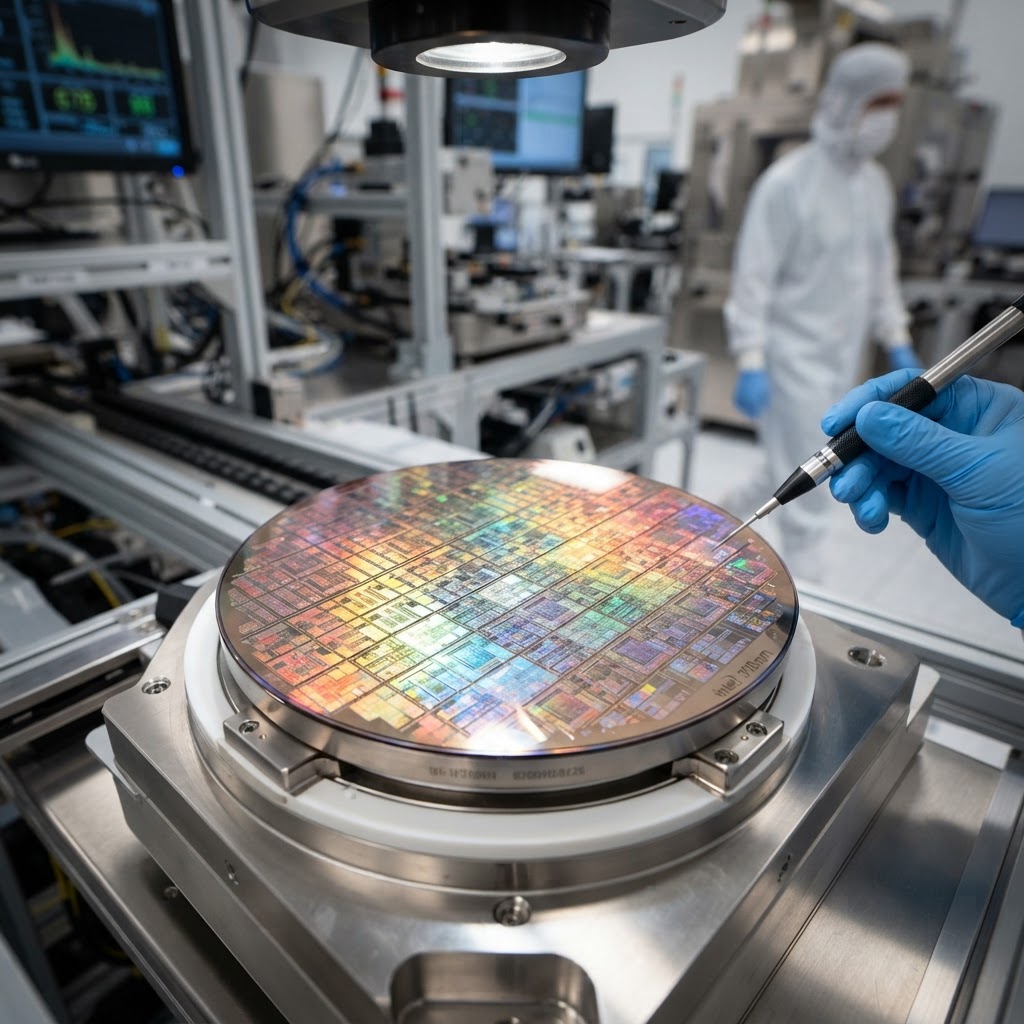
The scale of Intel's output is staggering from an industrial standpoint. A single Intel fab can process hundreds of thousands of 300mm wafers per year, with each wafer containing billions of transistors manufactured using extreme ultraviolet (EUV) lithography. Intel's 18A process node, scheduled for high-volume manufacturing ramp in 2025, features gate-all-around (GAA) transistors with RibbonFET architecture — a structural shift not seen since the introduction of FinFET technology.
Intel's total revenue in fiscal year 2024 was reported at approximately $53.1 billion, with Intel Foundry representing a growing segment as external customers begin qualifying Intel's process nodes. The operational complexity required to sustain this level of output — managing thousands of process steps per wafer, coordinating global logistics, and maintaining sub-nanometer tolerances — makes Intel's fabs a benchmark for industrial excellence.
From EUV to RibbonFET: How Intel's Process Innovation Sets a New Standard
At the heart of Intel's competitive strategy is an unwavering commitment to process technology leadership. The transition to Intel 18A — the company's most advanced node as of 2025 — marks a pivotal moment in its "Five Nodes in Four Years" acceleration plan, which Intel announced to close the gap with competitors after a period of manufacturing delays. Intel confirmed in early 2025 that 18A had achieved a critical "risk production" milestone, with multiple cloud and enterprise customers participating in early qualification.
EUV lithography is the enabling technology behind these advancements. Intel's fabs in Hillsboro, Oregon, house some of the world's most advanced ASML EUV machines, each costing upward of $150 million per unit. EUV allows chipmakers to pattern features on silicon with wavelengths of just 13.5 nanometers, enabling the density improvements that power AI accelerators, data center CPUs, and next-generation mobile processors.
Beyond lithography, Intel has invested heavily in backside power delivery — branded as PowerVia — which routes power through the back of the chip rather than competing with signal wires on the front. This architectural innovation improves power efficiency and performance density by significant margins. Intel demonstrated a functioning test chip using PowerVia in 2024, confirming the technology's readiness for integration into the 18A node roadmap.
Process innovation at Intel is not siloed within R&D — it is deeply integrated with manufacturing operations. Intel employs over 50,000 manufacturing and process engineers globally, and its copy-exactly manufacturing philosophy ensures that process recipes developed in Oregon are replicated with precision at fabs in Arizona, Ireland, and beyond. This approach reduces variability, accelerates yield ramp, and guarantees consistent quality for customers purchasing Intel Foundry services.
What Industrial Companies Can Learn From Intel's Fab Marketing Playbook
Intel's pivot to positioning itself as a foundry partner — not just a product company — is one of the most significant B2B marketing transformations in the industrial technology sector. By launching Intel Foundry as a distinct business unit with its own brand architecture, customer engagement model, and process node roadmap, Intel separated its manufacturing capability narrative from its consumer-facing chip products. This is a critical lesson: your manufacturing process is a product in itself.
Intel has invested significantly in educating its B2B audience through technical documentation, process design kits (PDKs), and direct engagement with fabless chip designers and systems companies. In 2024 and 2025, Intel held dedicated Intel Foundry Connect events globally, bringing together potential customers, ecosystem partners, and EDA tool vendors. For industrial manufacturers, this model of "ecosystem marketing" — where you build a platform and invite partners to build on it — creates stickiness and brand loyalty that transactional sales motions cannot achieve.
Data transparency is another pillar of Intel's B2B approach. Unlike many industrial suppliers who guard process performance data, Intel has published detailed process performance indicators for 18A, including power-performance-area (PPA) metrics, in order to accelerate customer design starts. This openness signals confidence in the product and lowers the friction for engineers making foundry selection decisions.
Industrial companies should consider what data they can share proactively to build trust with procurement and engineering stakeholders.
Finally, Intel's narrative around domestic manufacturing resilience — amplified by alignment with the U.S. CHIPS and Science Act, under which Intel received approximately $8.5 billion in direct funding commitments in 2024 — gives the company a powerful differentiation story. For industrial manufacturers, connecting your capabilities to national supply chain security, sustainability goals, or workforce development is not just good PR; it is a B2B positioning strategy that resonates deeply with enterprise buyers and government procurement officers in today's geopolitical environment.
The Road Ahead: Strategic Implications for Industrial Technology Leaders
Intel's trajectory through 2026 and beyond signals a broader shift in how advanced manufacturing companies will compete. The convergence of AI workloads, edge computing, and sovereign semiconductor policy means that fab capacity, process differentiation, and trusted supply chains will be more valuable than ever. Industrial technology companies that understand this shift and align their capabilities accordingly will capture disproportionate value.
For companies in the industrial supply chain — materials suppliers, equipment vendors, precision fabricators, or logistics providers — Intel's expansion represents a significant demand signal. Intel's Ohio investment alone is expected to create over 10,000 direct and indirect jobs, and the ecosystem of suppliers required to support a leading-edge fab campus is vast. Companies that proactively align their offerings with the needs of semiconductor manufacturers — from ultra-pure water systems to vibration-isolated tooling platforms — will find themselves in high-demand markets with strong pricing power.
Intel's transformation also illustrates the strategic importance of long-horizon capital planning. Its current fab buildout requires decade-scale ROI thinking, where investments made today in 18A capacity will generate returns well into the 2030s. Industrial leaders who resist pressure for short-term optimization and instead invest in capability-building — advanced automation, process digitization, workforce upskilling — will be better positioned to win in markets that reward precision and reliability above price alone.
If your organization is looking to benchmark its manufacturing strategy, improve its B2B positioning, or identify growth opportunities in the industrial technology sector, Intel's fab model provides a detailed and actionable blueprint. Start by auditing your own operations: where is your equivalent of RibbonFET — the process innovation that changes the competitive equation? Define it, invest in it, and build your marketing narrative around it.
Key Takeaways
- Intel committed approximately $25.8 billion in capital expenditures in fiscal year 2024, underscoring that manufacturing leadership requires sustained, long-cycle investment — not quarterly optimization.
- Intel's 18A process node incorporates both RibbonFET (gate-all-around) transistors and PowerVia backside power delivery, representing the most significant structural change in transistor architecture in over a decade.
- Intel received approximately $8.5 billion in CHIPS Act direct funding commitments in 2024, demonstrating how alignment with national industrial policy can unlock transformative capital and market positioning advantages.
- Intel Foundry's ambition to become a top-two global foundry by 2030 shows that even dominant industrial companies must reinvent their go-to-market model to remain relevant as market structures shift.
Key Quotes
"We are building the most advanced semiconductor manufacturing in the Western world — and we are doing it at a pace and scale that will define the industry for decades." — Pat Gelsinger, Former CEO, Intel Corporation
"The CHIPS Act is not just about chips — it is about the industrial base of the United States, and Intel is at the center of rebuilding that base." — Gina Raimondo, U.S. Secretary of Commerce
References
- Intel 2024 Annual Report — Official Intel investor relations page covering fiscal year 2024 financials, capital expenditure data, and Intel Foundry segment performance.
- Intel Foundry Process and Packaging Technology Overview — Intel's official foundry technology page detailing 18A node specifications, RibbonFET, PowerVia, and process roadmap milestones.
- U.S. CHIPS and Science Act — Commerce Department Overview — U.S. Department of Commerce press release on Intel's CHIPS Act funding commitments and domestic fab investment details.