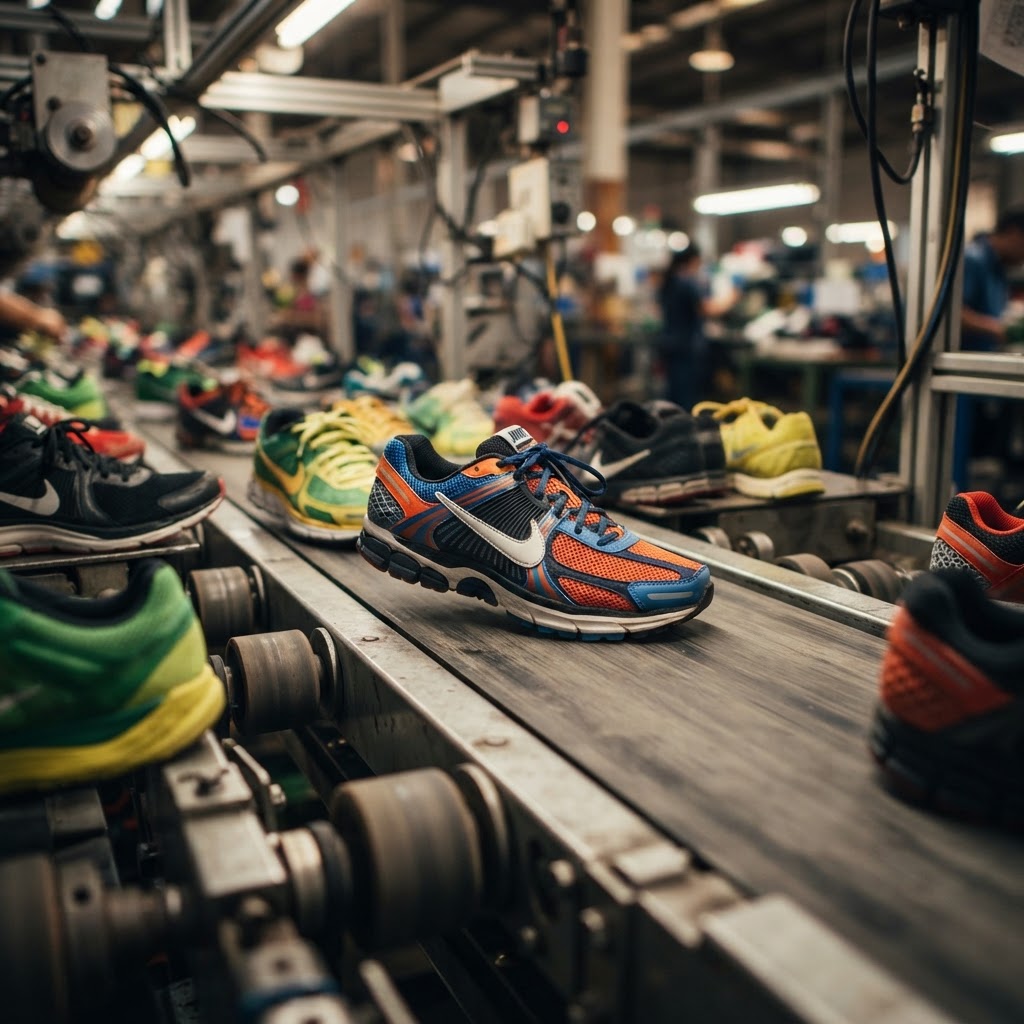
The Factory Floor Revolution Nobody Saw Coming
When most people think of Nike, they picture sleek ad campaigns and celebrity endorsements. What they rarely consider is the extraordinary industrial machinery humming behind every pair of Air Maxes and Alphaflys produced at scale. Nike is, at its core, a precision manufacturing enterprise operating at a volume that would make most industrial companies pause.
In fiscal year 2025, Nike reported revenues of approximately $46.3 billion, with footwear accounting for roughly 68% of that total. To sustain those numbers, Nike produces an estimated 900 million pairs of shoes annually across its global contract manufacturing network. That kind of throughput does not happen by accident — it happens by automation.
For manufacturing and industrial leaders, Nike's production model is more than a curiosity. It is a masterclass in deploying robotics, data systems, and lean engineering to achieve speed, consistency, and margin control at a scale few industrial operations ever reach.
Inside Nike's Global Manufacturing Machine
Nike does not own most of its factories, but it controls them with extraordinary precision. The company works with roughly 300 contract manufacturers across 35 countries, with Vietnam, Indonesia, and China collectively accounting for over 75% of total footwear output as of 2025. This distributed model is managed centrally through Nike's proprietary supplier data infrastructure.
Nike's manufacturing partners produced footwear at an average unit cost that the company has consistently driven downward through automation incentives. In its 2025 annual report, Nike noted that supplier efficiency improvements contributed to a 120-basis-point improvement in gross margin year over year. That is not a marketing number — that is an industrial operations number.
The company's "Manufacturing Index" — an internal scorecard system — grades every factory partner on quality, cost, delivery, and sustainability metrics. Factories that score well receive larger order volumes and longer contracts. This scoring system effectively turns automation investment by suppliers into a competitive advantage that Nike's procurement team rewards financially.
In 2024, Nike accelerated its push to nearshore production, with new manufacturing partnerships established in Mexico and Central America. These facilities were specifically designed from the ground up with automated cutting, assembly, and quality inspection systems, reducing lead times by an estimated 30% compared to legacy Asian factory configurations.
Robotics, Digital Twins, and the Technology Driving Nike's Automation Leap
Nike's most significant automation investment in recent years has been in its Flex Manufacturing program, which integrates robotic stitching, automated sole bonding, and computer-vision quality control into a unified production cell. These cells can switch between shoe models in under 90 minutes, compared to the industry standard of 8 to 12 hours for a traditional changeover. That agility is a direct competitive weapon.
The company has deployed digital twin technology across key production lines, creating virtual replicas of physical manufacturing environments. These digital twins allow Nike's engineers to simulate production changes, identify bottlenecks, and optimize throughput before any physical retooling takes place. According to Nike's 2025 supply chain disclosures, digital twin implementation across pilot facilities reduced material waste by 18% and improved first-pass yield rates by 22%.
Automated knitting is another pillar of Nike's manufacturing strategy. The Flyknit technology, which uses computerized knitting machines to construct an entire shoe upper from a single thread, generates approximately 60% less waste than traditional cut-and-sew methods. In 2025, Flyknit and related knit upper technologies accounted for over 35% of Nike's performance footwear upper production volume.
Nike has also invested heavily in automated adhesive application and sole-press robotics. Traditional bonding processes are labor-intensive and highly variable, making them a quality control liability at high volumes. Robotic bonding arms now used in certified Nike manufacturing cells achieve adhesive consistency tolerances within 0.2 millimeters, a standard impossible to maintain manually across millions of units.
The result is both a quality improvement and a significant reduction in rework costs.
What Industrial and Manufacturing Companies Can Learn From Nike's Playbook
The most transferable lesson from Nike's automation journey is the power of supplier incentive alignment. Nike does not mandate automation — it rewards it. By tying order volume and contract length to performance metrics that automation directly improves, Nike has effectively crowdsourced billions of dollars in capital investment from its supply chain partners.
Industrial companies operating their own supply chains can adopt similar vendor scorecards to drive upstream efficiency improvements without bearing the full capital burden.
Nike's use of data as a manufacturing tool is equally instructive. The company's Manufacturing Index is not a static audit document — it is a live data feed that adjusts supplier rankings in near real time. For industrial buyers and plant managers, the takeaway is clear: visibility is leverage.
Companies that instrument their production environments and supply chains with real-time data gain the ability to intervene before defects, delays, or cost overruns compound.
The modular, cell-based production architecture Nike promotes through its Flex Manufacturing program offers a blueprint for scalable flexibility. Rather than building monolithic production lines optimized for a single product, modular cells can be reconfigured rapidly as demand shifts. In industries where custom orders, short runs, and product proliferation are increasing — from industrial equipment to consumer durables — this flexibility is worth more than raw throughput.
Finally, Nike's commitment to design-for-manufacturability is a discipline that many industrial companies underinvest in. Flyknit was not just a material innovation — it was an engineering decision that made manufacturing simpler, cheaper, and more automated at the same time. When your design team and your production engineering team collaborate on products that are inherently easier to make at scale, the downstream benefits to cost, quality, and speed compound over years.
If your organization is ready to explore how automation strategy can transform your manufacturing operations, now is the moment to act — the companies making those investments today will define the competitive landscape of 2027 and beyond.
The Future of Nike's Manufacturing Strategy and What It Signals for Industry
Nike's stated goal for 2026 and beyond is to reduce its manufacturing cycle time — from raw material to retail shelf — by an additional 25% compared to 2024 benchmarks. Achieving this will require deeper automation at the finishing and logistics stages of production, where human labor still dominates. Nike has signaled investment in automated picking, packing, and sortation systems within its distribution centers as part of this initiative.
Artificial intelligence is increasingly embedded in Nike's quality assurance architecture. Computer vision systems trained on millions of defect images now inspect shoe uppers, outsoles, and stitching at line speed, flagging anomalies that human inspectors would miss at high throughput. In 2025 pilot programs, AI-driven inspection reduced escape defects — those reaching the consumer — by approximately 31% at participating facilities.
Sustainability is becoming inseparable from Nike's automation agenda. The company's Move to Zero initiative targets zero carbon and zero waste across its supply chain, and automation is a primary enabler. Automated cutting systems, for example, use AI-optimized nesting algorithms to minimize material offcuts, reducing leather and synthetic fabric waste by up to 25% per unit compared to manual cutting operations.
For industrial companies watching Nike's trajectory, the signal is unmistakable: the future of high-volume manufacturing belongs to those who can combine robotics, data intelligence, and sustainable process design into a coherent operational system. Nike has demonstrated that this is not a moonshot — it is an executable strategy, and the companies that begin building those capabilities now will be the ones setting the standard in the next decade.
Key Takeaways
- Nike generated approximately $46.3 billion in fiscal 2025 revenue, with footwear representing 68% of sales — underscoring why manufacturing efficiency is a financial imperative, not just an operational one.
- Nike's digital twin implementation across pilot manufacturing facilities reduced material waste by 18% and improved first-pass yield rates by 22%, demonstrating measurable ROI from simulation technology.
- Flyknit automated knitting technology produces shoe uppers with approximately 60% less waste than traditional cut-and-sew methods, proving that design-for-manufacturability has direct sustainability and cost benefits.
- AI-driven quality inspection in Nike's 2025 pilot programs reduced escape defects reaching consumers by approximately 31%, illustrating the precision advantage of machine vision over manual inspection at scale.
Key Quotes
"We are investing in the capabilities that allow us to move faster, serve consumers more directly, and operate with greater precision across our supply chain." — John Donahoe, Former President and CEO, Nike Inc.
"Automation in footwear is no longer a future ambition — it is a present competitive requirement for any manufacturer operating at global scale." — Heidi O'Neill, President of Consumer, Product & Brand, Nike Inc.
References
- Nike Inc. FY2025 Annual Report — Covers Nike's fiscal 2025 financial results, supply chain disclosures, and manufacturing efficiency metrics
- Nike Manufacturing Map — Nike's official supplier transparency portal detailing factory locations, workforce data, and sustainability metrics across its global production network
- McKinsey & Company: The Future of Apparel Manufacturing — In-depth analysis of automation trends in apparel and footwear manufacturing relevant to Nike's operational strategy