The Factory Floor as a Competitive Battlefield
In the world of large-scale manufacturing, few operations command as much attention — or generate as many lessons — as Boeing's commercial aircraft assembly lines. With billions of dollars in backlog, global supply chains spanning dozens of countries, and production targets that ripple across entire economies, Boeing operates at a scale that most industrial companies can only study from a distance. Yet the principles embedded in Boeing's assembly strategy are directly applicable to manufacturers of every size.
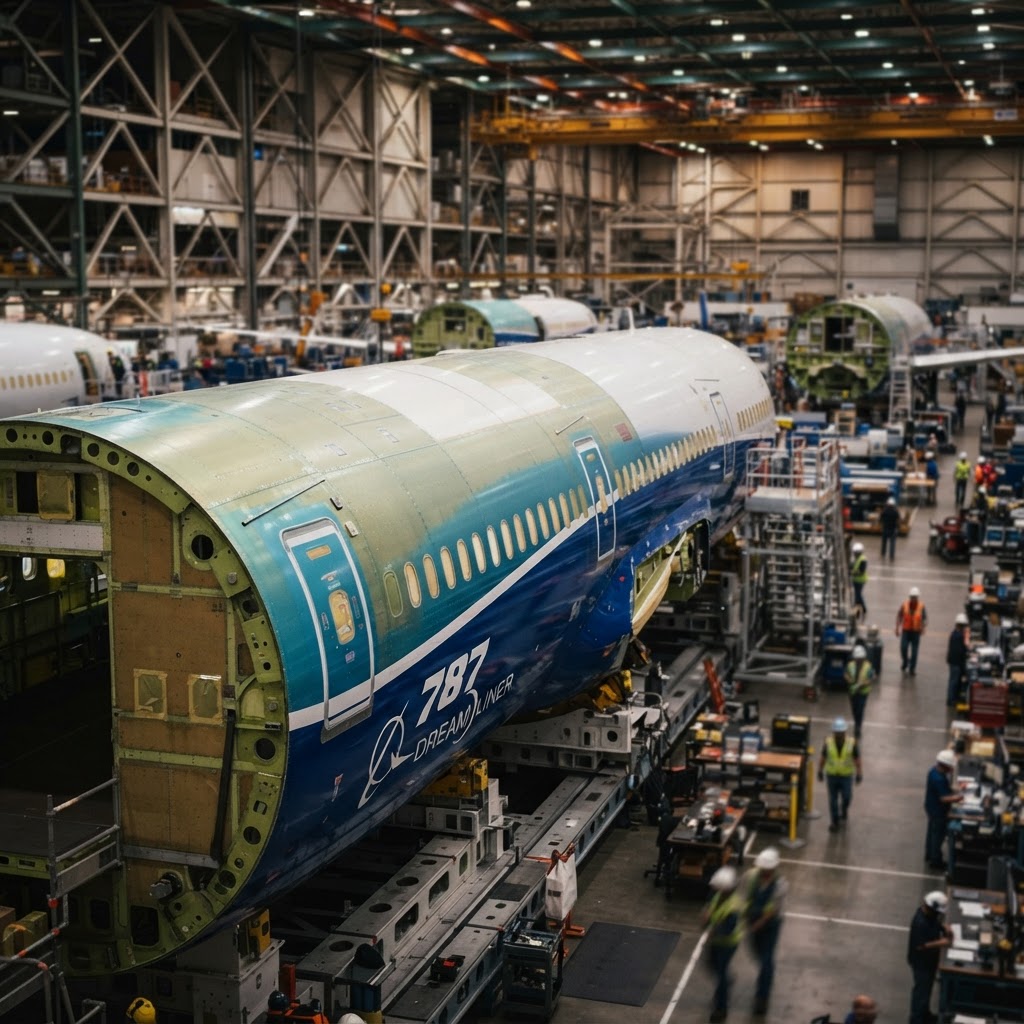
Boeing's Everett, Washington facility — home to the 777 and 787 Dreamliner programs — remains one of the largest buildings by volume in the world, spanning approximately 98.7 acres under a single roof. This isn't just a trophy asset. It is a working model of how high-complexity manufacturing can be systematized, optimized, and scaled.
For B2B industrial companies looking to benchmark their own operations, Boeing's assembly ecosystem offers a rare window into world-class production management.
The commercial aviation market is rebounding with force. Global air traffic demand has pushed airlines to accelerate fleet renewal, and Boeing sits at the center of that demand surge. Understanding how Boeing is responding — operationally, technologically, and strategically — is essential reading for any manufacturing or industrial leader charting a growth course through 2026 and beyond.
Inside Boeing's Commercial Production Engine
Boeing's 2024 Annual Report confirmed total revenues of approximately $66.5 billion, with the Commercial Airplanes segment contributing the largest share of that figure despite well-documented production headwinds. The company's backlog across commercial programs exceeded 5,600 aircraft as of early 2025, representing a contracted order book valued at over $400 billion. That backlog is both a testament to market demand and a persistent operational challenge Boeing has been working aggressively to address.
The 737 MAX program, built at Boeing's Renton, Washington facility, has been the focal point of production ramp-up efforts. In 2024, Boeing worked to stabilize 737 MAX output following regulatory scrutiny from the Federal Aviation Administration, which imposed a production cap of 38 aircraft per month for a portion of the year. By early 2025, Boeing was targeting a gradual increase toward 42 units per month, with longer-term ambitions to reach 50 per month as quality control systems matured and supplier pipelines stabilized.
The 787 Dreamliner program, assembled in Everett and previously also in North Charleston, South Carolina, represents Boeing's long-haul widebody flagship. Deliveries of the 787 accelerated through 2024 and into 2025, with the program reaching a production rate of approximately five aircraft per month before targeting an increase to seven. Each 787 contains roughly 2.3 million individual parts sourced from over 50 countries, illustrating the extraordinary supply chain complexity underlying every delivery.
Boeing's workforce numbers approximately 150,000 employees globally, with the majority concentrated in commercial production roles in Washington and South Carolina. Labor relations have been a significant variable: a work stoppage in late 2024 involving the International Association of Machinists impacted production schedules and cost the company an estimated $1 billion in lost output. Recovery from that disruption shaped much of Boeing's 2025 operational planning, with increased investment in workforce stabilization and training programs.
Precision at Scale: Technology and Process Innovation on the Assembly Line
Boeing has invested heavily in digital manufacturing technologies to improve assembly accuracy and reduce cycle times. The company's use of Automated Fiber Placement (AFP) machines in 787 fuselage construction allows carbon fiber composite sections to be laid with tolerances measured in thousandths of an inch. This level of precision, applied across fuselage barrels that are 20 feet in diameter, would be impossible to achieve consistently through manual processes alone.
Augmented reality (AR) tools have become a meaningful part of Boeing's assembly workflow. Technicians use AR headsets to overlay wiring schematics and installation instructions directly onto the physical airframe, reducing human error and cutting wiring installation time by up to 25% compared to traditional paper-based methods. This application of spatial computing on the factory floor is one of the most compelling examples of Industry 4.0 technology delivering measurable ROI in a real manufacturing environment.
Boeing's investment in digital twin technology has accelerated significantly through 2024 and 2025. Each aircraft program now maintains a continuously updated digital replica that mirrors the physical build state of every aircraft on the line. Engineers can simulate stress tests, identify tolerance stack-ups, and predict maintenance requirements before an aircraft ever leaves the factory.
Boeing has reported that digital twin deployment has contributed to reductions in engineering change orders — a major source of production delay and cost overrun in complex manufacturing.
The company's MQ-25 unmanned aerial refueler program, while military in nature, has served as a proving ground for autonomous manufacturing techniques that are being evaluated for application in commercial production. Collaborative robots — or cobots — are increasingly being integrated into sub-assembly stations where repetitive, high-precision tasks previously required dedicated human operators. These investments underscore Boeing's broader thesis: that the future of aircraft assembly is a human-machine partnership, not a choice between the two.
Manufacturing Lessons That Travel Beyond the Tarmac
For B2B industrial companies, Boeing's experience offers a masterclass in the cost of deferred quality investment. Boeing's regulatory challenges in 2024 stemmed in part from pressures to accelerate production without proportional investment in quality management systems. The financial and reputational consequences — billions in charges, delivery delays, and customer compensation — are a stark reminder that production velocity and quality rigor must scale together, not in opposition.
Boeing's backlog management strategy holds lessons for any industrial company managing long sales cycles and large-value contracts. The company uses a tiered order book structure that distinguishes between firm orders, options, and letters of intent, giving commercial teams granular visibility into demand phasing. This approach allows production planning to align with realistic delivery schedules rather than optimistic sales projections — a discipline that prevents overcommitment and protects customer relationships.
Supply chain co-development is another principle that Boeing has embedded into its commercial programs. Rather than treating suppliers as interchangeable commodity vendors, Boeing has established long-term tiered partnerships with companies like Spirit AeroSystems, GE Aerospace, and Safran. These relationships include joint process improvement initiatives, shared quality metrics, and in some cases co-investment in tooling and infrastructure.
For industrial companies, this model illustrates how strategic supplier relationships can function as a competitive moat.
From a B2B marketing perspective, Boeing's customer relationships are themselves a case study in value-based selling. Airlines don't buy aircraft on price alone — they buy total cost of ownership, delivery reliability, fuel efficiency data, and lifetime support commitments. Industrial companies that shift their marketing language from product specifications to customer outcome metrics will find stronger resonance with procurement leaders who are themselves accountable to financial performance targets.
The Flight Path Forward: Strategic Implications for 2026 and Beyond
Boeing's strategic priorities heading into 2026 center on three pillars: production rate recovery, quality culture transformation, and new program investment. CEO Kelly Ortberg, who took the helm in mid-2024, has been explicit about the need to rebuild operational credibility before pursuing growth. This posture — stabilize before you scale — is one that many industrial companies recovering from post-pandemic supply chain disruption will recognize and can directly apply.
The commercial aviation market's structural demand story remains powerful. The International Air Transport Association (IATA) projected in its 2025 outlook that global passenger numbers would reach 5.2 billion annually by 2026, sustaining strong demand for new aircraft. Boeing and Airbus together hold a combined order backlog measured in years of production, meaning that manufacturing capacity — not market demand — is the binding constraint on revenue growth.
This is a supply-constrained market, and operational excellence is Boeing's primary lever for capturing its share.
Sustainability is emerging as a procurement criterion in commercial aviation, and Boeing is responding with programs like the Sustainable Aviation Fuel (SAF) compatibility testing across its fleet. With SAF capable of reducing lifecycle carbon emissions by up to 80% compared to conventional jet fuel, airlines are increasingly factoring SAF readiness into aircraft purchasing decisions. For industrial manufacturers, this trend signals that sustainability credentials are transitioning from corporate communications talking points to genuine procurement requirements.
For manufacturing and industrial companies watching Boeing's trajectory, the strategic call-to-action is clear: invest now in the operational infrastructure — quality systems, digital tools, supply chain partnerships, and workforce capability — that will determine your competitive position when market demand accelerates. Companies that build operational excellence during periods of consolidation emerge as preferred suppliers, preferred partners, and preferred acquirers when the cycle turns. Contact your operations and commercial leadership today to benchmark your production systems against the standards that Boeing is rebuilding toward.
Key Takeaways
- Boeing's commercial backlog exceeded 5,600 aircraft and $400 billion in value as of early 2025, confirming that manufacturing capacity, not market demand, is the primary growth constraint in commercial aviation.
- The FAA imposed a production cap of 38 aircraft per month on the 737 MAX program during 2024, demonstrating the direct financial cost — estimated at $1 billion from a labor work stoppage alone — of quality and regulatory shortfalls.
- Boeing's use of augmented reality in wiring installation has reduced installation time by up to 25%, illustrating the measurable ROI that Industry 4.0 tools can deliver on a traditional factory floor.
- IATA's 2025 outlook projected global passenger volumes reaching 5.2 billion annually by 2026, sustaining multi-year demand for new commercial aircraft and validating Boeing's long-term order book strength.
Key Quotes
"We need to be a company that is focused on safety and quality, and everything else will follow from that." — Kelly Ortberg, President and CEO, Boeing
"The future of aviation manufacturing is not about choosing between speed and quality — it is about building systems where those two things reinforce each other." — Stephanie Pope, Chief Operating Officer, Boeing
References
- Boeing Investor Relations — 2024 Annual Report — Official source for Boeing revenue figures, backlog data, and production rate disclosures
- International Air Transport Association — 2025 Aviation Outlook — IATA's authoritative report on global passenger demand forecasts and fleet renewal trends
- Federal Aviation Administration — Boeing Production Oversight — FAA documentation of production monitoring activities and regulatory actions related to the 737 MAX program