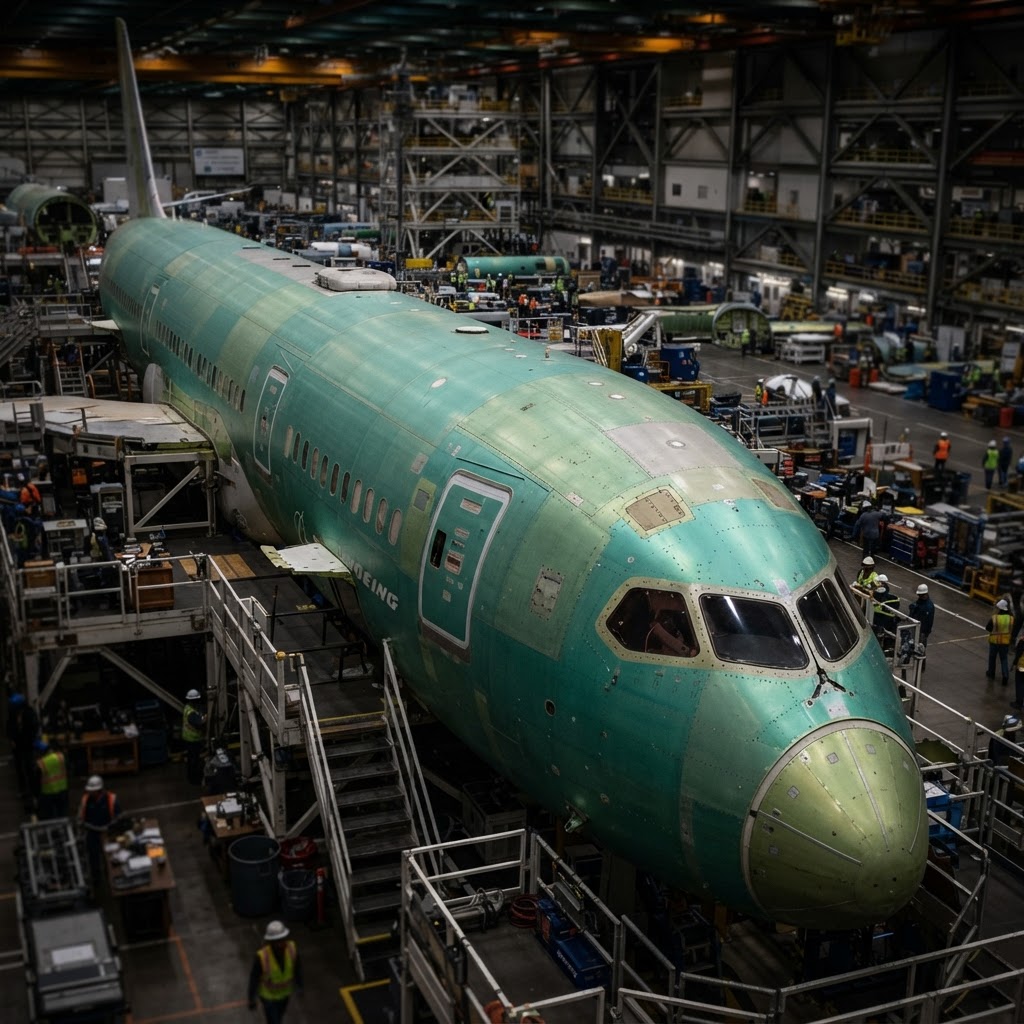
The Factory Floor as a Competitive Battlefield
In the world of large-scale manufacturing, few operations command as much strategic scrutiny as Boeing's commercial aircraft assembly lines. Every jet that rolls out of Boeing's Everett, Washington facility — the largest building by volume on Earth — represents a convergence of thousands of suppliers, millions of engineered parts, and decades of accumulated process knowledge. For B2B manufacturers and industrial companies watching from the sidelines, Boeing's assembly ecosystem is not just a marvel of engineering — it is a masterclass in operational strategy.
Boeing sits at the center of a global supply chain involving more than 12,000 supplier partners across 44 states and dozens of countries. The company's ability to coordinate this vast network while maintaining airworthiness standards is a competitive differentiator that most industrial companies only dream of replicating. Understanding how Boeing manages assembly at scale offers transferable lessons for any manufacturer competing in high-stakes, high-complexity markets.
After facing significant regulatory and reputational headwinds in 2024, Boeing has doubled down on quality, workforce investment, and process discipline. The company's ongoing recovery and transformation arc makes it one of the most instructive case studies in industrial B2B marketing and operational resilience available today.
Boeing's Manufacturing Operations: Scale, Output, and Structural Complexity
Boeing's 737 MAX assembly line in Renton, Washington, and its widebody 777 and 787 lines in Everett represent the twin pillars of the company's commercial aviation output. In 2024, Boeing delivered approximately 348 commercial aircraft — a figure that fell short of internal targets but reflected the company's aggressive quality remediation efforts following Federal Aviation Administration (FAA) oversight actions earlier that year. The FAA capped 737 MAX production at 38 aircraft per month through much of 2024, a constraint that directly limited Boeing's revenue ceiling.
Boeing's 2024 annual revenue came in at approximately $66.5 billion, with the Commercial Airplanes segment accounting for the largest share of that total. Backlog remained one of the company's most powerful indicators of long-term demand, holding steady at over 5,600 aircraft valued at more than $500 billion — representing roughly seven to eight years of production at current rates. That backlog is a testament to both the durability of air travel demand and Boeing's entrenched position as one of only two major commercial airframe manufacturers globally.
The Everett factory alone covers 98.3 acres of floor space and employs tens of thousands of workers across engineering, assembly, quality assurance, and logistics functions. The 787 Dreamliner program, assembled there, involves composite fuselage sections shipped from partner facilities in Italy and Japan before final integration in Washington State. This globally distributed model of assembly — sometimes called "final assembly" manufacturing — is a structural choice that carries profound supply chain implications.
Boeing's workforce strategy has also become a focal point of its manufacturing rebuild. Following a prolonged machinists' strike in late 2024 that idled key production lines for over seven weeks, Boeing reached a new labor agreement that included significant wage increases. The strike highlighted the outsized role that skilled labor plays in precision manufacturing environments and underscored the risks of workforce relations becoming a production variable.
Automation, Digital Twins, and the Technology Backbone of Boeing Assembly
Boeing has invested heavily in digital manufacturing technologies to reduce production variability and improve first-pass quality rates. The company's use of digital twin technology — virtual replicas of physical assembly processes — allows engineers to simulate and validate assembly sequences before a single physical component is touched. This approach reduces costly rework cycles and accelerates the identification of design-for-manufacturability issues upstream, where corrections are far less expensive.
In 2024 and into 2025, Boeing expanded its use of automated drilling and fastening systems on the 777X program. Automated fuselage assembly tools can place fasteners with sub-millimeter precision at speeds no human crew can match consistently over multi-hour shifts. Industry analysts at Oliver Wyman estimated in their 2025 MRO Outlook that automation in aerospace manufacturing could reduce direct labor hours per aircraft by up to 20% over the next five years, a figure that Boeing's own investment trajectory appears to be tracking closely.
Boeing's partnership with Microsoft on HoloLens mixed-reality headsets for assembly guidance represents another layer of technology integration on the factory floor. Assembly technicians using augmented reality overlays have demonstrated measurable reductions in wiring harness installation time — one of the most labor-intensive and error-prone tasks in aircraft manufacturing. Internal Boeing data cited in industry publications suggested error rates dropped by as much as 25% in early AR-guided assembly trials.
The company's model-based definition (MBD) initiative, which replaces traditional 2D engineering drawings with fully annotated 3D digital models, is also maturing across programs. MBD enables tighter coordination between Boeing's design teams and its Tier 1 and Tier 2 suppliers, reducing interpretation errors and accelerating engineering change order cycles. For B2B suppliers serving aerospace primes, fluency with MBD workflows has become a de facto qualification requirement.
What Industrial B2B Companies Can Learn From Boeing's Assembly Playbook
Boeing's experience in 2024 and 2025 offers a powerful lesson about the relationship between quality systems and brand equity in industrial markets. When regulatory actions and public scrutiny intensified around 737 MAX door plug incidents, Boeing's market capitalization and contract confidence took immediate hits. For any B2B manufacturer, this is a reminder that quality is not a back-office function — it is a frontline marketing asset that customers, regulators, and investors price in real time.
Boeing's backlog strategy also carries transferable lessons. The company has historically used long-term purchase agreements and fleet transition programs to lock in airline customers years — sometimes decades — in advance. B2B industrial companies that can structure multi-year service agreements, volume commitments, or technology roadmap partnerships with their customers create similar switching-cost moats that protect revenue visibility and reduce sales cycle volatility.
Boeing's supplier relationship model is equally instructive. The company segments its supply base into strategic partners, preferred suppliers, and commodity vendors — applying differentiated engagement models to each tier. Strategic partners like Spirit AeroSystems (now being reacquired) co-develop manufacturing solutions and share risk.
B2B companies that aspire to move up the value chain in their industries should study this tiering model carefully, as it defines where margin and influence actually reside in complex industrial ecosystems.
Finally, Boeing's investment in workforce development and apprenticeship programs reflects a sophisticated understanding of human capital as a supply chain input. Companies that treat skilled labor as a cost to be minimized rather than a capability to be cultivated consistently underperform on quality and delivery. If your organization is evaluating its own talent pipeline strategy, Boeing's 2025 workforce reinvestment commitments offer a relevant benchmark worth examining closely.
The Road Ahead: Strategic Implications for Boeing and Its Industrial Peers
Boeing's 2025 and 2026 trajectory is shaped by three converging forces: FAA production cap negotiations, the 777X certification timeline, and the financial pressure of carrying a debt load that exceeded $57 billion as of mid-2025. The company raised approximately $24 billion in new capital in late 2024 to stabilize its balance sheet, buying time to execute its production ramp strategy. Investors and customers alike are watching whether Boeing can demonstrate sustained quality performance at higher output rates — a challenge that has historically proven harder than it looks.
The 777X program, Boeing's next-generation widebody aircraft, remains one of the most consequential product introductions in commercial aviation. Originally slated for service entry years earlier, the program has faced repeated certification delays. Analysts at Citigroup projected in their 2025 aerospace sector outlook that 777X entry into service could occur in 2026, contingent on FAA type certificate approval — a milestone that would materially shift Boeing's widebody competitive position against Airbus's A350 family.
For industrial companies in adjacent sectors — aerospace components, industrial automation, advanced materials, and MRO services — Boeing's production ramp creates genuine downstream opportunity. Every incremental aircraft delivered translates into demand for engines, avionics, seating, cabin systems, and a decades-long stream of maintenance parts. Suppliers who have aligned their capacity planning and quality certifications with Boeing's ramp expectations are positioned to capture disproportionate value as output volumes recover.
The strategic imperative for B2B companies in Boeing's orbit is clear: use the current period of Boeing's transformation to deepen technical integration, achieve preferred supplier status, and build the quality credentials that will make your organization indispensable when production rates accelerate. The companies that invest in that positioning today will be the ones writing their own backlog stories tomorrow. If your organization is ready to align its capabilities with aerospace-grade quality expectations, now is the time to act.
Key Takeaways
- Boeing's commercial aircraft backlog exceeded 5,600 units valued at over $500 billion as of 2024, representing roughly seven to eight years of production runway and signaling durable long-term demand for the supply chain.
- The FAA's 38-aircraft-per-month production cap on the 737 MAX through much of 2024 directly constrained Boeing's revenue, demonstrating how regulatory compliance functions as a production rate lever in aerospace manufacturing.
- Boeing raised approximately $24 billion in new capital in late 2024 to manage a debt load exceeding $57 billion, illustrating the balance-sheet consequences of sustained production disruptions for large industrial manufacturers.
- Augmented reality-guided assembly tools piloted on Boeing programs showed error rate reductions of up to 25%, underscoring the measurable ROI of digital manufacturing technology investments at scale.
Key Quotes
"We are focused on fundamentally changing how we build airplanes — with more discipline, more stability, and a relentless focus on quality at every step of the process." — Kelly Ortberg, President and CEO, Boeing
"The aerospace supply chain is under enormous pressure to scale quality systems alongside production rates. The companies that invest in that capability now will define the competitive landscape for the next decade." — Robert Stallard, Aerospace Analyst, Vertical Research Partners
References
- Boeing 2024 Annual Report — Boeing's official investor relations page covering financial performance, backlog data, and segment reporting for the 2024 fiscal year
- FAA Boeing Oversight Updates — FAA's official newsroom page detailing production oversight actions, safety directives, and regulatory milestones related to Boeing's 737 MAX and broader manufacturing compliance
- Oliver Wyman 2025 MRO Outlook — Industry-leading annual report on maintenance, repair, and overhaul trends including automation adoption rates and labor hour projections across commercial aviation