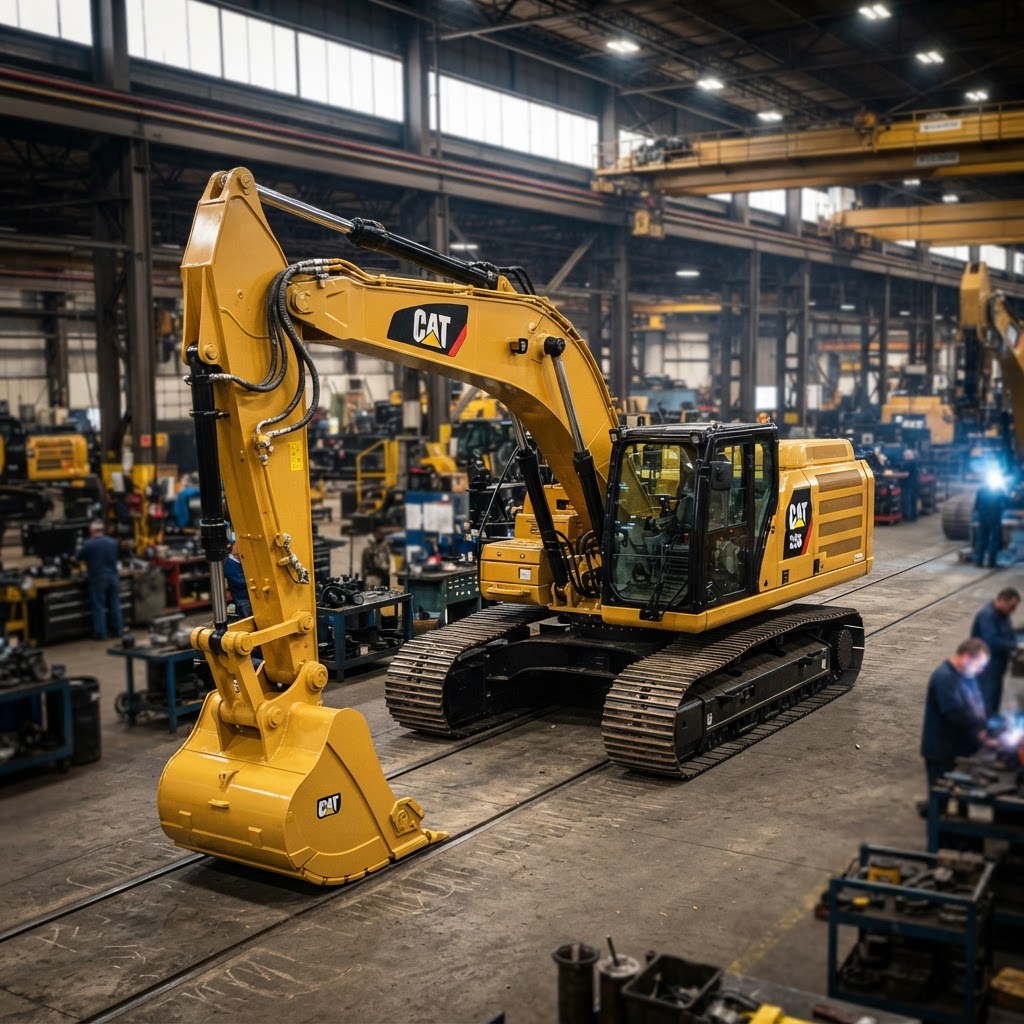
The Giant That Never Stopped Moving
Caterpillar Inc. has spent over a century building the machines that build the world. From massive mining trucks to precision hydraulic excavators, the company's yellow iron is synonymous with industrial progress. Yet in 2025 and beyond, the most consequential thing Caterpillar is manufacturing may not be physical at all.
The Deerfield, Illinois-based company has quietly transformed itself into a data-driven industrial powerhouse. Its connected-machine analytics platform, built on the backbone of its Cat Connect and Cat Digital suite, is rewriting how heavy equipment is monitored, maintained, and monetized. This is not a story about a manufacturer adding software as an afterthought.
This is a story about a manufacturer making data its core product.
For B2B marketers and industrial executives, Caterpillar's transformation offers a masterclass in how legacy manufacturing companies can evolve their value proposition without abandoning what made them great. The lessons here are practical, scalable, and urgently relevant.
Caterpillar's Manufacturing Footprint: Scale That Commands Attention
Caterpillar operates one of the most expansive manufacturing networks in the global industrial sector. The company runs more than 170 facilities across approximately 50 countries, employing over 109,000 people worldwide. In its 2024 annual report, Caterpillar posted total revenues of approximately 64.8 billion dollars, with machinery, energy, and transportation (ME&T) sales accounting for the vast majority of that figure.
The company's three primary business segments are Construction Industries, Resource Industries, and Energy & Transportation. Each segment contributes meaningfully to overall revenue, but Energy & Transportation has been a standout performer, generating strong demand from data center operators, utilities, and oil and gas companies seeking power solutions. In 2024, Energy & Transportation revenues held resilient even as some construction markets softened globally.
Caterpillar's manufacturing efficiency is anchored by its lean production philosophy, which the company has been refining for decades. Its flagship facilities in East Peoria, Illinois and Decatur, Illinois produce some of the largest and most complex machines in the world, including the 797 mining truck, which can haul payloads exceeding 400 tons. These facilities operate on precision-driven production schedules that minimize waste and maximize throughput.
What makes Caterpillar's manufacturing scale especially impressive is its dealer network. The company distributes products through more than 160 dealers operating roughly 2,900 dealer branch locations worldwide. This network is not just a sales channel; it is an integrated service and data-collection arm that feeds directly into Caterpillar's connected analytics ecosystem.
Cat Connect and the Rise of the Connected Machine
Caterpillar's connected-machine strategy centers on its Cat Connect platform, a suite of technology solutions designed to give equipment owners real-time visibility into machine health, location, fuel consumption, and productivity. As of 2025, Caterpillar has connected more than 1.3 million assets globally through its telematics and digital services infrastructure. This represents one of the largest connected equipment networks in the industrial world.
The Cat Digital division, launched as a dedicated unit to accelerate Caterpillar's software and analytics capabilities, has been central to this expansion. Cat Digital leverages machine learning models trained on billions of hours of operational data to deliver predictive maintenance alerts, fuel optimization recommendations, and fleet utilization benchmarks. For a construction company running a fleet of 50 excavators, the platform can flag a hydraulic pump degradation days before failure, potentially saving tens of thousands of dollars in unplanned downtime.
In 2024, Caterpillar reported that its services revenues, which include connected services, parts, and aftermarket offerings, totaled approximately 23 billion dollars. The company has publicly stated a target of reaching 28 billion dollars in services revenues by 2026. This ambition signals a fundamental shift in how Caterpillar thinks about its business model: machines generate cash once, but connected services generate recurring revenue streams over the entire equipment lifecycle.
Caterpillar has also integrated its analytics platform with third-party construction management software, including Trimble and Komatsu Smart Construction platforms, enabling interoperability across mixed-fleet job sites. This open-ecosystem approach is a deliberate competitive strategy. By making Cat data compatible with broader project management workflows, Caterpillar embeds itself deeper into the operational fabric of its customers' businesses.
Marketing and Growth Lessons for Industrial Companies
Caterpillar's transformation from a pure equipment manufacturer to a services-and-analytics business offers several critical marketing lessons for industrial B2B companies. The most important is this: your product is the entry point, not the endpoint. Caterpillar uses every machine sale as the beginning of a long-term data relationship with the customer.
The company's marketing strategy reinforces this positioning. Rather than leading with equipment specifications, Caterpillar increasingly leads with outcomes: lower cost per ton, higher machine availability, reduced fuel spend. This outcome-based messaging resonates with C-suite buyers in mining, construction, and energy who are under pressure to prove project ROI.
Industrial marketers should take note: technical buyers have evolved, and they now demand business-case fluency from their vendors.
Caterpillar has also invested heavily in content marketing and digital customer education through its Cat.com ecosystem and the My.Cat.Com owner portal. The portal gives fleet managers direct access to machine health dashboards, service history, and dealer communication tools. By making data accessible and actionable, Caterpillar reduces friction in the buyer-to-operator journey and increases platform stickiness.
This is the industrial equivalent of a software company's product-led growth strategy.
For companies looking to replicate this approach, the starting point is data infrastructure. If your product generates operational data, that data is a marketing asset. Build systems to capture it, contextualize it, and share it with customers in formats that help them make better decisions.
Then build your marketing narrative around the insights that data enables. If you are not yet treating connected data as a core part of your value proposition, start that conversation with your leadership team today.
The Road Ahead: Strategic Implications for Industrial Leaders
Looking into 2026 and beyond, Caterpillar is positioning itself at the intersection of electrification, automation, and artificial intelligence. The company has been actively developing battery-electric and hydrogen-powered equipment variants, with several prototype machines already undergoing field trials in mining and construction environments. Caterpillar's investment in sustainable power solutions aligns with the decarbonization mandates increasingly adopted by large mining and construction customers.
Autonomous machine technology is another major frontier. Caterpillar's autonomous haulage system has logged more than 4 billion tonnes of material moved across mining operations globally as of 2025. These systems do not just reduce labor costs; they generate continuous streams of operational data that feed back into the connected analytics platform, improving the intelligence of the entire network over time.
This self-reinforcing data flywheel is a powerful competitive moat.
The company is also deepening its focus on construction technology through Cat Grade, Cat Payload, and Cat Production Measurement systems. These hardware-software solutions are embedded directly into machines and connect seamlessly to the broader Cat Connect ecosystem. As job sites become increasingly digitized, Caterpillar's ability to offer an integrated technology stack from the machine to the cloud positions it as a strategic partner, not just an equipment vendor.
For industrial executives watching Caterpillar's trajectory, the core strategic implication is clear: the companies that will lead in the next decade are those that combine physical manufacturing excellence with digital services sophistication. Caterpillar is not choosing between being a great manufacturer and being a great technology company. It is insisting on being both, and that ambition should inspire every industrial leader thinking about where to invest next.
Key Takeaways
- Caterpillar posted approximately 64.8 billion dollars in total revenues in 2024, with services revenues reaching approximately 23 billion dollars, signaling the growing importance of recurring digital and aftermarket income.
- The Cat Connect platform has connected more than 1.3 million assets globally as of 2025, creating one of the largest industrial telematics networks in the world.
- Caterpillar's autonomous haulage systems have moved more than 4 billion tonnes of material in mining operations globally, demonstrating the real-world scalability of connected and autonomous machine technology.
- The company has set a services revenue target of 28 billion dollars by 2026, indicating a deliberate long-term shift from a transactional equipment business to a lifecycle-based services model.
Key Quotes
"Our strategy is to invest in services and expanded offerings, and to leverage technology and innovation to grow profitably through the cycle." -- Jim Umpleby, Chairman and CEO, Caterpillar Inc.
"We see a tremendous opportunity to use data and technology to help our customers improve their operations and reduce their costs." -- Rob Del Castillo, Chief Digital Officer, Caterpillar Inc.
References
- Caterpillar 2024 Annual Report -- Covers full-year financial performance, segment revenues, and strategic priorities including services growth targets
- Caterpillar Cat Connect Overview -- Details the Cat Connect telematics and digital services platform including fleet management and machine health capabilities
- Caterpillar Investor Relations: Services Growth Strategy -- Covers Caterpillar's long-term services revenue targets and digital transformation investment thesis