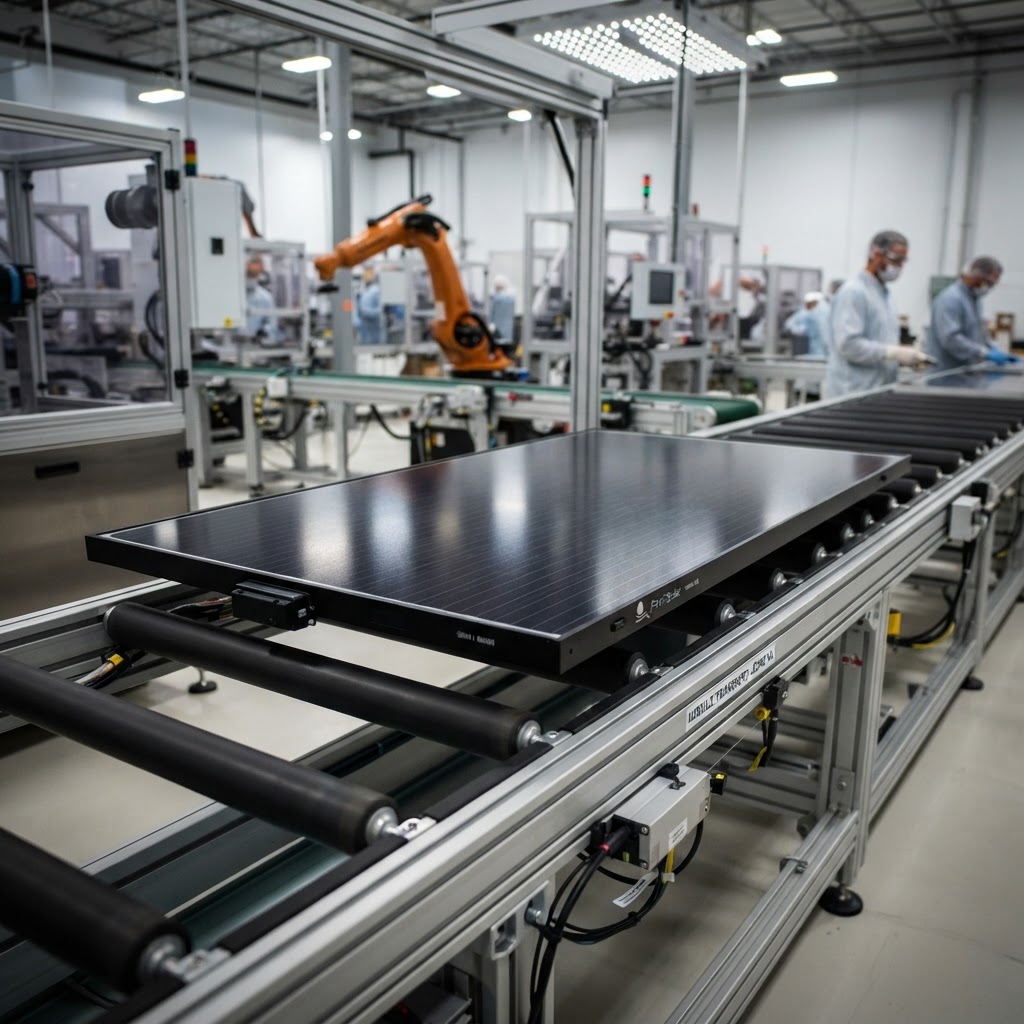
The Solar Manufacturer That Rewrote the Rulebook
In an industry crowded with commodity panel makers, First Solar stands apart as the only large-scale American manufacturer of thin-film photovoltaic modules. Founded in 1999 and headquartered in Tempe, Arizona, the company has spent decades refining a proprietary cadmium telluride (CdTe) technology that now competes directly with silicon-based panels on cost, efficiency, and reliability.
First Solar's rise is not simply a story about clean energy. It is a story about disciplined manufacturing, vertical integration, and the strategic use of innovation to build defensible competitive advantages. For B2B industrial and manufacturing leaders, the company offers a masterclass in what it means to scale a complex production process without sacrificing quality or margin.
The launch and ongoing expansion of the Series 7 module line has become the clearest symbol of First Solar's manufacturing ambitions. With record efficiency ratings, expanded production footprint, and a forward-looking supply strategy, Series 7 is the product line that industrial decision-makers across the energy sector are watching most closely right now.
First Solar's Manufacturing Footprint and Production Scale
First Solar operates gigawatt-scale manufacturing facilities across three continents, with plants in Perrysburg, Ohio; Kulim, Malaysia; and Chennai, India. The Ohio facility alone represents one of the largest solar manufacturing campuses in the Western Hemisphere, and its expansion has been accelerated significantly by domestic content requirements tied to the Inflation Reduction Act.
As of the company's 2024 annual report, First Solar reported a total manufacturing capacity approaching 21 gigawatts (GW) across all facilities. Net sales for full-year 2024 reached approximately 4.2 billion dollars, reflecting strong utility-scale demand and a robust contracted backlog. The company's contracted bookings extended well beyond 2026, providing a level of revenue visibility that most industrial manufacturers would envy.
The Chennai facility, which began ramping production in 2024, adds roughly 3.3 GW of annual capacity to the global network. This expansion was part of a multi-year capital investment program exceeding 1.1 billion dollars. The India plant is specifically designed to serve Southeast Asian and European markets where First Solar is aggressively pursuing utility-scale project developers.
What makes First Solar's manufacturing model distinctive is its degree of vertical integration. The company controls the full production chain from raw material sourcing through to module assembly and end-of-life recycling. This level of control allows First Solar to manage quality at every step, reduce supplier-related disruptions, and protect proprietary process improvements from reaching competitors.
Series 7: The Engineering and Process Innovation Behind the Module
The Series 7 module represents the latest generation of First Solar's CdTe thin-film technology, and it is engineered specifically for the demands of large-scale utility and commercial solar installations. Each module measures approximately 2.5 square meters, making it one of the largest commercially available solar panels on the market. That larger form factor directly reduces balance-of-system costs for project developers, a critical selling point in competitive procurement environments.
First Solar reported that Series 7 modules achieved a record conversion efficiency of 23.1 percent in controlled research conditions as of 2024, with commercial production modules consistently delivering efficiencies above 19 percent. The efficiency gap between CdTe technology and traditional silicon panels has narrowed substantially over the past two years. In temperature coefficient performance, which measures how much efficiency drops as temperatures rise, CdTe consistently outperforms silicon-based alternatives, making Series 7 especially well-suited for hot-climate installations.
The manufacturing process for Series 7 relies on a continuous deposition technique that applies ultra-thin semiconductor layers to large glass substrates at high speed. This process is inherently more automated and repeatable than the cell-and-string assembly methods used in silicon panel production. First Solar's production lines for Series 7 are designed to run at very high utilization rates, with automated quality inspection systems checking every module before it leaves the factory floor.
Energy intensity per watt produced has also been a focus of Series 7 manufacturing design. First Solar's lifecycle analysis data shows that its CdTe modules have a significantly lower carbon footprint per watt compared to polysilicon alternatives, in part because the deposition process requires less energy than the high-temperature silicon purification process. This environmental performance advantage is increasingly valued by corporate buyers and public utilities with scope 3 emissions targets.
What Industrial Companies Can Learn from First Solar's B2B Growth Strategy
First Solar does not sell to residential consumers. Its entire business model is built around long-cycle, relationship-driven B2B sales to utility companies, independent power producers, and large commercial energy buyers. The company's sales cycle often spans multiple years, and contracts are frequently structured around multi-year forward purchase commitments.
This demands a sales and marketing approach that prioritizes technical credibility, long-term partnership, and deep customer understanding over volume lead generation.
One of the most instructive elements of First Solar's B2B strategy is how it uses manufacturing transparency as a marketing asset. The company publishes detailed technical documentation, lifecycle analysis reports, and performance warranties that give procurement teams and project financiers the data they need to make high-stakes purchasing decisions. In industrial B2B markets, the ability to reduce perceived risk through rigorous documentation often matters more than price.
First Solar has also built a powerful story around domestic manufacturing and supply chain security, particularly for buyers operating under domestic content incentives tied to U.S. federal policy. By positioning its Ohio facilities as a strategic sourcing advantage, the company has differentiated itself from Chinese-manufactured silicon panels in a way that resonates directly with utility procurement priorities. Industrial manufacturers serving regulated or government-adjacent markets would do well to study this positioning approach.
For manufacturing and industrial companies looking to sharpen their own B2B marketing, the First Solar playbook offers a clear direction: invest in technical content, lead with verified performance data, and build your brand on manufacturing credibility rather than price competition. If your product is made better, show the evidence in a format your customers can take into a boardroom or a financing committee.
The Road Ahead: Strategic Implications for Solar and Industrial Manufacturing
First Solar's trajectory through 2025 and into 2026 reflects a broader shift in how advanced manufacturers are thinking about growth. The company is not chasing volume for its own sake. Instead, it is prioritizing margin, strategic market positioning, and long-term customer relationships over aggressive short-term expansion.
Its contracted backlog provides a stable revenue foundation that allows for deliberate capacity investment rather than reactive scaling.
The competitive pressure from low-cost Asian silicon panel manufacturers remains real, but First Solar's differentiation strategy has proven durable. Tariff policies, domestic content requirements, and growing concerns about supply chain provenance have created structural advantages for U.S.-based manufacturers that are likely to persist through the remainder of the decade. First Solar's early investment in domestic capacity is now paying strategic dividends that would have been difficult to predict five years ago.
Looking at the broader industrial manufacturing landscape, First Solar's model raises an important question for every B2B manufacturer: are you competing on price, or are you competing on defensible differentiation? Companies that have invested in proprietary processes, strong sustainability credentials, and deep customer relationships are consistently outperforming those that compete primarily on cost. First Solar's Series 7 line is a tangible example of what that kind of differentiated manufacturing looks like in practice.
For industrial leaders ready to benchmark their own manufacturing and commercial strategy against best-in-class operators, First Solar is a company worth studying in detail. Consider scheduling a strategic review of your own product differentiation, customer documentation practices, and manufacturing transparency. The gap between where you are and where First Solar operates may be the most valuable insight your leadership team gains this year.
Key Takeaways
- First Solar's total manufacturing capacity reached approximately 21 GW across global facilities as of the 2024 annual report, making it one of the largest thin-film solar producers in the world.
- Net sales for full-year 2024 were approximately 4.2 billion dollars, supported by a multi-year contracted backlog extending well past 2026.
- Series 7 modules achieved a record CdTe conversion efficiency of 23.1 percent in research conditions in 2024, with commercial production modules exceeding 19 percent consistently.
- The Chennai, India facility adds approximately 3.3 GW of annual capacity, part of a capital investment program exceeding 1.1 billion dollars across multiple sites.
Key Quotes
"Our Series 7 technology represents the most advanced thin-film photovoltaic product ever brought to commercial scale, and it is the foundation of our long-term manufacturing strategy." — Mark Widmar, Chief Executive Officer, First Solar
"The domestic manufacturing advantage we have built is not just a policy story. It is a supply chain resilience story that our customers increasingly understand and value." — Alexander Bradley, Chief Financial Officer, First Solar
References
- First Solar 2024 Annual Report — Covers full-year 2024 financial results, manufacturing capacity data, and capital investment disclosures
- First Solar Series 7 Product Page — Technical specifications, efficiency data, and performance documentation for the Series 7 module line
- U.S. Department of Energy Solar Technologies Office — Research and data on domestic solar manufacturing competitiveness and thin-film technology development