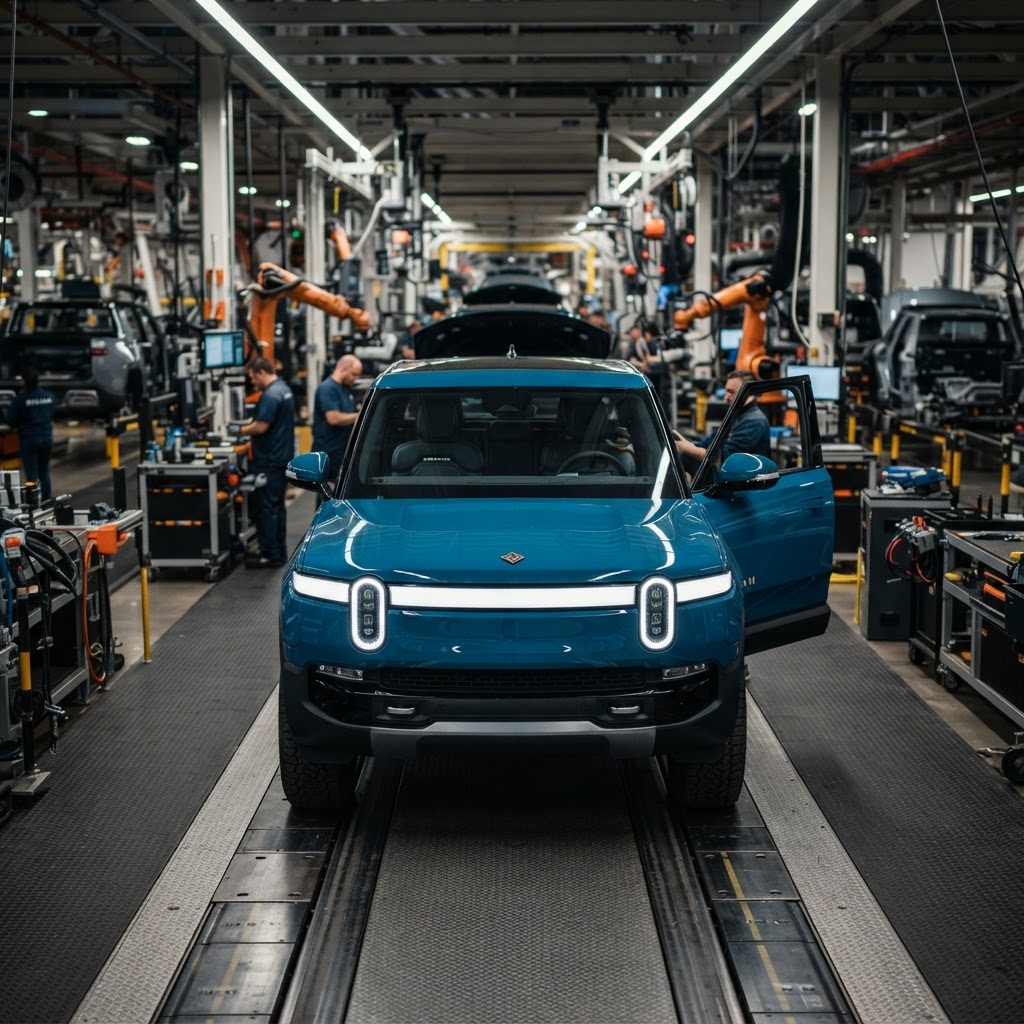
From Concept to Current: The Electric Adventure That's Reshaping Industrial Manufacturing
Rivian entered the automotive world with a bold promise: build purpose-driven electric adventure vehicles at scale while maintaining the kind of quality and brand authenticity that legacy automakers have struggled to replicate. The company's R1T pickup and R1S SUV quickly became symbols of what a next-generation EV company could achieve when it combined silicon valley software thinking with genuine heavy-industry manufacturing muscle.
For B2B leaders in manufacturing and industrial sectors, Rivian represents something more instructive than a flashy consumer product story. It is a real-world case study in how to ramp a complex, capital-intensive production facility, manage supply chain disruptions, invest in process innovation, and build a durable brand that commands premium pricing in a brutally competitive market.
The Normal, Illinois plant, a converted former Mitsubishi facility spanning roughly 3.3 million square feet, sits at the center of this story. Understanding how Rivian has used that asset, and what lessons it offers for industrial operators everywhere, is the purpose of this deep dive.
Inside Normal: Production Volumes, Capacity, and the Ramp Reality
Rivian produced approximately 49,476 vehicles at the Normal plant in 2024, a figure that reflects both the difficulty of EV manufacturing ramps and the genuine progress the company has made since its early production struggles. The company delivered around 51,579 vehicles in 2024, drawing down inventory built in previous periods while stabilizing its production cadence through the second half of the year.
The Normal facility is rated for an annual capacity of approximately 150,000 vehicles per year on a single shift, with theoretical capacity well above that figure with shift additions and line upgrades. Rivian's production efficiency improved meaningfully through 2024 and into 2025 as the company executed a significant plant retooling to introduce its next-generation R1 platform and the new R2 architecture preparation began in parallel.
The retooling, which temporarily idled the Normal plant for several weeks in mid-2024, was a calculated risk. Rivian accepted a short-term production hit in exchange for a more efficient assembly process, reduced material costs, and a platform capable of supporting higher margins at scale. The company reported that the new R1 platform reduced bill-of-materials costs by approximately 20 percent compared to the prior generation, a critical step toward gross profit positivity.
Rivian achieved positive gross profit in the fourth quarter of 2024, a milestone that validated the retooling strategy and signaled to industrial investors that the company's unit economics were on a sustainable trajectory. For manufacturing executives, the lesson is clear: strategic downtime invested in process improvement can generate compounding returns that far outweigh short-term volume losses.
Engineering the Line: Technology, Tooling, and Process Innovation at Scale
Rivian's manufacturing approach at Normal blends traditional automotive assembly techniques with a software-defined vehicle philosophy that has direct implications for how the factory floor is organized. Every R1T and R1S rolls off the line with over-the-air update capability, which means the production process must account for software versioning, calibration, and validation steps that did not exist in legacy vehicle assembly.
The company has invested heavily in in-house battery pack assembly, which takes place at the Normal facility rather than being outsourced to a tier-one supplier. This vertical integration decision increases capital requirements but gives Rivian direct control over one of the highest-cost and most quality-sensitive components in the vehicle. Battery pack assembly requires precision torque management, thermal interface material application, and end-of-line electrical testing, all of which Rivian has built into its Normal operations.
Rivian's partnership with Volkswagen Group, announced in 2024 and valued at up to 5.8 billion dollars, includes a technology licensing component centered on Rivian's electrical architecture and software stack. This means the Normal plant is not just producing vehicles; it is producing validated proof points for a technology platform that a major global OEM has committed to deploying at far greater scale. For industrial companies evaluating technology licensing or joint development agreements, this is a powerful model of how manufacturing excellence and IP value can reinforce each other.
The company has also implemented what it calls a "skateboard" platform approach, where the battery pack, motors, and suspension are integrated into a single structural module before body assembly. This modular build strategy reduces complexity on the main assembly line and allows for parallel workstreams that improve throughput efficiency. Industrial manufacturers in sectors from heavy equipment to aerospace are increasingly exploring similar modular strategies to reduce line congestion and improve quality control.
What Industrial Marketers Can Learn from Rivian's Brand and Growth Playbook
Rivian's marketing strategy is deliberately community-driven and experience-centered rather than specification-driven. The company has built a network of service centers, adventure hubs, and owner events that create ongoing touchpoints with customers long after the initial sale. For B2B industrial companies, this mirrors the shift from transactional selling to lifecycle engagement that is reshaping procurement relationships across sectors.
The Amazon commercial van contract, covering an order of up to 100,000 electric delivery vehicles, demonstrates how Rivian has used a flagship B2B relationship to anchor its production volumes and validate its technology at scale. By 2025, Rivian had delivered tens of thousands of EDV units to Amazon, providing a recurring revenue base that consumer-facing automakers rarely enjoy. Industrial companies with the ability to secure anchor customers for long-term supply agreements should study this model carefully.
Rivian has also used transparency as a growth lever, publishing detailed production and delivery data on a quarterly basis and communicating openly about manufacturing challenges and milestones. This approach builds credibility with institutional investors, potential fleet customers, and prospective employees. In B2B sectors where trust and technical credibility are primary purchase drivers, this kind of radical transparency can differentiate a supplier from competitors who rely on polished sales presentations alone.
For industrial companies looking to sharpen their own marketing and growth strategy, the Rivian playbook offers a concrete framework: anchor your narrative in manufacturing credibility, build community around your product's purpose, secure strategic partnerships that validate your technology, and communicate progress with honest specificity. If your organization is ready to elevate its B2B positioning with these principles, now is the time to audit your current content and customer engagement strategy and begin building a roadmap for transformation.


