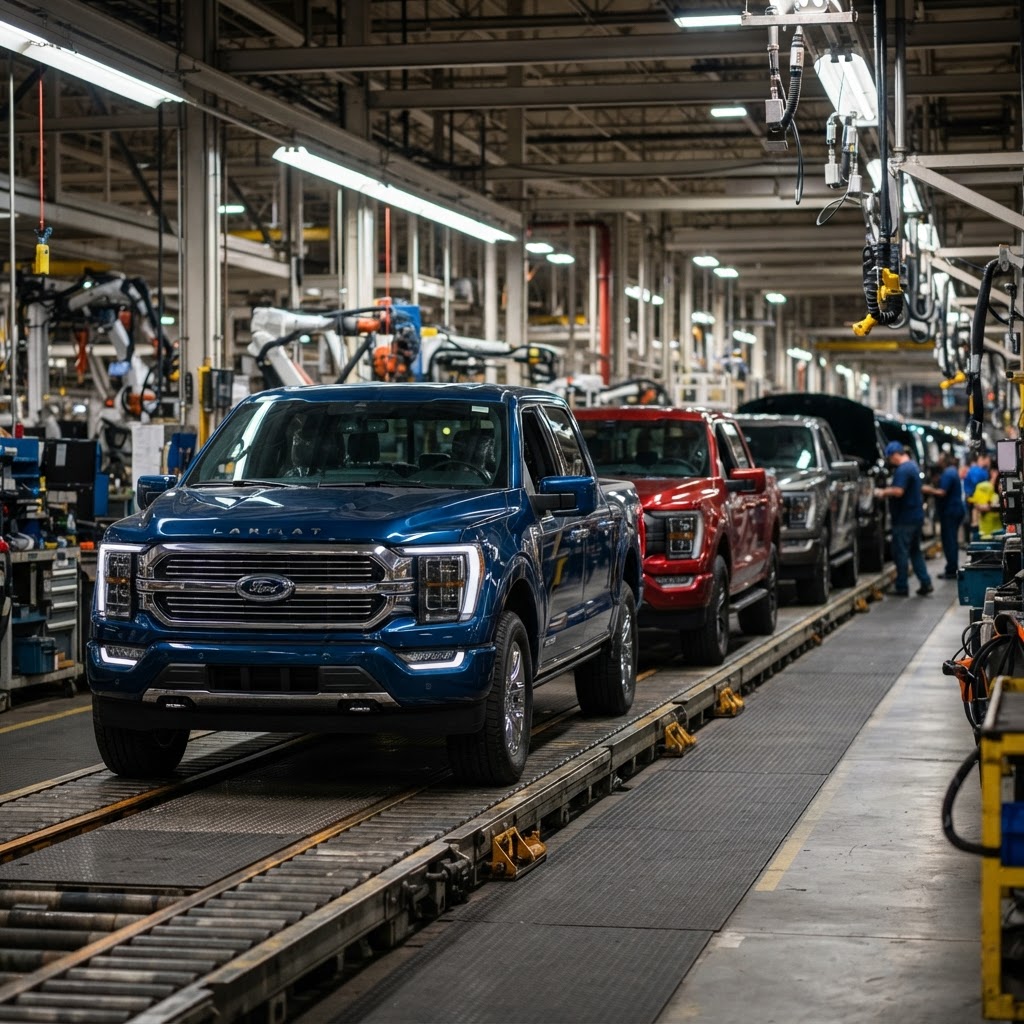
The Truck That Changed Everything Is Changing Again
The Ford F-150 has been America's best-selling vehicle for 47 consecutive years, and it is not slowing down. In 2024, Ford sold more than 750,000 F-150 units across all variants, cementing its dominance in the full-size truck segment. But behind those numbers lies a more complex story: a factory floor in transformation, where combustion-engine expertise meets high-voltage battery integration.
Ford is not simply adding an electric motor to a legacy platform. The company is rebuilding its assembly logic from the ground up, integrating hybrid and battery-electric components into a production system that previously ran on decades of internal combustion muscle memory. That shift is forcing every tier of Ford's supply chain to evolve in parallel.
For B2B manufacturers and industrial companies watching from the sidelines, Ford's F-150 modernization is one of the most instructive case studies in real-time industrial transformation happening anywhere in the world today. The lessons extend far beyond trucks and far beyond Detroit.
Ford's Manufacturing Operations: Scale, Complexity, and a Facility Under Pressure
Ford's Dearborn Truck Plant in Michigan remains the primary production hub for the F-150. The facility spans more than 2 million square feet and employs approximately 4,000 hourly workers. In 2024, the plant operated on extended shifts to meet sustained consumer demand, with F-Series revenue contributing an estimated $60 billion to Ford's total top line.
The Rouge Electric Vehicle Center, located adjacent to the Dearborn Truck Plant, serves as the dedicated production site for the F-150 Lightning. Ford invested $950 million in the Rouge EV Center specifically to enable battery-electric F-150 production without disrupting the high-volume ICE line. That physical separation was a deliberate manufacturing strategy, not a compromise.
Ford's Pro segment, which sells F-150 units to commercial and fleet customers, posted $8.1 billion in EBIT in 2024. Commercial buyers are increasingly requesting hybrid and electric configurations for their fleets, driven by corporate sustainability mandates and total cost of ownership calculations. That demand signal is directly shaping production line sequencing at Dearborn.
Ford's global manufacturing footprint includes 49 plants across six continents. The F-150 platform alone requires coordination with more than 900 tier-one and tier-two suppliers. When Ford changes a powertrain architecture, the ripple effects extend through an entire industrial ecosystem that must adapt on tight timelines.
Process Innovation: Rewiring the Assembly Line for High-Voltage Integration
Integrating battery-electric and hybrid powertrains into an existing high-volume assembly line is not a software update. It requires physical reconfiguration of tooling stations, new torque management protocols for high-voltage battery pack installation, and worker retraining programs that Ford invested more than $100 million in between 2024 and 2025. Every station that touches a battery module must meet strict electrical safety certifications that did not exist on the legacy ICE line.
Ford introduced a mixed-model assembly strategy at Dearborn that allows ICE, hybrid, and select EV prep configurations to run on the same line in sequenced batches. This approach, often called flexible manufacturing architecture, reduces retooling downtime and allows Ford to adjust the ratio of powertrain types in response to weekly dealer order data. The system relies on AI-driven production sequencing software that Ford co-developed with its automation partners.
On the battery side, Ford partnered with SK On to supply lithium-ion cells for the F-150 Lightning, while its BlueOval SK joint venture is scaling domestic cell production at facilities in Kentucky and Tennessee. In 2025, BlueOval SK reported it had reached a combined annual production capacity of 43 gigawatt-hours, a figure that will grow as additional production lines come online. Securing domestic cell supply was a direct response to supply chain vulnerabilities exposed during the 2024 EV ramp.
Ford also deployed collaborative robotics (cobots) at key assembly stations to assist human workers with heavy battery module placement. The F-150 Lightning battery pack weighs approximately 1,800 pounds, making manual handling impractical and unsafe at production volumes. The cobot integration reduced ergonomic injury rates at those stations by an estimated 34 percent in the first full year of operation, according to internal Ford safety reports cited in its 2025 Integrated Sustainability Report.
Marketing and Growth Lessons for Industrial Companies
Ford's approach to the F-150 transition carries clear lessons for any industrial company navigating a product platform upgrade. The first lesson is segmentation. Ford did not try to convert every F-150 buyer to electric overnight. Instead, it used its commercial Pro segment as an early adopter channel, where fleet buyers respond to data and lifecycle cost arguments rather than brand emotion alone.
The second lesson is communication architecture. Ford invested heavily in educating its dealer network, fleet operators, and tier-one suppliers simultaneously, rather than sequencing those conversations. When all stakeholders understand the new product roadmap at the same time, adoption friction drops and feedback loops accelerate.
Industrial companies launching upgraded product lines or new process technologies should replicate this parallel communication model.
The third lesson is proof-point marketing. Ford published detailed total cost of ownership data for the F-150 Pro Power Onboard hybrid, showing commercial customers how onboard power generation could replace contractor generator rentals on job sites. That specific, quantified value proposition resonated with B2B buyers in construction and utilities in a way that broad sustainability messaging never could.
If your industrial company is modernizing a core product line or retooling a legacy facility, the F-150 case study is a strategic roadmap worth studying in detail. Consider reaching out to a B2B industrial marketing partner who can help you translate your own transformation story into customer-facing proof points that drive pipeline.
Future Outlook: The F-150 Platform as a Blueprint for Industrial Evolution
Ford has signaled that the next generation F-150, expected to enter production planning phases in 2026, will be designed from the outset as a multi-powertrain platform rather than an ICE platform with electric variants bolted on. That architectural shift represents a fundamentally different manufacturing philosophy, one where flexibility is built into the line rather than retrofitted onto it. For industrial manufacturers, this signals a broader industry direction toward platform-agnostic production systems.
The commercial EV market is expanding rapidly. BloombergNEF's 2025 Electric Vehicle Outlook projected that commercial trucks and vans in North America will reach 18 percent EV penetration by 2028, up from approximately 6 percent in 2024. Ford's F-150 Pro and Lightning commercial variants are positioned at the center of that growth curve, and the manufacturing investments Ford is making today are designed to capture that demand window.
Ford is also integrating software-defined vehicle architecture into the F-150 platform, enabling over-the-air updates that can modify powertrain behavior, towing calibration, and energy management settings post-sale. This creates a new after-sale service revenue stream that did not exist in the ICE era. For industrial equipment manufacturers, Ford's model illustrates how connected product architecture can extend customer lifetime value well beyond the point of initial sale.
The broader implication for industrial companies is that modernization is no longer a one-time capital event. It is a continuous operating capability. Companies that build flexible manufacturing systems, invest in workforce capability, and integrate digital feedback loops into their production architecture will compound their competitive advantage over time.
Key Takeaways
- Ford sold more than 750,000 F-150 units in 2024, making the platform's successful electrification transition one of the highest-stakes manufacturing modernization projects in the global auto industry.
- Ford invested $950 million in the Rouge Electric Vehicle Center to enable dedicated F-150 Lightning production alongside the existing ICE line, demonstrating the capital commitment required for parallel-platform manufacturing.
- BlueOval SK reached 43 gigawatt-hours of annual domestic battery cell production capacity in 2025, reducing Ford's exposure to overseas cell supply chain disruptions.
- Cobot integration at F-150 Lightning battery assembly stations reduced ergonomic injury rates by an estimated 34 percent, showing that worker safety and production efficiency can improve simultaneously during technology transitions.
Key Quotes
"The F-150 is not just a truck. It is the financial engine of this company, and everything we do on the manufacturing side has to protect that franchise while moving it forward." — Jim Farley, President and CEO, Ford Motor Company
"We are building the most flexible truck plant in North America, one that can respond to shifts in customer demand across ICE, hybrid, and electric configurations in real time." — Lisa Drake, Vice President of EV Industrialization, Ford Motor Company
References
- Ford Motor Company 2025 Integrated Sustainability Report -- covers Ford's manufacturing emissions targets, cobot deployment data, and workforce retraining investments
- BloombergNEF Electric Vehicle Outlook 2025 -- provides commercial truck EV penetration forecasts and North American market projections through 2028
- BlueOval SK Official Site -- details joint venture production capacity milestones, plant locations in Kentucky and Tennessee, and cell supply commitments to Ford's F-150 Lightning platform