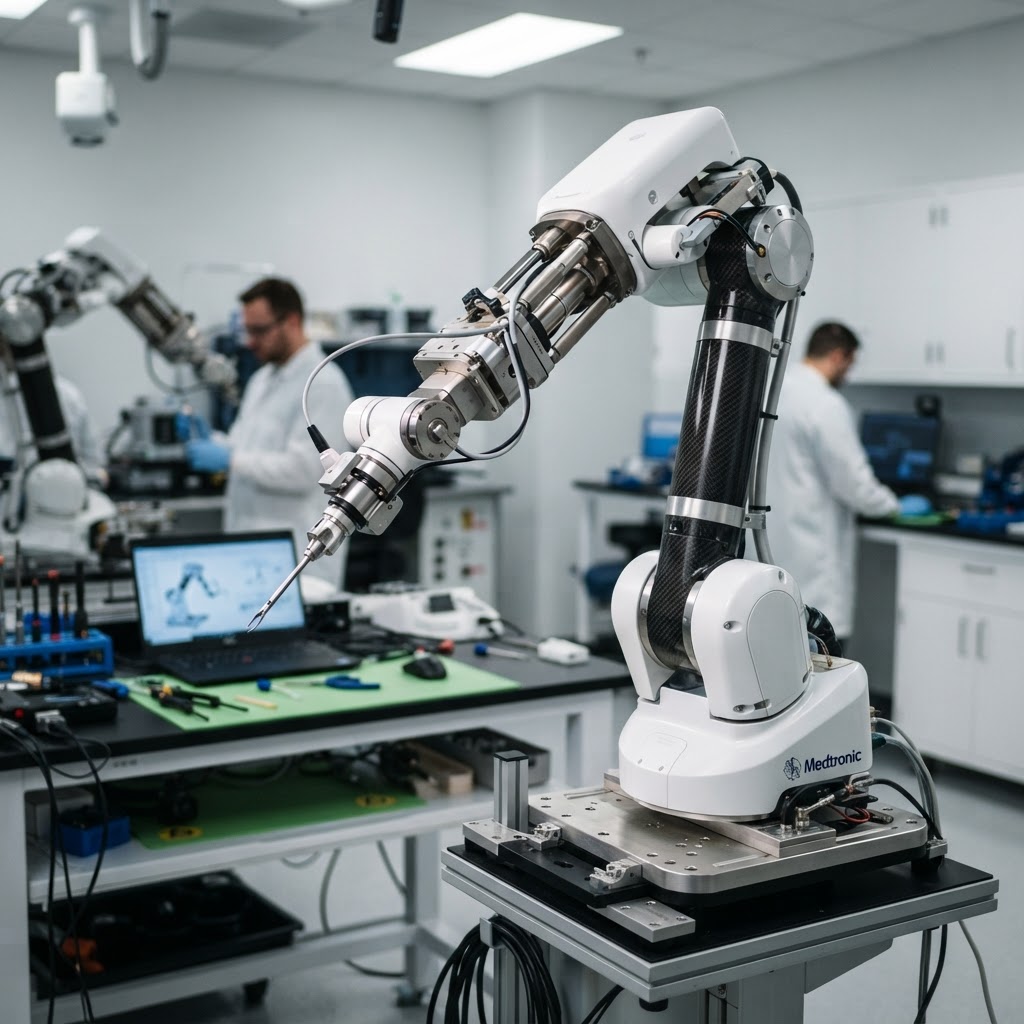
When Surgery Meets the Assembly Line
Medtronic is one of the most recognizable names in medical technology, but its story is equally a story about manufacturing at an extraordinary level of precision. With operations spanning more than 200 countries and territories, the company sits at the intersection of advanced engineering, regulated production, and global logistics. For B2B manufacturers and industrial leaders, Medtronic offers a blueprint worth studying closely.
The company's Hugo robotic-assisted surgery (RAS) platform has become a focal point for both its clinical ambitions and its manufacturing evolution. Hugo is not simply a product launch; it represents a fundamental shift in how Medtronic designs, builds, and scales complex electromechanical systems for the operating room. The stakes are high, the tolerances are tight, and the lessons are broadly applicable.
This report examines Medtronic's manufacturing infrastructure, the Hugo RAS platform's production and market trajectory, and what industrial companies in adjacent sectors can learn from one of the world's most sophisticated medical device makers.
Inside Medtronic's Global Manufacturing Engine
Medtronic reported total revenue of approximately 32.4 billion USD in its fiscal year 2025, reflecting steady growth across its cardiovascular, neuroscience, medical surgical, and diabetes segments. The company employs roughly 95,000 people globally, with a significant share of that workforce dedicated to manufacturing, quality assurance, and supply chain operations. Its production network spans facilities in the United States, Ireland, Costa Rica, China, and beyond.
The company's manufacturing complexity is difficult to overstate. A single Medtronic device, such as a cardiac rhythm management implant, may contain hundreds of individual components sourced from dozens of suppliers and assembled under ISO 13485-certified conditions. Regulatory compliance is not a checkbox; it is baked into every process step, making Medtronic's factories some of the most disciplined production environments in any industry.
In fiscal year 2025, Medtronic's Medical Surgical segment, which houses the Hugo platform, generated approximately 8.2 billion USD in revenue. This segment has been a key area of investment as the company pursues robotic surgery as a long-term growth vector. Capital allocation toward robotic platforms, including manufacturing capacity and R&D, has increased meaningfully over the past two fiscal years.
Medtronic has also made significant strides in supply chain resilience following broad industry disruptions. The company accelerated dual-sourcing strategies and regional inventory buffers, reducing lead time variability across critical component categories by an estimated 20 percent between fiscal years 2024 and 2025.
Engineering the Hugo RAS Platform: Innovation on the Factory Floor
The Hugo RAS system is a modular, multi-arm robotic surgery platform designed to compete in a market long dominated by Intuitive Surgical's da Vinci system. What makes Hugo particularly interesting from a manufacturing standpoint is its modular arm architecture. Unlike monolithic robotic systems, Hugo's arms are independent units, which simplifies shipping, installation, and field servicing, while also creating more scalable production workflows.
As of mid-2025, Hugo had received regulatory clearance in more than 50 markets globally, including CE mark approval in Europe and approvals across Latin America, Asia-Pacific, and the Middle East. Medtronic had placed Hugo systems in over 300 hospitals worldwide by the end of fiscal year 2025, with procedural volume growing at a double-digit rate quarter over quarter. The company cited urology and gynecology as its leading procedure categories for Hugo adoption.
From a production standpoint, scaling a robotic surgery platform requires extraordinary precision across both mechanical and software subsystems. Hugo's wristed instruments, for example, must meet micron-level tolerances in their articulation joints. Medtronic has invested in automated assembly and inspection systems at its surgical robotics manufacturing sites to maintain consistency at scale, with machine vision systems verifying joint clearances and torque profiles on every unit.
The company has also emphasized open console design and cloud-connected data analytics as core differentiators for Hugo. These software layers are not afterthoughts; they require parallel investment in firmware validation, cybersecurity compliance, and over-the-air update infrastructure. For industrial manufacturers building connected products, this integration of hardware and software production pipelines is one of Hugo's most instructive lessons.
Growth Lessons for Industrial and Manufacturing Companies
Medtronic's approach to launching Hugo offers a masterclass in how large industrial companies can commercialize complex, capital-intensive products in competitive markets. The company did not attempt a global simultaneous launch. Instead, it pursued a sequenced market entry strategy, building clinical evidence in select geographies before expanding distribution.
This approach reduced early adoption risk and allowed manufacturing ramp to align with real demand signals.
For B2B manufacturers, this market sequencing lesson is directly transferable. Whether you are launching a new CNC machining center, an industrial IoT gateway, or an automated inspection system, phased rollouts allow you to manage production capacity, service infrastructure, and sales training in a controlled manner. Trying to be everywhere at once is one of the most common and costly mistakes in industrial product launches.
Medtronic has also invested heavily in clinical training and simulation as a demand-generation tool. The company operates dedicated Hugo training centers where surgical teams can practice procedures before taking the platform into live operating rooms. For industrial companies, the equivalent is application engineering support, demo centers, and operator certification programs that reduce buyer hesitation and accelerate time to first use.
Finally, Medtronic has been transparent about Hugo's competitive positioning, openly acknowledging the strength of Intuitive Surgical while articulating specific differentiation points around modularity, cost of ownership, and data connectivity. Industrial marketers can learn from this candor. Buyers in regulated and high-stakes industries respond better to honest competitive framing than to vague claims of superiority.
If you want to reach the decision-makers at hospitals, factories, or infrastructure operators, speak to their real concerns with real data.
The Road Ahead: Strategic Implications for Industrial Leaders
Medtronic's Hugo platform is still in the early innings of its growth curve. The global surgical robotics market was valued at approximately 14 billion USD in 2024 and is projected to exceed 24 billion USD by 2030, according to multiple industry analysts. Medtronic is competing for a share of that expansion against Intuitive Surgical, Johnson and Johnson's Ottava platform, and a growing field of regional players in Asia and Europe.
For Medtronic to capture meaningful share, its manufacturing operations must scale efficiently while maintaining regulatory compliance across every new market. This means continued investment in automation, supplier development, and quality systems that can flex with volume without introducing defects. The company has signaled ongoing capital expenditure commitment to surgical robotics infrastructure in its fiscal year 2026 guidance.
For industrial companies watching from the sidelines, the broader implication is clear: the convergence of robotics, software, and advanced manufacturing is no longer a future trend. It is the present competitive landscape. Companies that invest now in flexible, connected production systems will be better positioned to serve markets that increasingly demand precision, traceability, and data integration as baseline requirements.
If your organization is evaluating investments in robotic automation, connected manufacturing, or advanced quality systems, now is the time to benchmark against leaders like Medtronic. Review your production architecture, assess your software integration capabilities, and identify the gaps before a competitor does it for you. The industrial companies that thrive over the next decade will be those that treat manufacturing excellence as a strategic asset, not just an operational cost center.
Key Takeaways
- Medtronic reported approximately 32.4 billion USD in total revenue in fiscal year 2025, underscoring the scale of its global manufacturing and commercial operations.
- The Hugo RAS platform had received regulatory clearance in more than 50 markets and was installed in over 300 hospitals globally as of the end of fiscal year 2025.
- Medtronic's Medical Surgical segment generated approximately 8.2 billion USD in fiscal year 2025 revenue, reflecting robust institutional demand for surgical technology.
- The global surgical robotics market is projected to grow from approximately 14 billion USD in 2024 to over 24 billion USD by 2030, creating significant production and supply chain scaling challenges for all major players.
Key Quotes
"Hugo is designed to democratize robotic surgery, giving more surgeons in more places access to a platform that is modular, data-connected, and built to evolve with clinical needs." -- Geoff Martha, Chairman and CEO, Medtronic
"The opportunity in surgical robotics is enormous, and we believe our modular approach and open data ecosystem give Hugo a durable advantage as the market matures." -- Gary Slade, President, Surgical Robotics, Medtronic
References
- Medtronic Fiscal Year 2025 Annual Report -- Covers Medtronic's full-year revenue, segment performance, and strategic priorities including surgical robotics investment
- Medtronic Hugo RAS System Overview -- Official product page detailing Hugo's modular architecture, cleared indications, and global regulatory status
- Grand View Research: Surgical Robotics Market Report 2025 -- Industry analysis covering global surgical robotics market size, growth projections through 2030, and competitive landscape