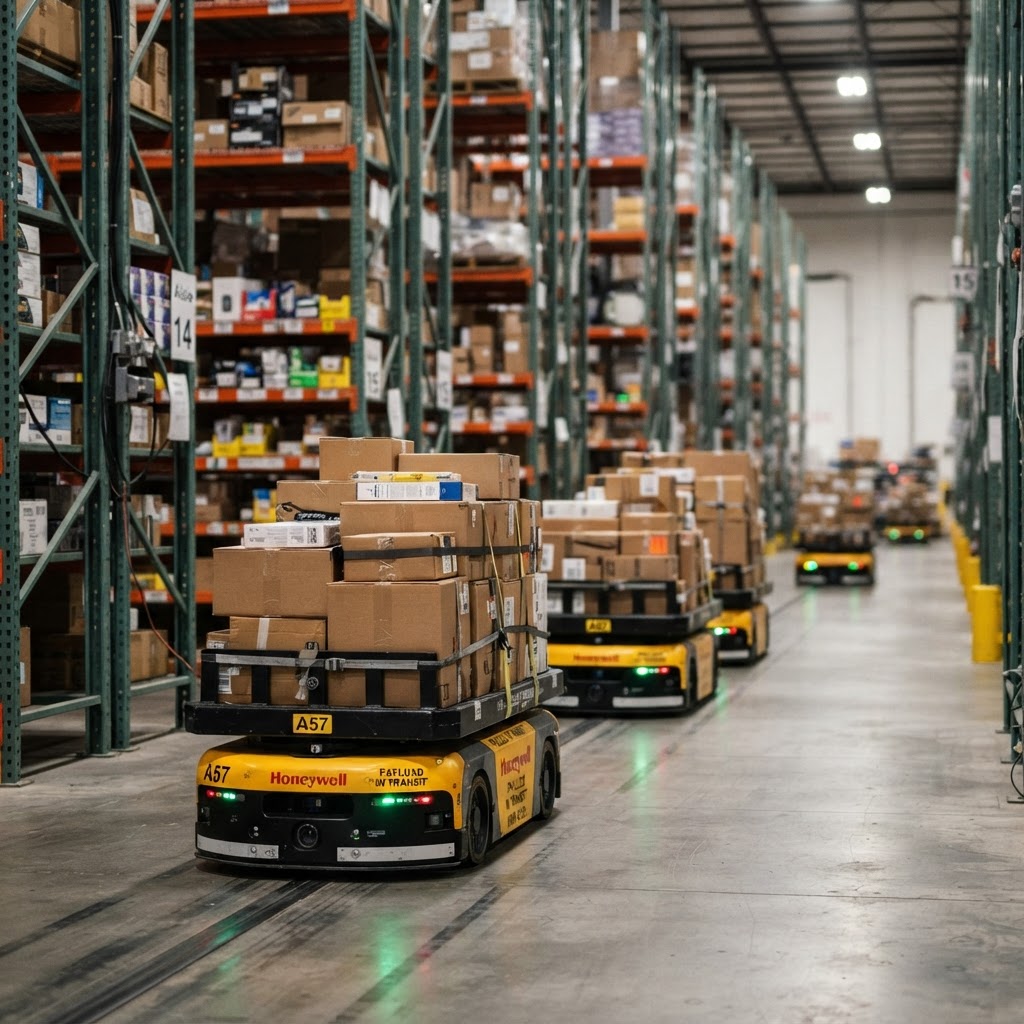
The Fulfillment Revolution Has a New Architect
The warehouse is no longer a passive storage facility. It is a precision-engineered system where robotics, artificial intelligence, and real-time data converge to move goods faster than any human workforce could manage alone. Honeywell has positioned itself at the center of this transformation, building one of the most comprehensive warehouse automation platforms in the industrial world.
Honeywell's Intelligrated division and its broader warehouse automation portfolio have quietly become one of the company's most strategically important growth engines. With global e-commerce volumes continuing to surge and labor shortages tightening fulfillment operations worldwide, the timing of Honeywell's robotics-driven push could not be more calculated.
For B2B industrial buyers, logistics operators, and manufacturing executives, Honeywell's approach offers a detailed blueprint for how legacy industrial companies can reinvent themselves through automation. This report breaks down the platform, the performance data, and the strategic lessons embedded in every conveyor, robotic arm, and software dashboard Honeywell deploys.
Honeywell's Warehouse Automation Business: Scale, Revenue, and Reach
Honeywell's Warehouse and Workflow Solutions segment, operating under its Intelligrated brand, generated significant revenue contributions within the broader Industrial Automation unit, which posted approximately 3.8 billion dollars in revenue in its 2024 annual report. The warehouse automation segment alone has seen double-digit order growth as fulfillment demand accelerates across North America, Europe, and Asia-Pacific.
The company operates more than 100 active installation projects at any given time, ranging from greenfield distribution center builds to retrofit automation upgrades for existing facilities. Honeywell's systems now support some of the largest retail and third-party logistics operators in the world, including major grocery chains, apparel brands, and pharmaceutical distributors.
Honeywell's robotics-driven fulfillment systems are capable of processing upwards of 150,000 units per hour in high-throughput environments, according to company technical specifications published in 2025. That figure reflects the combined output of sortation systems, robotic picking arms, autonomous mobile robots (AMRs), and the Momentum warehouse execution software that ties all components together.
The company's global service footprint spans more than 3,000 active customer sites, with a growing percentage of revenue now coming from long-term software and service contracts rather than one-time hardware installations. This shift toward recurring revenue is a deliberate strategic move that reflects a broader industry trend toward platform-based industrial business models.
The Technology Stack: AMRs, Robotic Picking, and Momentum Software
At the core of Honeywell's fulfillment platform is its fleet of autonomous mobile robots, which the company expanded significantly through its acquisition of Robotics capabilities and continued R&D investment exceeding 700 million dollars across its Industrial Automation segment in 2024. These AMRs navigate warehouse floors using a combination of lidar, computer vision, and real-time map updating, eliminating the need for fixed infrastructure like conveyor rails in many zones.
Honeywell's robotic picking technology uses AI-driven vision systems to identify, grasp, and sort items with a pick accuracy rate reported at 99.9 percent in controlled deployments, according to Honeywell's 2025 product documentation. The system handles a wide range of SKU variability, including irregular shapes, soft packaging, and polybag items that historically challenged robotic grippers.
The Momentum Warehouse Execution System (WES) serves as the software brain of the entire operation. It orchestrates the movement of every robot, conveyor, and human worker in the facility through a unified dashboard, processing millions of data events per second to optimize throughput and minimize bottlenecks. In a 2025 case study published by Honeywell, a major North American retailer reduced order cycle time by 35 percent after deploying the Momentum platform across three distribution centers.
Honeywell's Guided Work Solutions, a wearable voice-directed technology suite, complements the robotic systems by directing human workers in hybrid fulfillment environments. The technology has demonstrated productivity improvements of up to 35 percent in picking operations and error rate reductions of up to 50 percent, according to data published in Honeywell's 2025 industrial automation white papers. Together, these layers form a tightly integrated platform that competitors have struggled to match at equivalent scale.
Marketing and Growth Lessons for Industrial Companies
Honeywell's growth in warehouse automation offers a masterclass in how legacy industrial brands can compete in fast-moving technology markets. The company did not simply bolt on a robotics product line. It built a full-stack platform narrative that addresses the entire fulfillment operation from inbound receiving to outbound shipping, making the value proposition far easier to communicate to operations executives and procurement teams.
The B2B marketing lesson here is about ecosystem positioning. Honeywell markets its warehouse automation platform not as a collection of hardware components but as an integrated solution that reduces total cost of ownership, improves labor efficiency, and scales with volume demand. This framing resonates with CFOs and COOs who are under pressure to justify capital expenditure on automation against measurable ROI timelines.
Honeywell also invests heavily in proof-of-concept demonstrations and pilot programs, allowing prospective customers to validate system performance before committing to full-scale deployments. This reduces perceived risk and accelerates the sales cycle for large enterprise deals. For industrial marketers, this model of evidence-based selling is increasingly the standard for complex automation solutions.
Content marketing and thought leadership have also played a measurable role in Honeywell's positioning. The company produces detailed technical white papers, ROI calculators, and deployment case studies that speak directly to the operational pain points of logistics and manufacturing buyers. Industrial companies looking to grow in automation markets should treat content as a pipeline asset, not a brand exercise.
If your organization is evaluating a warehouse automation investment in 2026, Honeywell's platform documentation and ROI modeling tools are a strong starting point for benchmarking.
Future Outlook: AI Integration, Global Expansion, and the Next Wave of Fulfillment
Honeywell has signaled publicly that artificial intelligence and machine learning will become increasingly central to its warehouse automation roadmap through 2026 and beyond. The company is integrating predictive analytics into its Momentum WES platform, enabling distribution centers to anticipate demand spikes and pre-position inventory and robotic resources before order volumes surge.
The global warehouse automation market is projected to reach 41 billion dollars by 2027, according to industry research published in 2025, and Honeywell is positioning aggressively to capture share in high-growth regions including Southeast Asia and the Middle East. The company has announced partnerships with regional logistics operators in both markets as part of its international expansion strategy.
Honeywell's 2025 investor presentations highlighted a backlog of warehouse automation orders valued at over 2 billion dollars, reflecting strong forward demand across retail, grocery, pharmaceutical, and e-commerce verticals. This backlog provides revenue visibility that gives Honeywell a meaningful competitive advantage in planning its manufacturing capacity and R&D investment cycles.
The strategic implication for industrial companies watching Honeywell's trajectory is clear: the future of fulfillment belongs to integrated platform providers who combine hardware, software, and service into a single accountable relationship. Companies that continue to sell point solutions will face increasing pressure as customers consolidate vendor relationships around full-stack automation partners like Honeywell.
Key Takeaways
- Honeywell's Industrial Automation segment generated approximately 3.8 billion dollars in 2024 revenue, with warehouse automation representing one of its fastest-growing sub-segments.
- Honeywell's robotic picking systems achieve a reported 99.9 percent pick accuracy rate, enabling high-SKU fulfillment environments to operate with significantly reduced error costs.
- Deployment of Honeywell's Momentum WES platform delivered a 35 percent reduction in order cycle time for a major North American retailer across three distribution centers in 2025.
- Honeywell reported a warehouse automation order backlog exceeding 2 billion dollars in its 2025 investor presentations, reflecting sustained enterprise demand across multiple verticals.
Key Quotes
"We are bringing together robotics, software, and deep domain expertise to help our customers build the fulfillment operations of the future." — Vimal Kapur, Chief Executive Officer, Honeywell
"The integration of AI into warehouse execution systems is not a future consideration. It is happening now, and operators who delay adoption risk falling behind on throughput and cost competitiveness." — John Waldron, President, Honeywell Intelligrated
References
- Honeywell 2024 Annual Report — covers Industrial Automation segment revenue, R&D investment, and strategic priorities
- Honeywell Intelligrated Warehouse Automation Solutions — product documentation, case studies, and Momentum WES platform overview
- Modern Materials Handling: Warehouse Automation Market Forecast 2025 — third-party market sizing and growth projections for warehouse robotics through 2027