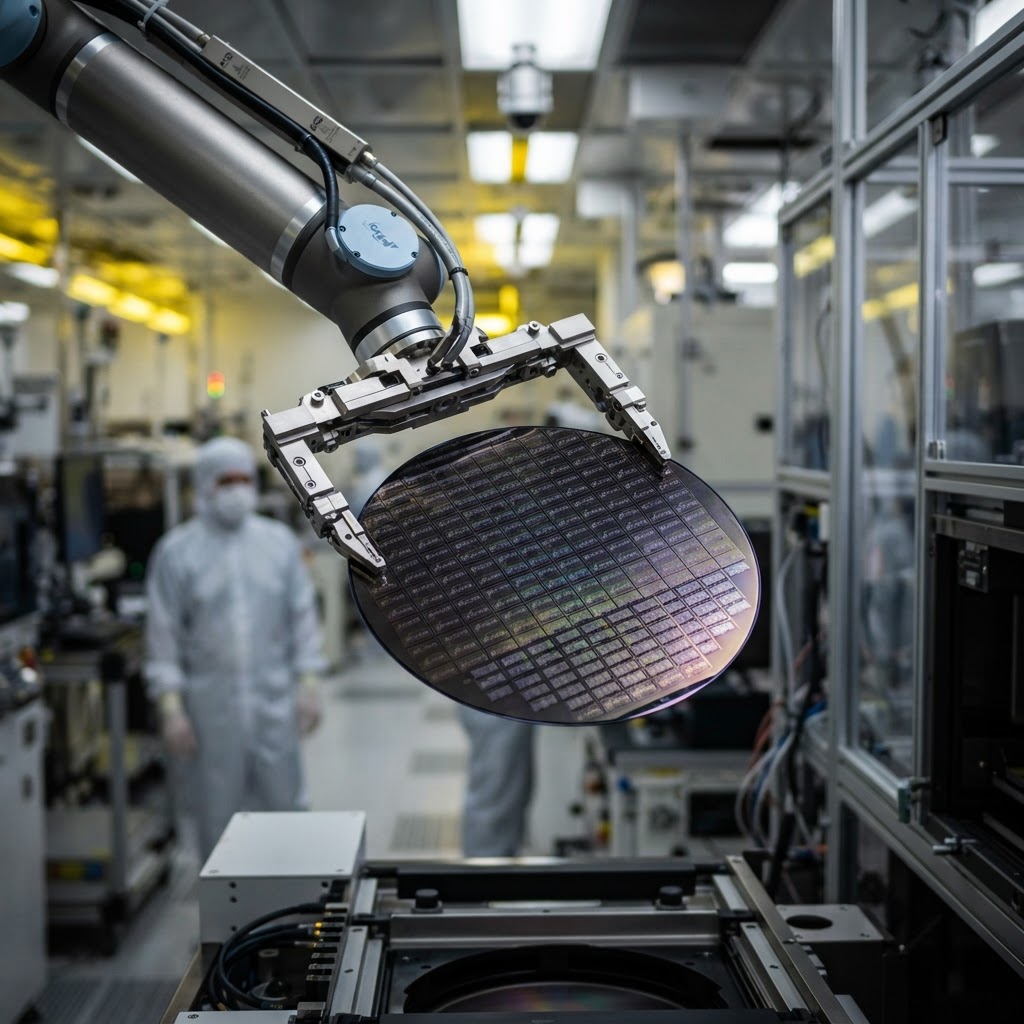
Silicon Ambition Meets American Soil
In an era when semiconductor supply chains have become a matter of national urgency, Micron Technology is making one of the boldest manufacturing bets in U.S. industrial history. The Boise, Idaho-based company is transforming a patch of high desert into what will become the largest semiconductor fabrication complex ever built on American soil. For manufacturing and industrial leaders watching from the sidelines, this is not just a chip story.
It is a masterclass in long-horizon capital commitment and strategic positioning.
Micron is the only U.S.-based company that designs and manufactures both DRAM and NAND flash memory at scale. With data centers, AI accelerators, electric vehicles, and advanced industrial automation all demanding more memory bandwidth, the timing of Micron's expansion could not be more deliberate. The company has positioned itself at the intersection of every major technology growth curve happening right now.
Understanding how Micron is building, funding, and marketing its megafab strategy offers lessons that extend far beyond the semiconductor sector. Industrial companies in steel, chemicals, advanced materials, and precision manufacturing can extract real competitive intelligence from how Micron is executing at scale.
Inside Micron's Manufacturing Footprint and Financial Scale
Micron reported revenue of approximately $25.1 billion in its fiscal year 2024, a sharp recovery driven by surging demand for high-bandwidth memory (HBM) used in AI inference and training systems. The company operates fabrication facilities across the United States, Japan, Taiwan, and Singapore, with its Idaho campus serving as the nerve center of its domestic DRAM production strategy.
The Idaho megafab project, centered in Clay, Idaho (near Boise), is backed by a projected investment of up to $15 billion through 2030, with additional phases potentially pushing total investment past $100 billion over the following decade. This is a multi-generational capital commitment, not a short-term plant upgrade. Micron has secured up to $6.1 billion in direct funding under the U.S.
CHIPS and Science Act, one of the largest single awards made under the program.
Micron's global manufacturing workforce exceeds 40,000 employees, and the Idaho project alone is expected to create approximately 17,000 direct and indirect jobs in the region over time. The sheer labor and infrastructure requirements of a facility like this ripple through local supply chains for construction, utilities, chemicals, and specialized equipment.
For industrial buyers and suppliers evaluating Micron as a partner or customer, these numbers signal stability and long-term procurement demand. Companies that supply ultra-pure water systems, specialty gases, precision robotics, or cleanroom construction services are looking at a decade-plus of contract opportunity tied directly to this single expansion.
Node Leadership and the Technology Stack Driving Production Efficiency
Micron's competitive advantage is rooted in its leadership in advanced DRAM node technology. The company has been ramping production of its 1-beta (1β) DRAM node, which delivers roughly 35 percent improvement in bit density compared to the prior generation. This kind of density gain directly reduces cost-per-bit and improves the economics of each wafer produced.
High-bandwidth memory has become the headline product for Micron's technology roadmap. HBM3E, Micron's latest-generation product, delivers memory bandwidth exceeding 1.2 terabytes per second per stack. Major AI chip customers, including Nvidia, have qualified Micron's HBM3E for use in next-generation GPU platforms, giving Micron a direct revenue link to the AI infrastructure buildout.
The Idaho megafab will be purpose-built to manufacture leading-edge DRAM at volume using extreme ultraviolet (EUV) lithography. EUV tools, supplied primarily by ASML, cost upward of $200 million each and require highly specialized facility infrastructure including vibration dampening, temperature control within fractions of a degree, and particle-free environments measured in parts per trillion. Building a facility capable of housing and operating these tools is itself a feat of industrial engineering.
Micron has also invested heavily in its packaging technology, using through-silicon via (TSV) stacking to assemble HBM products. Advanced packaging is increasingly where competitive differentiation happens in memory, and Micron's vertical integration from wafer fabrication through final packaging gives it cost and quality advantages that fabless competitors cannot easily replicate.
What Industrial B2B Companies Can Learn from Micron's Growth Playbook
Micron's approach to market positioning offers a blueprint that industrial companies across sectors should study carefully. Rather than competing solely on commodity pricing, Micron has invested in application-specific product development, working directly with hyperscale data center operators and AI chip designers to co-engineer memory solutions tailored to specific workloads. This kind of deep customer integration transforms a supplier into a strategic partner.
The company has also been deliberate about using public policy as a business development tool. By engaging aggressively with the CHIPS Act process, Micron secured federal funding that de-risks its capital investment while simultaneously raising the political and economic cost of any future competitor gaining the same support. Industrial manufacturers in energy, defense supply chains, and critical materials would benefit from applying the same policy-first thinking to their own expansion strategies.
Micron's communications strategy has also evolved significantly. The company now produces detailed manufacturing and sustainability reports that speak directly to procurement teams at major technology companies. These documents highlight yield rates, energy consumption per gigabyte, water recycling performance, and workforce development metrics.
For B2B industrial companies, this level of operational transparency is increasingly what enterprise customers require before signing long-term supply agreements.
If your company is planning a major capital expansion or entering a new market segment, now is the time to audit how your marketing and business development functions align with your operational capabilities. The companies that win large industrial contracts in the next decade will be the ones that can tell a credible, data-rich story about what they build and how they build it.
The Road Ahead: Strategic Implications for Micron and the Broader Industry
The Idaho megafab is not just a manufacturing project. It is a geopolitical statement. As the U.S. government continues to restrict advanced chip exports to certain markets and works to reduce dependence on Asian semiconductor supply chains, Micron's domestic expansion positions the company as a preferred supplier for U.S. defense contractors, federal agencies, and companies prioritizing supply chain resilience.
Analysts project the global DRAM market will grow from approximately $90 billion in 2024 to over $130 billion by 2027, driven primarily by AI server deployments and the continued expansion of edge computing infrastructure. Micron is investing ahead of that demand curve, which requires both financial confidence and operational precision. Companies that can build at the pace of demand growth, rather than chasing it, tend to capture disproportionate market share.
For Micron's industrial suppliers and ecosystem partners, the megafab expansion also creates a compounding effect. Every new fabrication bay requires updated chemical delivery systems, additional wastewater treatment capacity, expanded power infrastructure, and ongoing maintenance contracts. The supplier ecosystem around a modern semiconductor fab is itself a multi-billion-dollar industrial economy.
The broader lesson for manufacturing leaders is that scale investments made during periods of market uncertainty tend to produce the strongest returns when demand recovers. Micron's willingness to commit capital through a challenging memory pricing cycle in 2024 reflects a discipline that separates category leaders from cycle followers. Industrial companies that are evaluating capacity expansion in 2025 and 2026 should take note: the best time to build is before your competitors realize they need to.
Key Takeaways
- Micron secured up to $6.1 billion in CHIPS Act funding, one of the largest awards under the program, directly supporting its Idaho DRAM megafab.
- The company reported approximately $25.1 billion in fiscal year 2024 revenue, reflecting a strong recovery driven by AI-related HBM demand.
- Micron's 1-beta DRAM node delivers roughly 35 percent improvement in bit density over the prior generation, reducing cost-per-bit at scale.
- The global DRAM market is projected to grow from approximately $90 billion in 2024 to over $130 billion by 2027, a trend Micron is positioning to capture ahead of competitors.
Key Quotes
"We are building the future of American semiconductor manufacturing, and Idaho is where that future begins." — Sanjay Mehrotra, President and CEO of Micron Technology
"The CHIPS Act is about more than subsidies. It is about reestablishing the United States as a place where the world's most advanced technology gets made." — Gina Raimondo, Former U.S. Secretary of Commerce
References
- Micron Technology Investor Relations — official financial reports, earnings releases, and CHIPS Act funding announcements
- U.S. Department of Commerce CHIPS Program Office — details on CHIPS Act awards including Micron's $6.1 billion funding agreement
- SEMI Industry Data and Reports — semiconductor market size projections and manufacturing capacity analysis