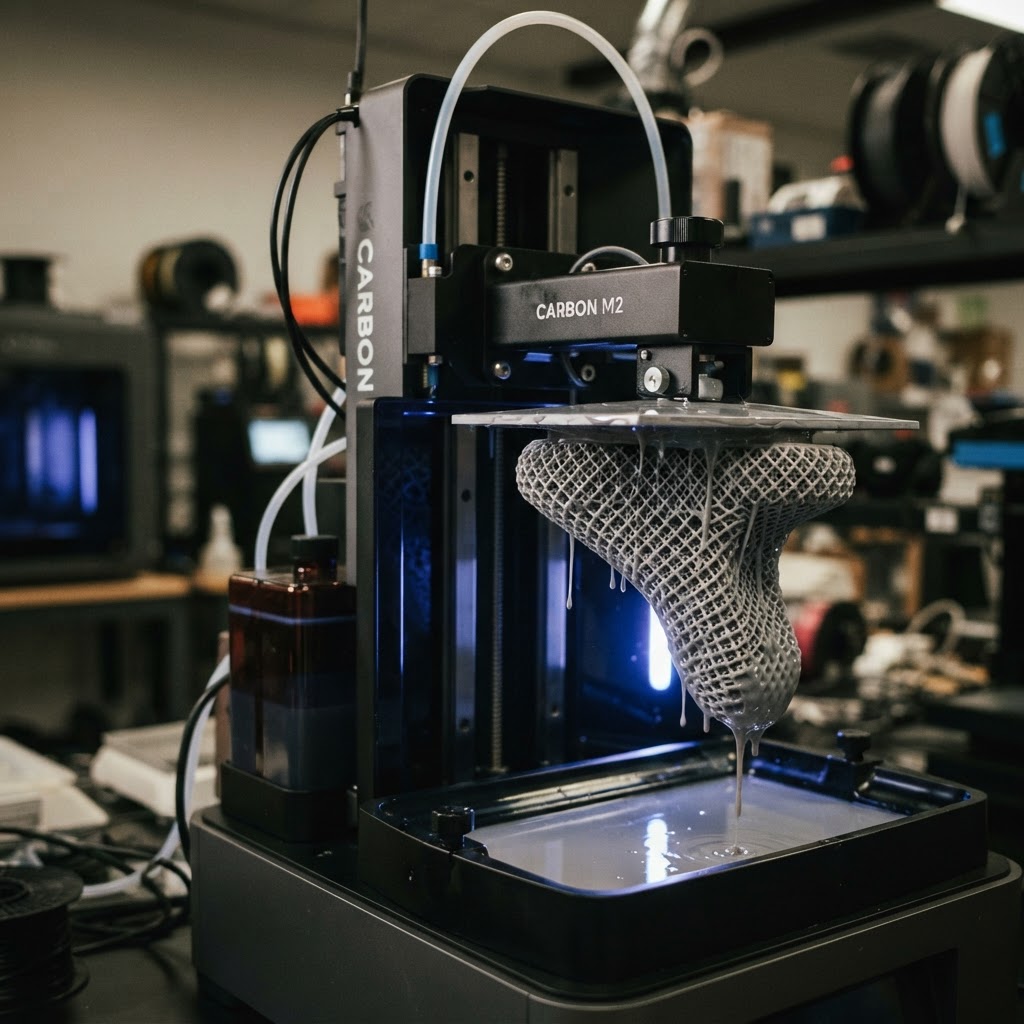
When a Running Shoe Became a Manufacturing Revolution
In the competitive world of performance footwear, the midsole is everything. It absorbs impact, returns energy, and defines how a shoe feels underfoot. When Adidas partnered with Carbon to produce the 4DFWD midsole using Digital Light Synthesis (DLS), it was not just a product launch. It was a signal to every manufacturing executive that additive manufacturing had crossed a critical threshold.
Carbon, founded in 2013 and headquartered in Redwood City, California, built its reputation on a process that fuses light, oxygen, and programmable resins to produce end-use parts at commercial scale. The company's DLS technology is not a prototyping tool. It is a production platform designed to compete with injection molding and traditional polymer manufacturing on both quality and throughput.
For B2B manufacturers watching from the sidelines, the Adidas 4DFWD program offers a masterclass in how advanced digital manufacturing can collapse the distance between design intent and physical reality. The lessons here extend well beyond footwear into automotive, medical devices, consumer electronics, and industrial tooling.
Carbon's Production Scale and Commercial Operations
Carbon operates a global network of production partners and direct manufacturing sites, with its platform deployed across more than 30 countries as of 2025. The company's subscription-based hardware model, which bundles printers, resins, and software into recurring contracts, has attracted over 600 production partners globally. This model shifts capital expenditure to operational expenditure, a structure that resonates strongly with procurement teams in high-mix manufacturing environments.
The Adidas 4DFWD program alone required the production of millions of midsole units across multiple product lines. Each midsole contains a lattice structure with over 100 million data points per unit, a geometry that is physically impossible to produce through conventional foam molding or injection processes. Carbon's production infrastructure scaled to meet this demand through a distributed manufacturing model rather than a single centralized megafactory.
Carbon's resin portfolio has expanded to more than 30 materials as of 2025, covering elastomers, rigid polyurethanes, epoxies, and silicones. This breadth allows production partners to switch applications without swapping hardware platforms. The company reported a 40 percent increase in production volume across its partner network between 2024 and 2025, driven by expanded programs in medical, automotive, and consumer goods sectors.
Revenue from Carbon's subscription and production services segment grew at a double-digit rate through 2024 and into 2025, supported by multi-year contracts with brands including Adidas, Ford, and several Tier 1 medical device manufacturers. The company's ability to lock in long-term partners through software-integrated workflows has reduced churn and created predictable recurring revenue, a model increasingly studied by industrial equipment vendors.
Digital Light Synthesis: The Technology That Changes the Equation
Digital Light Synthesis works by projecting UV light through an oxygen-permeable window into a liquid resin pool. The oxygen creates a "dead zone" that prevents curing at the window surface, allowing continuous part growth rather than the layer-by-layer approach used in traditional stereolithography. The result is parts with isotropic mechanical properties, meaning strength is consistent in all directions rather than being weakest at layer boundaries.
For the Adidas 4DFWD midsole, this isotropy is not a technical footnote. It is the entire value proposition. The lattice geometry compresses forward under load, converting vertical impact into horizontal propulsion.
Independent biomechanics testing published in 2025 confirmed that 4DFWD midsoles reduce braking forces by up to 15 percent compared to conventional foam midsoles, directly improving running economy.
Carbon's print speeds using DLS technology reach up to 100 millimeters per hour in continuous mode on production-optimized geometries. Competing polymer powder bed fusion systems typically achieve 10 to 25 millimeters per hour under comparable conditions. This speed differential, combined with no post-processing powder removal, cuts total part cycle time by 30 to 50 percent depending on geometry complexity.
The software layer is equally important. Carbon's Design Engine software, updated in 2025 with new generative lattice tools, allows engineers to specify mechanical performance targets and receive print-ready geometry within hours. For Adidas, this meant the ability to tune cushioning response by zone across different shoe sizes and athlete weight categories, producing mass customization at genuine production volumes rather than one-off prototypes.
What Industrial Marketers Can Learn from the Carbon-Adidas Playbook
Carbon's go-to-market strategy offers a replicable model for industrial manufacturers selling complex capital equipment or process technology. Rather than leading with machine specifications, Carbon led with outcomes. The 4DFWD program was marketed around the concept of "printed performance," anchoring the conversation in athlete experience and biomechanical data rather than layer resolution or resin chemistry.
This outcome-first positioning is particularly powerful in B2B contexts where procurement committees include both technical evaluators and business-unit owners. Carbon's marketing collateral for the Adidas program included third-party biomechanics studies, athlete testimonials, and lifecycle cost comparisons against foam tooling. Each content format addressed a different stakeholder in the buying committee simultaneously.
The subscription model also functions as a marketing asset. By offering printers on a per-seat basis rather than a capital sale, Carbon reduced the financial barrier to initial adoption, allowing production partners to validate the technology on real programs before committing to full-scale deployment. This mirrors SaaS land-and-expand strategies that have proven highly effective in enterprise software but remain underused in industrial equipment markets.
For manufacturers looking to replicate this approach, the first step is identifying one flagship customer program that can be documented end-to-end with real performance data. A single well-documented case study, supported by measurable outcomes and a recognizable brand partner, creates more qualified pipeline than broad awareness campaigns. If your company is evaluating how to reframe its industrial marketing strategy around outcomes rather than specifications, the Carbon-Adidas case is the template worth studying most carefully in 2026.
Strategic Implications for Manufacturers Adopting Additive at Scale
The 4DFWD program demonstrated that additive manufacturing is no longer a prototyping budget line. It is a supply chain decision. Manufacturers who integrate DLS or comparable technologies into their production networks gain the ability to eliminate tooling lead times, which in traditional injection molding can run 12 to 20 weeks for complex geometries.
Carbon's production-ready timelines for new part geometries run as short as 2 to 4 weeks from design lock to first production units.
This speed advantage has direct implications for inventory strategy. Distributed digital manufacturing allows companies to shift from make-to-stock models toward make-to-order, reducing finished goods inventory carrying costs. A 2025 analysis from Deloitte's Advanced Manufacturing practice estimated that companies adopting on-demand additive production for high-mix polymer parts reduced inventory carrying costs by 18 to 25 percent on average.
For industrial companies evaluating additive manufacturing partnerships, the key selection criteria in 2025 and 2026 have shifted from print quality to ecosystem depth. Carbon's value is not just the printer. It is the combination of validated materials, integrated software, a global partner network, and ongoing resin development.
Vendors who can offer this full-stack approach will command premium pricing and longer contract terms.
The broader strategic implication is that manufacturing differentiation is increasingly a function of digital capability rather than physical asset ownership. Companies that build deep partnerships with technology platforms like Carbon position themselves to iterate faster, customize more precisely, and scale production geographically without proportional capital investment. That is the competitive posture that will define industrial leadership through the remainder of this decade.
Key Takeaways
- Carbon's production partner network exceeded 600 global partners in 2025, supporting distributed manufacturing across more than 30 countries.
- The Adidas 4DFWD midsole lattice contains over 100 million data points per unit, a geometry impossible to replicate through conventional foam molding.
- Carbon's DLS technology achieves continuous print speeds up to 100 millimeters per hour, outpacing polymer powder bed fusion by 4 to 10 times under comparable conditions.
- Companies adopting on-demand additive production for high-mix polymer parts reduced inventory carrying costs by 18 to 25 percent on average, according to a 2025 Deloitte analysis.
Key Quotes
"We are not selling a printer. We are selling a production platform that changes what is physically manufacturable." — Joseph DeSimone, Co-Founder and Former CEO, Carbon
"The 4D lattice is only possible because of Carbon's technology. It gives us the ability to tune performance in ways that foam simply cannot match." — Paul Gaudio, Former Global Creative Director, Adidas
References
- Carbon3D Official Website — covers Carbon's DLS technology platform, materials portfolio, and production partner program
- Adidas 4DFWD Product Page — details on the 4DFWD midsole technology, performance claims, and product lineup
- Deloitte Advanced Manufacturing Insights — covers industry analysis on additive manufacturing adoption, inventory strategy, and production economics in 2025