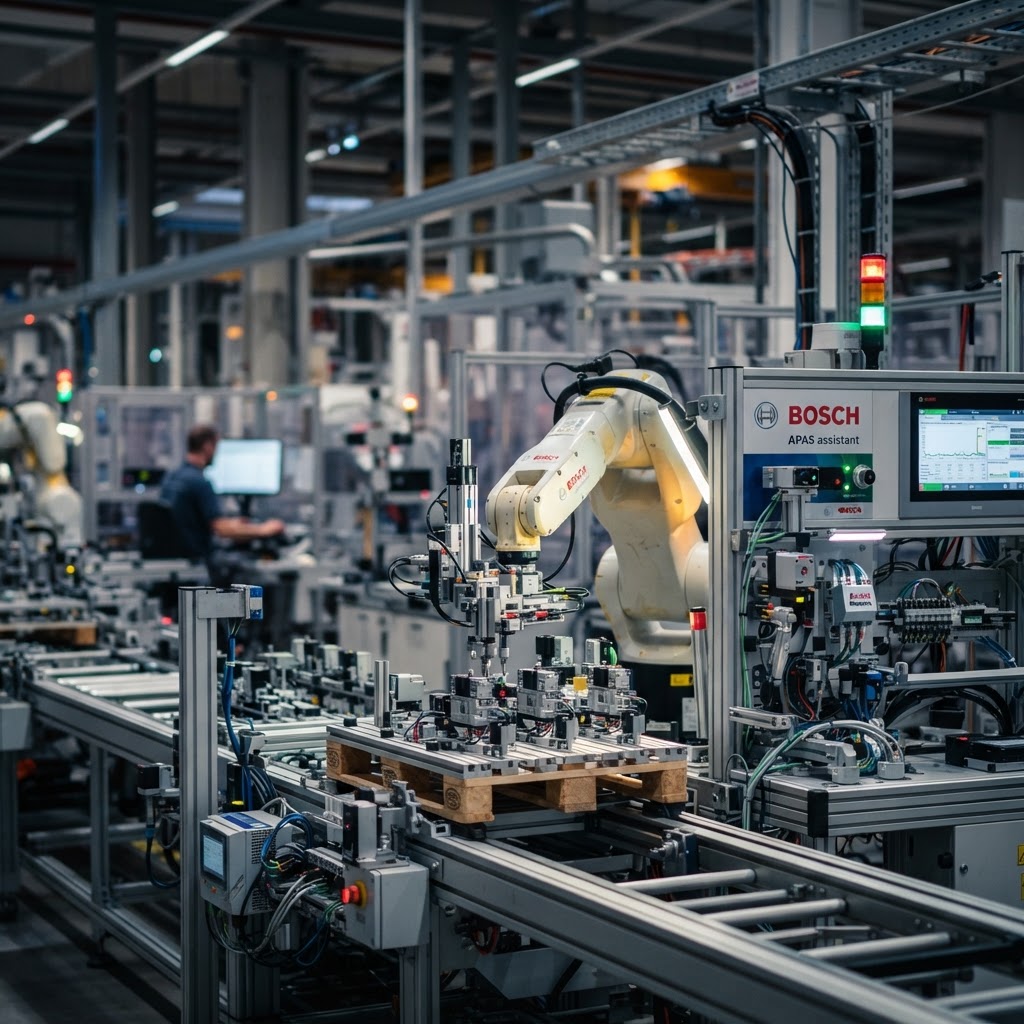
The Factory of Tomorrow Is Already Running in Stuttgart
In an era where manufacturers are racing to digitize operations, one company has quietly built one of the most advanced connected manufacturing ecosystems on the planet. Bosch, the German engineering giant, has not simply adopted Industry 4.0 principles. It has become one of their most visible proof points.
With operations spanning more than 270 manufacturing locations worldwide, Bosch is demonstrating at scale what intelligent, connected production actually looks like in practice.
The story of Bosch's industrial transformation is not just a technology story. It is a business strategy story, a workforce story, and a competitive differentiation story rolled into one. For manufacturing and industrial companies evaluating their own digital journeys, Bosch offers a rare and detailed blueprint.
The company has invested billions, iterated relentlessly, and turned its own factories into living laboratories.
This report examines how Bosch Manufacturing Solutions and the broader Bosch connected factory initiative are reshaping industrial production, what the data reveals about performance gains, and what B2B manufacturers can learn from the approach.
Bosch's Manufacturing Footprint and Financial Muscle
Bosch reported total sales of approximately 91.6 billion euros in its 2024 annual results, with the Industrial Technology sector, which includes manufacturing solutions and automation, contributing meaningfully to that figure. The company employs roughly 429,000 people globally, with a significant share working directly in production and engineering roles. This scale gives Bosch both the resources to invest heavily in innovation and the operational complexity that makes smarter manufacturing a genuine business necessity.
The Bosch Manufacturing Solutions (BMS) division operates as an internal solutions provider that also offers its technology and expertise to external customers. BMS supports Bosch's global plant network while simultaneously marketing connected factory platforms, assembly systems, and process automation tools to third-party industrial clients. This dual mandate sharpens its commercial discipline in ways that purely internal IT initiatives rarely achieve.
In 2024, Bosch invested approximately 7.1 billion euros in research and development across the group, maintaining one of the highest R&D intensity ratios in the global manufacturing sector. A meaningful portion of that investment has been directed toward software-defined manufacturing, AI-enabled quality control, and connected sensor infrastructure. The company holds more than 40,000 active patents, underscoring the depth of its technical differentiation.
Bosch's Automotive Technology division remains its largest revenue contributor, but the Industrial Technology and Energy and Building Technology segments are growing in strategic importance. The pivot toward cross-sector connected manufacturing platforms reflects a deliberate effort to diversify revenue and reduce cyclical exposure to automotive production volumes.
Intelligent Factories and the Connected Production Ecosystem
Bosch's Industry 4.0 strategy is organized around four pillars: connected machines, data-driven quality, predictive maintenance, and flexible automation. The company has deployed its own Industrial Internet of Things (IIoT) platform, called the Bosch IoT Suite, across dozens of its internal plants, collecting billions of data points per day from sensors, assembly lines, and logistics systems. By 2025, Bosch had connected more than 280,000 machines and devices across its global factory network.
One of the most compelling performance metrics comes from Bosch's predictive maintenance programs. The company reports that AI-powered predictive maintenance has reduced unplanned downtime by up to 25 percent in pilot plants, translating directly into higher overall equipment effectiveness (OEE) scores. At the Homburg plant in Germany, which produces hydraulic components, connected sensor data and machine learning models have helped cut energy consumption by roughly 12 percent year over year.
Bosch Manufacturing Solutions has also developed a modular assembly platform called the ActiveMover, a linear transport system designed for high-precision, high-throughput production lines. ActiveMover installations are now deployed across industries including medical devices, electronics, and automotive tier-one suppliers. The system enables rapid line reconfiguration, which is increasingly critical as product lifecycles shorten and batch sizes decrease across manufacturing sectors.
On the quality assurance front, Bosch has integrated AI-based visual inspection systems that process images at speeds and accuracy levels beyond human capability. In surface inspection applications, these systems have achieved defect detection rates exceeding 99.5 percent, according to internal Bosch benchmarks published in 2025. This level of precision directly reduces scrap rates, warranty claims, and customer returns, creating measurable financial value across the supply chain.
Marketing and Growth Lessons for Industrial B2B Companies
Bosch's commercial approach with Bosch Manufacturing Solutions offers a powerful lesson for industrial companies: turn internal excellence into external credibility. By operating its own factories as live demonstration environments, Bosch can invite prospective customers to see its connected manufacturing technology performing in real production conditions, not in a showroom or a simulation. This proof-based selling model is enormously effective in a sector where buyers are skeptical of vendor claims.
The BMS division also uses a clearly segmented go-to-market strategy, targeting discrete manufacturing verticals such as automotive, electronics, and consumer goods with industry-specific use cases rather than generic automation pitches. This vertical specialization allows Bosch sales teams to speak fluently about line-specific KPIs, regulatory environments, and integration challenges that matter most to each buyer. For B2B manufacturers looking to grow their industrial customer base, vertical depth almost always outperforms horizontal breadth in complex solution selling.
Content and thought leadership play an important role in Bosch's industrial marketing mix. The company publishes detailed case studies, white papers, and technical documentation through the Bosch Expert Hub and its manufacturing-focused digital channels. These resources serve both lead generation and buyer education functions, helping procurement teams and plant managers build internal business cases for investment.
Industrial companies that invest in substantive technical content consistently see shorter sales cycles and higher close rates.
Finally, Bosch has leaned into partnerships and ecosystem building as a growth accelerator. Collaborations with SAP on manufacturing execution systems and with major cloud providers on edge computing infrastructure have expanded BMS's addressable market and accelerated product development timelines. For mid-market industrial manufacturers, identifying two or three strategic technology partners can dramatically extend capabilities without requiring proportional increases in internal headcount.
Strategic Outlook: What Comes Next for Connected Manufacturing
Bosch has signaled clearly that software will become an increasingly central part of its industrial business model. In 2025, the company announced plans to grow software-related revenues to more than 10 billion euros annually by the end of the decade, with a significant share tied to manufacturing and automation applications. This shift toward software and services revenue reflects a broader industry trend: customers increasingly want ongoing optimization support rather than one-time hardware installations.
AI integration will intensify across every layer of the Bosch factory platform. From generative AI tools that assist process engineers in root cause analysis to reinforcement learning algorithms that autonomously adjust production parameters in real time, the intelligence embedded in connected factories will compound in capability over the next several years. Bosch has established dedicated AI centers in Germany, India, and the United States to accelerate this development.
Sustainability is also becoming a core axis of industrial competitiveness, not merely a compliance requirement. Bosch has committed to maintaining carbon neutrality across its own operations, a status it achieved ahead of schedule, and is now helping customers reduce scope 3 emissions through energy-optimized production systems. As industrial buyers increasingly face their own decarbonization mandates, suppliers who can demonstrate measurable energy efficiency gains will hold a distinct competitive advantage.
For manufacturing and industrial companies evaluating their own Industry 4.0 roadmaps, the Bosch model offers a clear starting point: connect your highest-value assets first, build data infrastructure before chasing AI applications, and treat your own operations as your most credible sales tool. If you are ready to benchmark your connected manufacturing maturity against industry leaders, contact your technology partners today and begin with a focused pilot plant assessment.
Key Takeaways
- Bosch reported total sales of 91.6 billion euros in 2024, with approximately 7.1 billion euros reinvested in R&D, sustaining one of the highest innovation intensity rates in global manufacturing.
- By 2025, Bosch had connected more than 280,000 machines and devices across its global factory network through its IIoT platform infrastructure.
- AI-powered predictive maintenance programs have reduced unplanned downtime by up to 25 percent in Bosch pilot plants, delivering measurable OEE improvements.
- Bosch has set a target to grow software-related revenues to over 10 billion euros annually by the end of the decade, signaling a fundamental business model shift toward recurring digital revenue.
Key Quotes
"We are not just a hardware company anymore. Software and services are becoming the backbone of our industrial value proposition." — Stefan Hartung, Chairman of the Board of Management, Bosch Group
"Industry 4.0 is not a destination. It is a continuous improvement journey that requires investment, patience, and the willingness to learn from your own production data." — Rolf Najork, Member of the Board of Management, Bosch Group, Industrial Technology
References
- Bosch Annual Report 2024 — Official source for Bosch Group financials, R&D investment figures, and strategic priorities
- Bosch Manufacturing Solutions — Overview of BMS product portfolio including ActiveMover, assembly systems, and connected factory services
- Bosch IoT and Digitalization — Bosch's published overview of its Industry 4.0 strategy, IIoT deployments, and connected manufacturing case studies