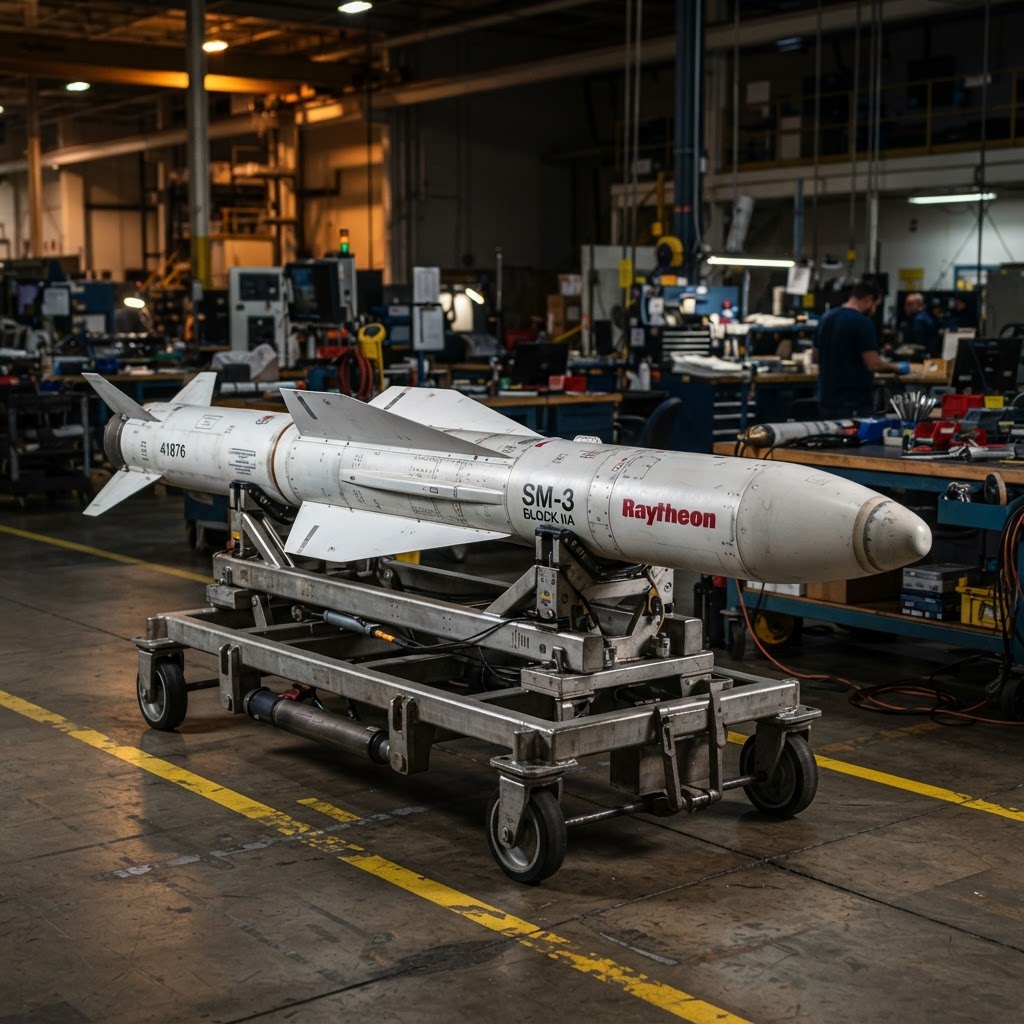
The Front Line Starts on the Factory Floor
When a Patriot missile intercepts a ballistic threat at 50,000 feet, the outcome was determined long before launch. It was determined on a production floor in Tucson, Arizona, where tolerances are measured in microns and every component is traceable to a specific operator and timestamp. Raytheon Technologies, now operating as RTX Corporation, has built one of the most sophisticated defense manufacturing ecosystems in the world.
The company's missile defense segment is not simply an assembly operation. It is a vertically integrated manufacturing enterprise that spans propulsion, guidance electronics, seeker technology, and systems integration under one strategic roof. For industrial and B2B manufacturing leaders, Raytheon's model offers a masterclass in scaling precision production without sacrificing quality or speed.
As global demand for integrated air defense systems surges in response to shifting geopolitical conditions, Raytheon's production infrastructure is under more scrutiny and more pressure than ever before. Understanding how the company has engineered its manufacturing operations to meet that demand reveals lessons applicable far beyond the defense sector.
Inside Raytheon's Missile Defense Production Infrastructure
RTX's Raytheon segment reported full-year 2024 net sales of approximately 27 billion dollars, with its missile and defense systems division accounting for a substantial share of that revenue. The Tucson facility alone spans over 1.6 million square feet and employs more than 12,000 workers, making it one of the largest defense manufacturing campuses in North America. Production lines at the facility are responsible for the Patriot Advanced Capability-3 (PAC-3), the Standard Missile family, and the Evolved SeaSparrow Missile (ESSM).
Backlog figures tell an even more compelling story. RTX reported a total company backlog of approximately 218 billion dollars entering 2025, with the Raytheon segment holding the largest share of funded defense contracts. The Patriot system alone has been ordered or committed to by more than 19 nations, driving a production ramp that required Raytheon to add over 3,000 manufacturing jobs across its defense facilities in 2024.
Raytheon's supply chain integration is equally impressive. The company sources more than 60 percent of its missile system components from a network of certified domestic suppliers, many of which are co-located within 200 miles of the Tucson campus. This geographic clustering reduces lead times, simplifies quality audits, and builds resilience against single-source disruptions.
Capital investment has kept pace with demand. RTX committed more than 2.5 billion dollars in capital expenditure across its defense manufacturing network in 2024, a significant portion of which was directed at expanding missile production capacity and modernizing test and verification infrastructure. This level of reinvestment signals a company treating its production floor as a strategic asset, not a cost center.
Manufacturing Intelligence: How Raytheon Builds Precision at Scale
At the core of Raytheon's production advantage is its Model-Based Systems Engineering (MBSE) framework, which creates a digital thread connecting design intent to physical production output. Every missile system component is tied to a digital model that tracks its manufacturing history, inspection results, and performance test data. This approach has reduced engineering change cycle times by an estimated 30 percent compared to traditional documentation-based workflows.
Raytheon has invested heavily in automated assembly and robotic integration across its guidance and seeker manufacturing lines. Automated optical inspection systems now handle more than 80 percent of circuit board verification tasks on the Patriot guidance electronics line, reducing human error rates and cutting inspection time per unit by nearly 40 percent. The company's adoption of collaborative robotics (cobots) in final assembly has also improved ergonomic conditions while maintaining the fine-motor precision that missile integration demands.
Additive manufacturing has moved from prototype support to production-relevant application at Raytheon. In 2024, the company qualified over 150 additively manufactured parts for use in fielded missile systems, including structural brackets and thermal management components. This capability shortens the path from design modification to production insertion, which is critical when responding to evolving threat profiles and customer specifications.
Cybersecurity is embedded directly into the manufacturing process, not bolted on afterward. Raytheon's production networks operate under a Zero Trust architecture that monitors data flows between CNC machines, test equipment, and quality management systems in real time. This approach aligns with Department of Defense Cybersecurity Maturity Model Certification (CMMC) Level 3 requirements and positions Raytheon as a benchmark for secure industrial operations in the defense supply chain.
What Industrial Manufacturers Can Learn From Raytheon's Growth Playbook
Raytheon's growth is not accidental. It is the result of a disciplined strategy that aligns production investment with long-term contract visibility. The company uses its multi-decade program relationships, some Patriot contracts span 20-plus years of sustainment and upgrade cycles, to justify large capital commitments that shorter-cycle manufacturers cannot replicate.
Industrial companies serving OEM or government markets should consider how multi-year service agreements and lifecycle contracts can anchor similar investment decisions.
Brand positioning in defense manufacturing is built on demonstrated performance, not advertising spend. Raytheon's marketing strategy centers on published intercept success rates, international interoperability certifications, and third-party validated reliability data. For B2B manufacturers in adjacent sectors, the takeaway is clear: technical credibility is the most durable form of brand equity, and it must be earned on the production floor before it can be communicated in the market.
Raytheon's workforce development model is also instructive. The company runs apprenticeship and technician certification programs in partnership with Arizona and New Mexico community colleges, creating a pipeline of credentialed manufacturing talent that reduces hiring friction and onboarding time. Industrial companies struggling with skilled labor shortages should examine this co-investment model as a scalable alternative to purely reactive recruiting.
Foreign Military Sales (FMS) have become a major growth engine for Raytheon, with international missile defense orders representing a growing share of new contract awards in 2025. The company's ability to navigate complex FMS regulatory frameworks while maintaining production schedules is a competitive differentiator that smaller defense and industrial suppliers actively seek to emulate. If your organization serves regulated export markets, building dedicated compliance and program management capability is no longer optional.
It is a growth prerequisite.
The Strategic Horizon: Air Defense Manufacturing in a Multipolar World
Global demand for integrated air and missile defense systems is projected to grow at a compound annual growth rate of approximately 7.5 percent through 2030, according to defense market analysts tracking NATO expansion commitments and Indo-Pacific procurement cycles. Raytheon is positioned at the center of this growth, with active production programs serving customers across Europe, the Middle East, and the Asia-Pacific region. The company's manufacturing scalability will be tested as these programs mature simultaneously.
RTX has signaled plans to expand its missile production footprint further, with reports in early 2025 indicating potential new facility investments in the southeastern United States to diversify geographic risk and tap alternative labor markets. These decisions reflect a broader industrial logic: as program volumes grow, single-site dependency becomes a strategic liability. Distributed manufacturing networks offer resilience, though they demand more sophisticated coordination and quality management systems.
The integration of artificial intelligence into production planning is the next frontier for Raytheon's manufacturing operations. Predictive maintenance algorithms are already deployed across major CNC equipment fleets at the Tucson facility, and the company is piloting AI-assisted scheduling tools that optimize labor and machine utilization across multi-shift production lines. Early results suggest throughput improvements of 12 to 18 percent on constrained assembly stations.
For industrial manufacturers watching Raytheon's trajectory, the strategic implication is direct: the companies that will win the next decade of defense and industrial manufacturing are those that treat production capability as a strategic moat. Investment in digital infrastructure, workforce development, and supply chain integration is not overhead. It is the product.
If your organization is ready to benchmark your manufacturing operations against world-class standards and build a credibility-driven growth strategy, now is the time to act.
Key Takeaways
- Raytheon's parent company RTX reported approximately 27 billion dollars in Raytheon segment net sales for full-year 2024, driven by surging global missile defense demand.
- RTX entered 2025 with a total backlog of approximately 218 billion dollars, providing multi-year production visibility that enables large-scale capital investment decisions.
- Raytheon qualified over 150 additively manufactured parts for fielded missile systems in 2024, reflecting a meaningful shift from prototype to production-grade additive use.
- Automated optical inspection systems now handle more than 80 percent of circuit board verification tasks on Patriot guidance electronics lines, cutting inspection time by nearly 40 percent per unit.
Key Quotes
"We are investing in our factories and our people because production capacity is national security capacity. The demand signal is real and we are responding to it." — Gregory Hayes, Executive Chairman, RTX Corporation
"The Patriot system's reliability record is a direct reflection of the rigor we apply on the production floor. Every interceptor that performs in the field was built to a standard, not to a schedule." — Wesley Kremer, President, Raytheon
References
- RTX Corporation Investor Relations — Official source for RTX annual reports, earnings releases, and backlog data for 2024 and 2025
- Defense Security Cooperation Agency — Covers Foreign Military Sales approvals and Patriot system international orders
- DefenseNews RTX Coverage — Reporting on Raytheon facility investments and missile production ramp activities in 2025