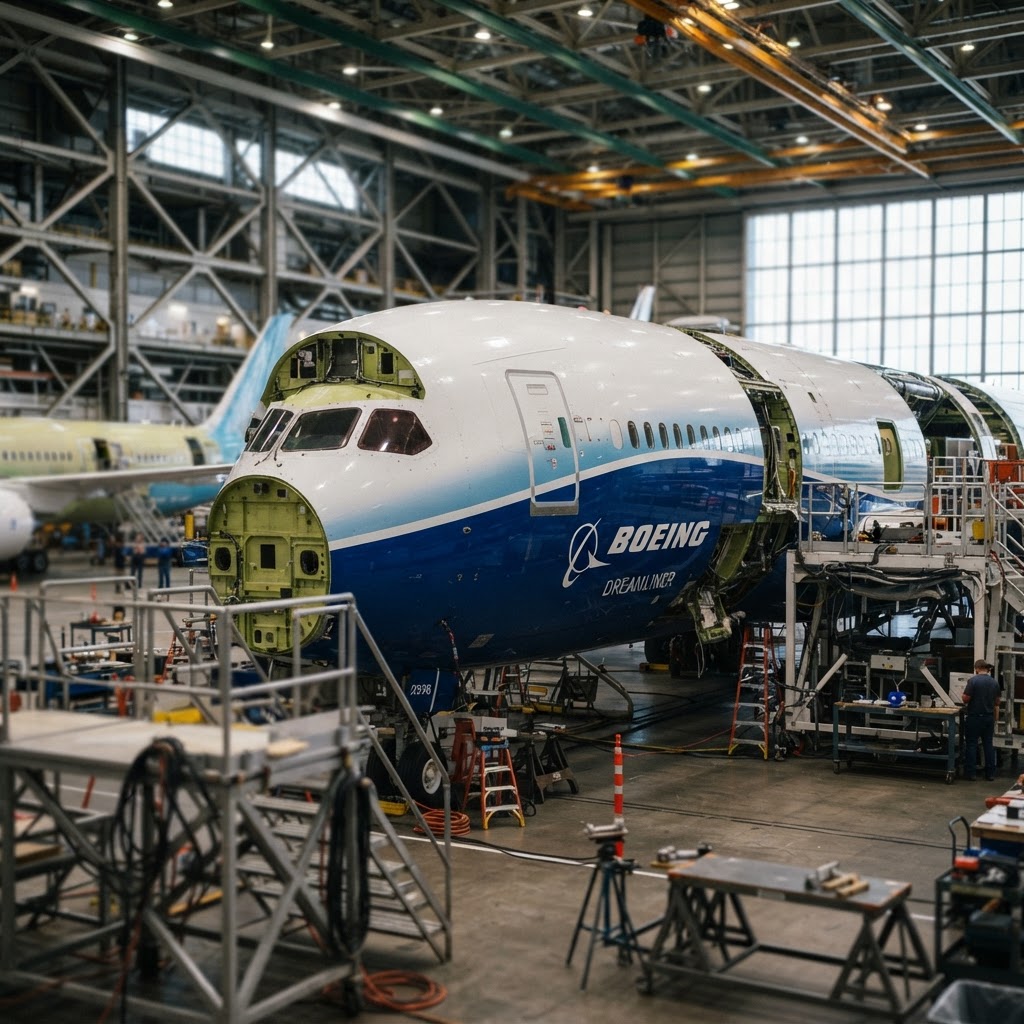
The Giant Wakes: Boeing's Everett Factory and the Road Back to Scale
Few manufacturing facilities on earth command the sheer scale of Boeing's Everett, Washington plant. Spanning more than 98 acres under a single roof, the Everett factory is the largest building by volume in the world, housing final assembly lines for the 787 Dreamliner and 777 families. For industrial and B2B decision-makers watching large-scale manufacturing recovery in real time, Boeing's Everett operations offer a masterclass in complexity, resilience, and strategic reinvention.
Boeing entered 2025 carrying the weight of a prolonged production crisis. Quality escapes, supplier disruptions, and regulatory scrutiny had throttled 787 output for years, forcing the company to rework hundreds of aircraft and absorb billions in charges. Yet by mid-2025, Boeing had begun demonstrating measurable progress on its recovery roadmap, with production rates climbing and its commercial backlog holding firm.
For B2B manufacturers in aerospace supply chains, industrial tooling, and advanced materials, Boeing's recovery is not just news. It is a strategic signal about where investment, process discipline, and supplier partnership are headed across the entire sector.
Anatomy of a Recovery: Production Rates, Backlog, and Financial Realities
Boeing's 787 program had been producing aircraft at rates well below its intended five-per-month target through much of 2024. By early 2025, the company confirmed it was targeting a return to five 787s per month by the end of 2025, with longer-term ambitions to push toward ten per month as demand from carriers like United Airlines, Air India, and Riyadh Air continued to build. The global backlog for the 787 family stood at over 500 aircraft entering 2025, representing years of contracted revenue.
Boeing's total commercial backlog exceeded 5,500 aircraft as of its 2024 annual report, valued at approximately $440 billion. The 787 and 777X programs represent a substantial share of that figure, underscoring just how much industrial output is riding on Everett's ability to execute. Every month of delayed delivery carries direct financial consequence, including penalty clauses and deferred cash flows.
The company reported 2024 revenues of approximately $66 billion across its commercial, defense, and services segments. Commercial airplanes accounted for the largest revenue segment, though margins remained under pressure from abnormal production costs tied to rework and quality remediation. Boeing's new CEO Kelly Ortberg, who took the role in mid-2024, has made production system stability and supplier quality the centerpiece of his operational agenda.
For Tier 1 and Tier 2 suppliers, these production rate targets are direct demand signals. Spirit AeroSystems, which supplies 787 fuselage sections, was in the process of being reintegrated into Boeing in 2024 and 2025, a move designed to tighten quality control at the most critical juncture in the assembly process.
Precision at Altitude: Technology and Process Innovation Inside the 787 Line
The 787 Dreamliner was already a technological landmark when it entered service, built primarily from carbon fiber reinforced polymer composites rather than traditional aluminum. That composite-heavy design, which accounts for roughly 50 percent of the aircraft's structural weight, demanded entirely new assembly tooling, automated fiber placement machines, and precision inspection systems. The Everett facility has invested heavily in non-destructive testing technologies to verify composite integrity at every stage of assembly.
Boeing has deployed automated drilling and fastening systems along its 787 fuselage join lines, reducing human variability in one of the most tolerance-sensitive operations in commercial aircraft production. These systems can place fasteners with sub-millimeter precision at rates no manual operator can consistently match. The result is measurable reduction in rework cycles, which had been a significant cost driver during the crisis period.
Digital thread technology plays an increasingly central role in Boeing's quality management approach at Everett. Each 787 accumulates a digital record of every inspection, torque value, and dimensional check performed during assembly, creating a traceable data backbone that supports both regulatory compliance and continuous improvement. The FAA's heightened oversight of Boeing through 2024 and into 2025 made this kind of data traceability not just a competitive advantage but a compliance requirement.
Boeing has also leaned into model-based definition practices, replacing paper-based engineering drawings with fully digital 3D models that communicate directly to manufacturing execution systems on the factory floor. This reduces translation errors between engineering intent and production execution, a category of defect that contributed to several of the quality escapes that triggered regulatory scrutiny in 2024.
What Industrial Marketers Can Learn From Boeing's Recovery Playbook
Boeing's situation offers B2B marketers a counterintuitive lesson: transparency about operational challenges, when paired with a credible recovery narrative, can actually reinforce long-term customer confidence. Kelly Ortberg's public acknowledgment of Boeing's production system weaknesses, combined with specific commitments to supplier reintegration and workforce investment, gave major airline customers enough visibility to maintain their order positions rather than defect to Airbus.
For industrial companies selling into aerospace supply chains, Boeing's recovery priorities define a clear marketing opportunity map. Suppliers of precision measurement systems, automated assembly equipment, composite inspection technology, and digital manufacturing software are all positioned to benefit from Boeing's drive to modernize its production infrastructure. Marketing messaging that speaks directly to rework reduction, first-pass quality rates, and regulatory traceability will resonate strongly with Boeing procurement teams and their counterparts at other airframers.
Boeing's decision to reabsorb Spirit AeroSystems illustrates a broader strategic shift toward vertical integration as a quality control mechanism. Industrial suppliers that can demonstrate deep integration capability, rather than just component delivery, will find stronger purchase in this environment. Thought leadership content, technical white papers, and case studies showing measurable quality outcomes carry more weight than generic capability brochures in this buying context.
The Boeing recovery story also underscores the importance of production rate scalability as a sales argument. Airlines and airframers do not just need solutions that work at today's volume. They need partners who can scale alongside them as rates climb from five to ten aircraft per month.
If your company markets to aerospace manufacturers, now is the time to quantify and communicate your own scalability credentials. Request a conversation with our team to explore how your manufacturing story can be positioned for this moment.
Flight Path Forward: Strategic Implications for Boeing and Its Industrial Ecosystem
Boeing's 2025 and 2026 trajectory hinges on several interdependent variables: FAA production caps, supplier ramp readiness, workforce stabilization following 2024 labor actions, and the successful introduction of the 777X into service. The 777X program, which targets certification in 2025, will add another complex assembly program to Everett's workload, requiring careful resource allocation across both lines.
The competitive landscape adds urgency. Airbus delivered 766 commercial aircraft in 2024, maintaining a significant lead over Boeing's delivery count for the year. Boeing delivered 348 commercial aircraft in 2024, a figure that reflected both the 737 MAX quality investigation fallout and 787 production constraints.
Closing that gap requires not just faster production but cleaner production, where first-time quality eliminates the rework loops that consumed capacity and cash.
For the broader industrial ecosystem around Everett, a sustained Boeing recovery translates into multi-year demand for specialized labor, advanced tooling, and supply chain investment across the Pacific Northwest and beyond. Economic modeling from the Washington State Department of Commerce has consistently highlighted Boeing's outsized multiplier effect on regional manufacturing employment and GDP contribution.
Looking further ahead, Boeing's investments in digital assembly infrastructure and supplier quality integration are building a foundation that will support the next generation of narrowbody and potential new midmarket aircraft programs. Industrial suppliers who establish deep relationships and demonstrated performance records during the current recovery period will be best positioned to win work on those future platforms.
Key Takeaways
- Boeing's commercial backlog exceeded 5,500 aircraft valued at approximately $440 billion as of the 2024 annual report, confirming sustained long-term demand despite near-term delivery challenges.
- Boeing delivered 348 commercial aircraft in 2024, compared to Airbus's 766, highlighting the scale of the competitive gap the company must close through production system improvement.
- The 787 program is targeting a return to five aircraft per month by end of 2025, with a longer-term goal of ten per month, creating a direct demand signal for precision tooling and automation suppliers.
- Boeing's reintegration of Spirit AeroSystems in 2024 and 2025 reflects a sector-wide shift toward vertical integration as a quality assurance strategy, with implications for how Tier 1 suppliers position their value propositions.
Key Quotes
"Our first obligation is to our people and to the flying public, and that means we have to get the quality of our production right before we talk about rate." -- Kelly Ortberg, President and CEO of Boeing
"The 787 is one of the most capable airplanes ever built, and the demand from airlines around the world is very real. Our job is to deliver on that demand with the quality and reliability our customers expect." -- Stephanie Pope, Chief Operating Officer of Boeing
References
- Boeing 2024 Annual Report -- Covers Boeing's full-year 2024 financial results, backlog figures, and production program updates across commercial and defense segments.
- FAA Boeing Oversight Updates -- Official FAA page tracking regulatory actions, production oversight measures, and safety directives related to Boeing commercial aircraft programs.
- Boeing Commercial Airplanes Orders and Deliveries -- Boeing's official orders and deliveries data tool, updated monthly with aircraft delivery counts and backlog statistics by program.