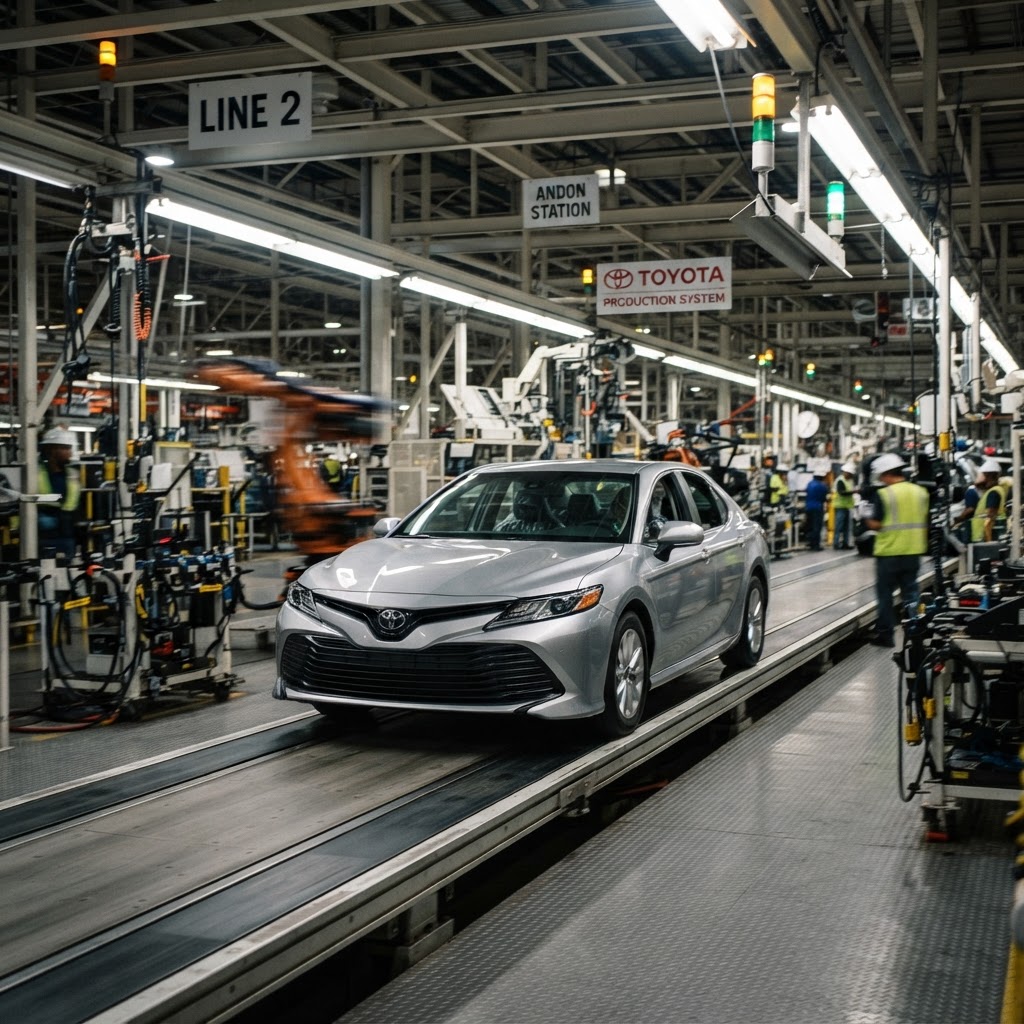
The Factory as a Living System
In manufacturing, few names carry the weight of Toyota. For decades, the Toyota Production System (TPS) has served as the gold standard for operational efficiency, waste elimination, and continuous improvement. Yet in 2025, Toyota is not resting on its legacy.
It is actively rewriting what lean manufacturing means in a world defined by electrification, digital intelligence, and supply chain volatility.
For B2B leaders in manufacturing and industrial sectors, Toyota's evolution offers something rare: a real-time case study in how a century-old production philosophy adapts without losing its core identity. The principles of kaizen, jidoka, and just-in-time remain intact, but the tools, technologies, and organizational structures surrounding them have fundamentally shifted.
Understanding how Toyota is navigating this transformation is not just an academic exercise. It is a strategic blueprint that industrial companies of every size can study, adapt, and apply to their own operations.
Toyota's Manufacturing Operations in 2025
Toyota remains one of the largest automakers on the planet by volume. In its fiscal year 2025 annual report, Toyota disclosed global vehicle production exceeding 10.5 million units, reinforcing its position at the top of the global automotive hierarchy. Its consolidated net revenues reached approximately 45 trillion Japanese yen, reflecting both strong vehicle demand and expanding mobility services.
The company operates more than 50 manufacturing plants across 28 countries. This global footprint is not simply a scale advantage. It is a living demonstration of TPS deployed across diverse labor markets, regulatory environments, and cultural contexts. Each plant serves as a node in a tightly coordinated production network where deviation from standard work is immediately visible and correctable.
Toyota's North American operations have seen particular investment through 2024 and 2025. The company committed over 8 billion USD to expand its battery and vehicle assembly capacity in Kentucky and Indiana, targeting both hybrid and battery-electric vehicle (BEV) production lines. These investments reflect a deliberate strategy to localize production closer to end markets while maintaining TPS discipline throughout the build-out.
Inventory management remains a signature strength. Despite global logistics disruptions that challenged most automakers through 2024, Toyota maintained supplier lead times within controlled variance bands by applying real-time visibility tools layered on top of its classic kanban systems. This hybrid approach, blending analog TPS discipline with digital monitoring, has become a defining feature of Toyota's operational model in 2025.
Digital Intelligence Meets the Toyota Production System
Toyota's technology evolution centers on what the company calls the Toyota Intelligent Factory initiative. Launched across multiple plants in 2024, this program integrates IoT sensor networks, AI-driven quality inspection, and collaborative robotics into existing TPS workflows. The goal is not to replace the human element of kaizen but to accelerate the feedback loops that make continuous improvement possible.
In its Motomachi plant in Japan, Toyota deployed AI-powered visual inspection systems capable of detecting surface defects at a rate 40 percent faster than manual inspection, according to 2025 operational disclosures. Critically, the system flags anomalies in real time and routes corrective actions back to assembly team leaders within the same production hour. This tight feedback loop is pure TPS logic executed at digital speed.
Collaborative robots, or cobots, now assist on over 30 percent of Toyota's global final assembly lines as of 2025. These are not autonomous replacement systems. They are designed to handle ergonomically stressful or repetitive sub-tasks, freeing skilled workers to focus on judgment-intensive quality verification.
Toyota's approach treats cobots as standard work tools, not as disruptive technology overlays.
On the supply chain side, Toyota has expanded its use of digital twin modeling across key component suppliers. By 2025, more than 200 tier-one suppliers in its North American network were operating within a shared digital visibility platform that allows Toyota's production planners to simulate disruption scenarios and adjust pull signals before physical shortages occur. This represents a significant maturation of the just-in-time model, adding a layer of predictive resilience that the classic TPS framework did not originally anticipate.
What Industrial Marketers and Growth Leaders Can Learn from Toyota
For B2B marketing and growth leaders at industrial companies, Toyota's story in 2025 contains several directly applicable lessons. The first is the power of system-level storytelling. Toyota does not market individual features or technologies in isolation.
It markets a coherent philosophy, TPS, and every innovation is positioned as an expression of that philosophy. Industrial companies with complex product lines can adopt the same approach: lead with a unifying operational principle, then let individual solutions prove that principle.
The second lesson is the value of customer co-development as a marketing asset. Toyota's supplier integration programs, including its digital twin network, are not just operational tools. They are relationship-deepening mechanisms that create switching costs and generate compelling case studies.
Industrial companies that embed themselves in their customers' production data and workflows build the same kind of durable competitive positioning.
Third, Toyota demonstrates that operational excellence is itself a form of marketing. Its reputation for build quality and reliability consistently drives purchase preference in fleet and commercial vehicle segments, where total cost of ownership dominates the buying decision. B2B marketers should quantify and communicate operational proof points, uptime rates, defect reductions, and lead time improvements, with the same rigor they apply to feature comparisons.
Finally, Toyota's investment in workforce capability as a public narrative is instructive. The company regularly publishes data on training hours, technician certification programs, and team leader development pipelines. For industrial companies competing for skilled talent and sophisticated buyers simultaneously, this kind of transparency builds both employer brand and customer confidence.
If your organization is not telling its workforce development story, you are leaving a significant B2B marketing asset unused. Consider auditing your operational proof points today and building a content strategy around them.


