The Machine Behind the Most Valuable Product on Earth
Every year, hundreds of millions of people unbox an iPhone without thinking about the extraordinary industrial operation that made it possible. Behind that sleek aluminum and glass device lies one of the most complex, tightly coordinated supply chains in manufacturing history. Apple does not own a single iPhone assembly plant, yet it controls every detail of how its products are built.
For manufacturing and industrial companies operating in B2B markets, Apple's model is not just impressive. It is instructive. The lessons embedded in Apple's contract manufacturing strategy, supplier governance, and process innovation are directly applicable to industrial operations of any scale.
This report breaks down how Apple engineers its global supply chain, where the numbers tell the real story, and what industrial leaders can take back to their own factory floors.
Inside Apple's Global Assembly Network
Apple relies on a small number of elite contract manufacturers for iPhone final assembly. Foxconn (Hon Hai Precision Industry) remains the dominant partner, responsible for an estimated 70 percent of global iPhone production as of 2025. Pegatron and Luxshare Precision round out the primary assembly base, with Luxshare gaining significant share in recent years due to its lower costs and operational agility.
As of 2025, Apple's supplier network spans over 50 countries and includes more than 180 direct suppliers. The company's annual supplier spend exceeded $300 billion in fiscal year 2024, according to Apple's published Supplier Responsibility Progress Report. This figure underscores how Apple functions less like a traditional manufacturer and more like an industrial orchestrator at planetary scale.
Foxconn's Zhengzhou facility, often called iPhone City, employs between 150,000 and 200,000 workers during peak production seasons. The facility covers approximately 5.4 square kilometers and processes millions of units per month. At peak demand cycles, the plant can produce an estimated 500,000 iPhones per day.
Apple has also accelerated geographic diversification. By the end of 2025, an estimated 15 to 20 percent of iPhone production had shifted to India, primarily through Foxconn and Tata Electronics facilities in Tamil Nadu and Karnataka. This shift represents one of the most significant structural changes in Apple's manufacturing footprint in over a decade.
Process Engineering and Quality Control at Scale
Apple's manufacturing precision is built on a proprietary quality control framework embedded directly into supplier operations. Apple engineers are stationed at Foxconn and other partner facilities year-round, reviewing production tolerances, material defect rates, and process compliance in real time. This blurs the traditional line between OEM and contract manufacturer.
The iPhone 16 series, launched in late 2024, introduced new structural challenges for assembly partners. The titanium frame used in Pro models requires five-axis CNC machining with tolerances measured in microns. Apple mandated that suppliers invest in upgraded CNC equipment, and the company co-funded portions of that capital expenditure as part of long-term supply agreements.
This kind of shared investment model is increasingly common in Apple's supplier relationships.
Apple's Supplier Clean Energy Program is another dimension of process innovation. By 2025, Apple reported that over 320 suppliers had committed to using 100 percent renewable energy for Apple production. This program directly influences how suppliers design and operate their facilities, pushing industrial energy management to the forefront of supplier qualification criteria.
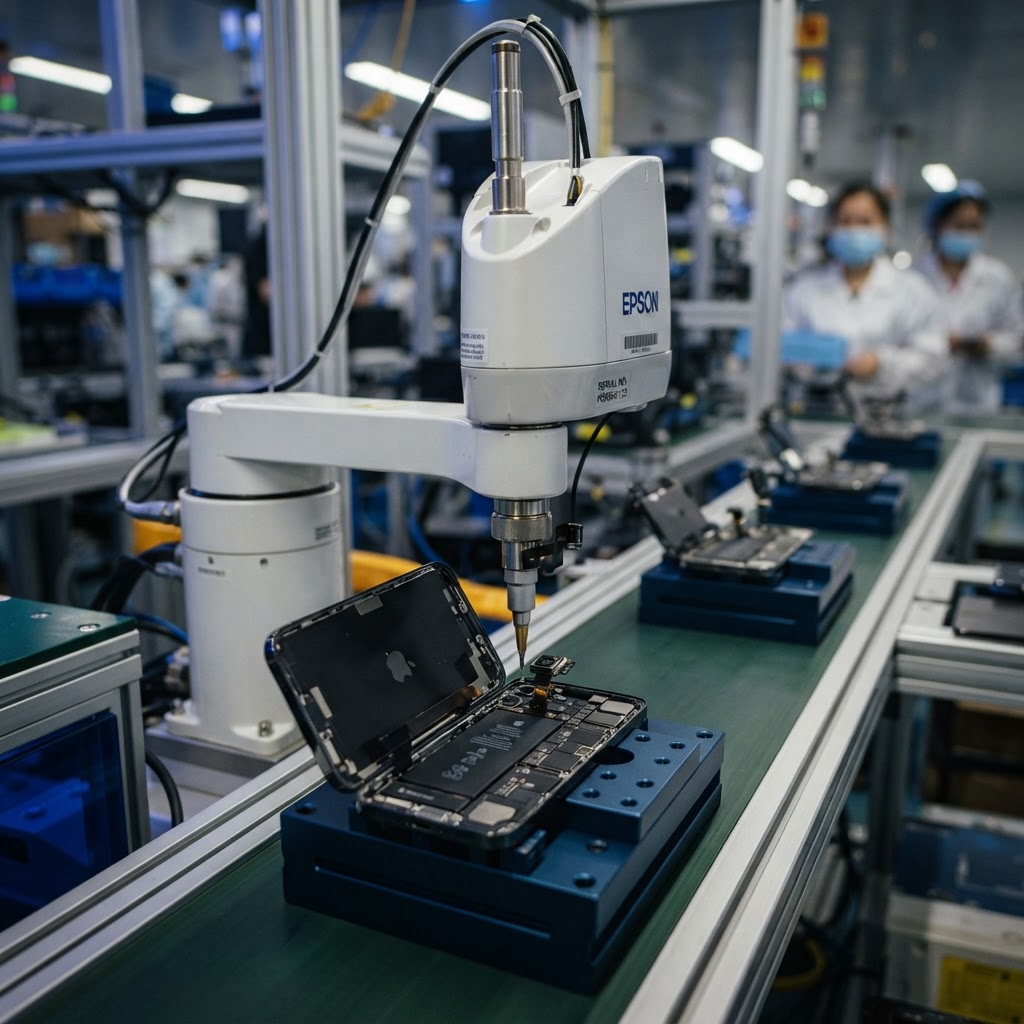
Automation investment across Apple's supply chain has accelerated significantly. Foxconn announced in 2024 that it was deploying over 40,000 additional industrial robots across its Apple production lines, part of a broader push to reduce labor dependency and improve yield rates. Luxshare has made parallel investments, with automation levels on Apple lines reportedly reaching 60 percent of key assembly steps by mid-2025.
Manufacturing Strategy Lessons for Industrial B2B Companies
The most important lesson Apple offers industrial companies is the power of supplier governance as a competitive weapon. Apple does not just audit suppliers. It co-engineers with them.
It embeds personnel, shares technology roadmaps, and ties supplier development directly to product development timelines. Industrial manufacturers that treat supplier relationships as transactional are leaving enormous operational value on the table.
Apple's geographic diversification strategy also carries direct lessons. The shift toward India-based production was not reactive. It was planned years in advance, with Apple working alongside Indian government agencies and logistics partners to build the necessary infrastructure.
Industrial companies operating in single-region supply chains face compounding risk exposure that strategic manufacturing diversification can mitigate.
Capacity planning is another area where Apple's model provides a blueprint. Apple uses rolling 12-month demand forecasts shared directly with key suppliers, enabling those partners to plan capital expenditures with confidence. This kind of forecast transparency, when structured within clear contractual frameworks, can dramatically reduce lead times and inventory waste throughout an industrial supply chain.
Finally, Apple's use of sustainability performance as a supplier qualification metric is a growing trend that B2B industrial companies cannot ignore. Procurement leaders at major manufacturers are increasingly scoring suppliers on emissions data, energy sourcing, and waste reduction benchmarks. Companies that build these capabilities now will gain preferred-supplier status in the contracts that matter most.
If your operation has not yet mapped its Scope 3 emissions or benchmarked renewable energy options, this is the moment to start.
The Future of Apple's Manufacturing Model and What It Signals for Industry
Apple's India expansion is expected to continue accelerating through 2026. Analyst projections from 2025 suggest that India could account for 25 to 30 percent of total iPhone production within two years, driven by policy incentives under India's Production Linked Incentive scheme and Apple's desire to reduce geopolitical concentration risk tied to China.
Artificial intelligence is beginning to reshape quality inspection across Apple's supply chain. Several Foxconn facilities deployed AI-powered visual inspection systems in 2024 and 2025 that can identify cosmetic and structural defects at speeds no human inspector can match. Defect detection accuracy on these systems has reportedly exceeded 99.5 percent, reducing rework rates and improving yield on high-tolerance components.
Apple is also beginning to internalize more component manufacturing through its custom silicon strategy. The Apple Silicon program, extending through the M-series chips and custom modem development, reduces dependence on external semiconductor suppliers and gives Apple tighter control over the most value-dense components in its products. This vertical integration at the component level, while maintaining assembly outsourcing, represents a hybrid model that many large industrial OEMs are beginning to explore.
For industrial companies watching these trends, the signal is clear: the manufacturers that thrive in the next decade will be those that combine outsourced scale with insourced intelligence. Owning the process knowledge, the quality standards, and the technology roadmap matters more than owning every square foot of factory floor.
Key Takeaways
- Apple's annual supplier spend exceeded $300 billion in fiscal year 2024, making it one of the largest B2B procurement operations on earth.
- Foxconn's Zhengzhou facility can produce an estimated 500,000 iPhones per day at peak capacity, representing a scale benchmark for high-volume assembly operations.
- Over 320 Apple suppliers committed to 100 percent renewable energy for Apple production by 2025, demonstrating how OEM sustainability mandates are reshaping supplier qualification standards.
- India is projected to account for 25 to 30 percent of iPhone production by 2026, signaling a structural shift in global electronics manufacturing geography.
Key Quotes
"We want to make sure that we're buying from suppliers who share our values and who are treating workers with dignity and respect." — Tim Cook, CEO of Apple Inc.
"Apple's supply chain is the best supply chain in the world. The complexity they manage at scale is something that is studied across every manufacturing industry." — Hau Lee, Professor of Operations, Information, and Technology at Stanford Graduate School of Business
References
- Apple Supplier Responsibility Progress Report 2025 — Covers Apple's supplier standards, clean energy commitments, and labor compliance programs
- Foxconn 2024 Annual Report — Details Foxconn's revenue breakdown, Apple production capacity investments, and automation strategy
- Bloomberg: Apple's India Manufacturing Expansion — Covers Apple's accelerating shift of iPhone production to India through Tata and Foxconn facilities