The Factory as a Product: Tesla's Radical Rethink of How Cars Are Built
Most manufacturers treat the factory as a backdrop, a necessary cost center behind the real product. Tesla has flipped this entirely, treating its manufacturing process as a competitive weapon in its own right. The result is a production philosophy that is reshaping how industrial leaders think about scale, integration, and speed.
At the center of this shift are two landmark innovations: the structural battery pack and gigacasting. Together, these technologies have eliminated hundreds of parts, reduced assembly time dramatically, and forced competitors to reconsider decades of established production logic. For B2B manufacturing and industrial companies, the lessons here go far beyond electric vehicles.
This report examines how Tesla's manufacturing architecture works, what the data says about its impact, and what industrial companies can take from this playbook into their own operations.
Tesla's Manufacturing Operations: Scale, Output, and the Gigafactory Network
Tesla operates Gigafactories across four continents, with major production hubs in Fremont (California), Austin (Texas), Berlin (Germany), and Shanghai (China). As of 2025, Tesla's Shanghai Gigafactory alone produces over 950,000 vehicles annually, making it one of the highest-output single automotive plants on the planet. The Austin facility has ramped Cybertruck production while also serving as the primary development site for next-generation manufacturing processes.
Tesla reported total vehicle deliveries of approximately 1.79 million units in 2024, a figure that reflects both the company's scale and the pressure it faces from intensifying global EV competition. Revenue for fiscal year 2024 came in at roughly $97.7 billion, with automotive revenue comprising the largest share. Despite margin compression from aggressive pricing, Tesla's gross margin on its automotive segment remained a subject of close industry scrutiny as it navigated cost reduction efforts.
The Gigafactory model is built around vertical integration at a level that most manufacturers have moved away from over the past three decades. Tesla produces its own battery cells (via the 4680 format), casts its own structural components, and controls a significant portion of its supply chain in-house. This integration is expensive upfront but delivers compounding advantages in quality control, iteration speed, and unit economics.
Capital expenditure for 2024 exceeded $8 billion as Tesla continued to invest in manufacturing capacity and process innovation. This level of sustained reinvestment signals that Tesla views manufacturing capability as a long-term moat, not a short-term cost. For industrial companies evaluating their own capital allocation, this posture deserves serious attention.
Gigacasting and the Structural Battery Pack: Engineering a New Production Paradigm
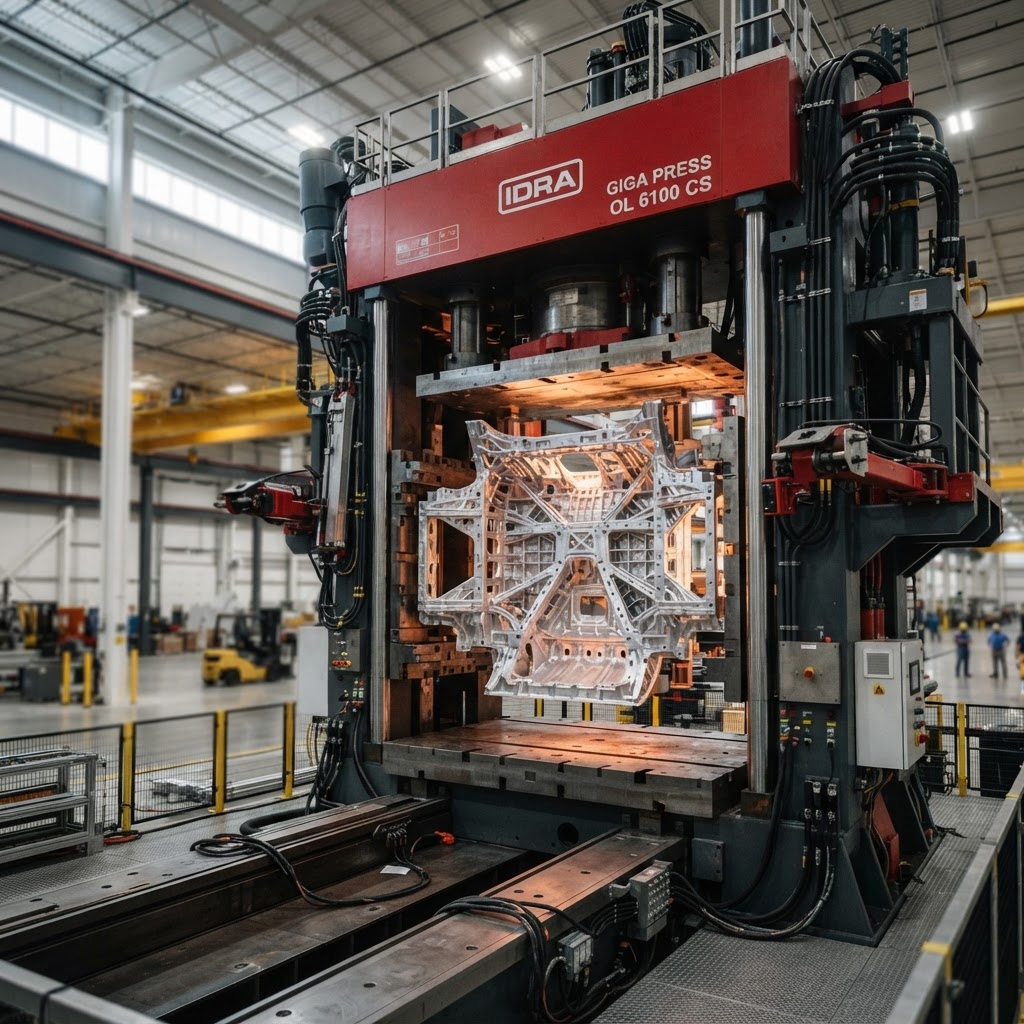
Gigacasting refers to the use of extremely large high-pressure die-casting machines to produce single-piece aluminum components that would traditionally require dozens of stamped and welded parts. Tesla pioneered this approach with the rear underbody of the Model Y, casting what was previously a 70-plus part assembly into a single structural component. The company then extended the process to the front underbody, effectively sandwiching the vehicle around a central structural element.
That central element is the structural battery pack. Rather than housing battery cells in a separate module that sits beneath the vehicle floor, Tesla integrates the cells directly into the vehicle's load-bearing structure. The pack itself becomes part of the chassis.
This eliminates a redundant structural layer, reduces vehicle weight by an estimated 10 percent in relevant sections, and lowers manufacturing complexity significantly. The 4680 cylindrical cell format, with its larger form factor and tabless design, was engineered specifically to make this structural integration feasible.
The combined effect of front gigacasting, rear gigacasting, and the structural battery pack is a reduction of roughly 370 parts in the underbody alone compared to previous Tesla architectures. Fewer parts mean fewer welds, fewer potential failure points, fewer suppliers, and a shorter assembly line. Tesla has reported that these changes reduce factory floor space requirements for relevant assembly steps by approximately 40 percent, a massive operational efficiency gain at scale.
The gigapresses themselves, supplied primarily by Italian manufacturer IDRA Group, exert clamping forces of up to 9,000 tons for the largest castings. The machines are enormous, requiring significant facility engineering to house and operate. However, the per-unit cost reduction achieved through consolidated part counts and reduced labor steps creates a favorable return on investment at Tesla's production volumes.
Competitors including Toyota and Volkswagen have announced their own gigacasting programs in response, validating the strategic logic Tesla demonstrated.
Manufacturing Innovation as a Marketing and Growth Strategy for Industrial Companies
Tesla rarely markets its manufacturing processes in traditional advertising, yet the gigacasting story has traveled widely through engineering communities, trade media, and investor channels. This illustrates a critical B2B marketing truth: when your process is genuinely differentiated, documentation and transparency become powerful demand-generation tools. Industrial companies that publish technical case studies, production data, and engineering insights attract high-quality prospects who are already pre-qualified.
For manufacturing and industrial firms, the gigacasting narrative offers a replicable communications framework. Tesla did not simply announce a new process. It showed the before-and-after part count, shared the weight reduction figures, and allowed engineers to speak publicly about the design philosophy.
This kind of technical specificity builds credibility with procurement teams, engineering buyers, and strategic partners in ways that feature-benefit advertising cannot replicate.
The structural battery pack also demonstrates the value of cross-functional innovation storytelling. The breakthrough was not purely mechanical, not purely chemical, and not purely software-driven. It was the integration of all three.
Industrial companies that can narrate multi-disciplinary process improvements, drawing connections across materials science, automation, and systems engineering, position themselves as strategic partners rather than commodity suppliers.
If your company is rethinking its manufacturing architecture or looking to communicate complex process innovations to industrial buyers, the Tesla model offers a proven template. Start by quantifying your own part-count reductions, cycle time improvements, or material efficiency gains. Then build a content strategy around those numbers.
The audience that cares about those metrics is exactly the audience most likely to convert into long-term clients.
The Road Ahead: Strategic Implications for the Industrial Sector
Tesla's next-generation manufacturing platform, sometimes referred to internally as the unboxed process, proposes to assemble vehicles in large sub-modules simultaneously rather than sequentially along a traditional line. If successfully implemented at scale, this would further reduce manufacturing floor space and cut assembly time by an estimated 50 percent compared to conventional approaches. Announcements tied to the more affordable next-generation vehicle platform suggest this process may enter production in 2025 or 2026.
For the broader industrial sector, the implications extend well beyond automotive. The gigacasting approach is already being explored for aerospace structural components, heavy equipment housings, and industrial machinery frames. As alloy development improves and press technology becomes more accessible, the economic case for large-format single-piece casting will reach a wider range of applications and production volumes.
Supply chain strategy is also being reshaped by these innovations. When a single casting replaces 70 components, the tier-one and tier-two suppliers who previously produced those components must adapt or risk displacement. Industrial companies that supply into complex assembly ecosystems should be actively modeling how consolidation trends in gigacasting and structural integration could affect their revenue base over the next five years.
The manufacturers who will lead the next decade are those who treat process innovation as a strategic asset today. Whether you are in heavy equipment, defense components, energy systems, or precision fabrication, the question Tesla's manufacturing story forces you to ask is direct: what in your production architecture could be consolidated, integrated, or recast into something fundamentally simpler and stronger?
Key Takeaways
- Tesla's Shanghai Gigafactory produces over 950,000 vehicles per year, making it one of the highest single-plant output facilities in global automotive manufacturing.
- The combined gigacasting and structural battery pack architecture eliminates approximately 370 underbody parts compared to prior Tesla production designs.
- Tesla's 2024 capital expenditure exceeded $8 billion, reflecting a sustained commitment to manufacturing as a primary competitive differentiator.
- Gigacasting reduces relevant assembly floor space requirements by an estimated 40 percent, a benchmark that competing manufacturers including Toyota and Volkswagen are now targeting in their own programs.
Key Quotes
"The machine that makes the machine is just as important as the machine itself. We need to think of the factory as the product." -- Elon Musk, CEO of Tesla
"Gigacasting is not just a manufacturing technique. It is a systems-level rethinking of how a vehicle is architectured from the ground up." -- Sandy Munro, Founder of Munro and Associates
References
- Tesla 2024 Annual Report -- Covers Tesla's fiscal 2024 revenue, capital expenditure, and production volumes across global Gigafactory locations.
- Munro Live: Tesla Structural Battery Pack Teardown Analysis -- Detailed engineering teardown and part-count analysis of Tesla's structural battery and gigacast underbody architecture.
- IDRA Group Gigapress Technology Overview -- Technical specifications and clamping force data for IDRA OL 9000 gigapresses used in Tesla's casting operations.