The Billion-Dollar Bet That's Reshaping American Industry
General Motors is no longer the company that filed for bankruptcy in 2009. Today, GM stands as one of the most aggressive investors in electric vehicle manufacturing infrastructure in the world. With its Ultium battery platform and the landmark Factory ZERO plant in Detroit-Hamtramck, GM has signaled to every industrial company that transformation is not optional.
The scale of GM's commitment is staggering. The company has pledged over $35 billion in EV and autonomous vehicle investment through 2025, with a significant portion directed at retooling existing facilities and building new ones from the ground up. For B2B manufacturers and industrial operators watching from the sidelines, the lessons here are both urgent and transferable.
This report breaks down exactly how GM is executing its manufacturing transformation, what technologies are driving the shift, and what industrial companies of every size can learn from the Ultium playbook.
Factory ZERO: A Template for the Modern American Manufacturing Plant
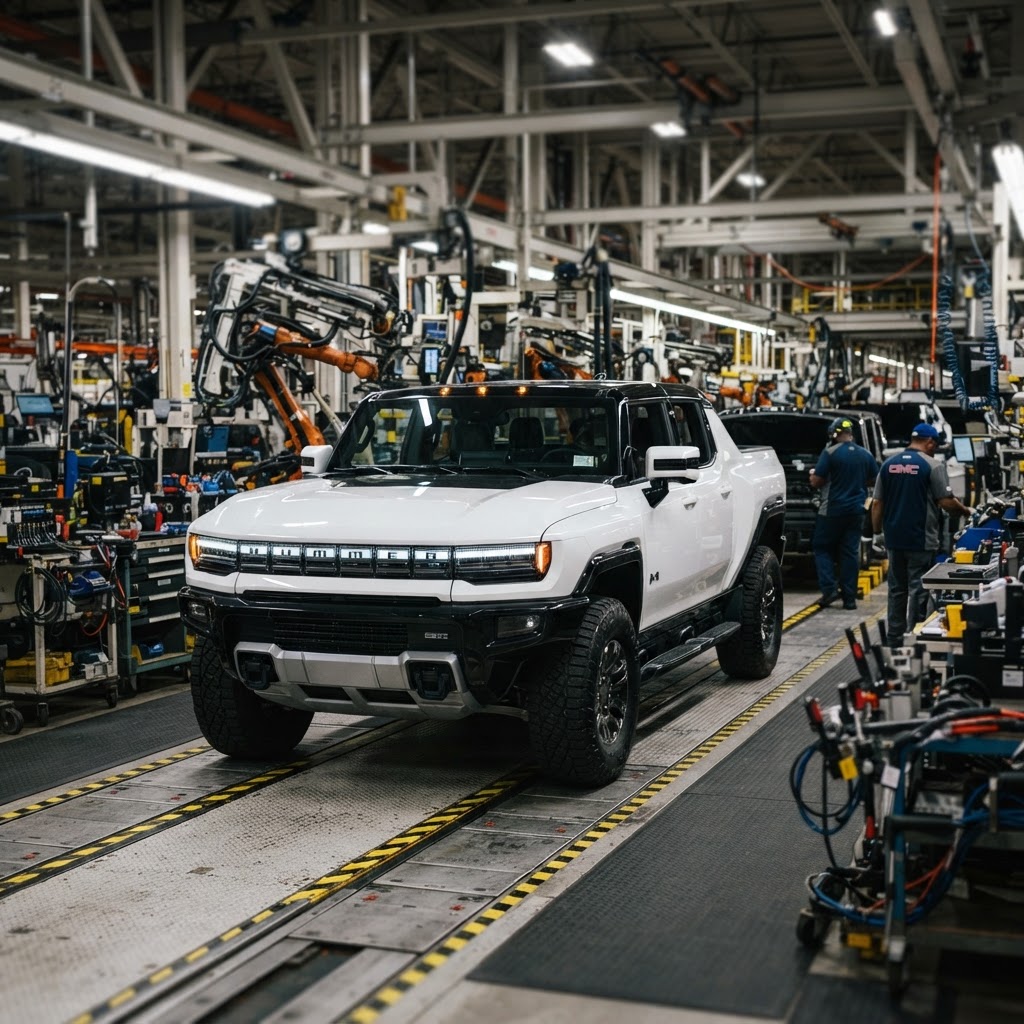
Factory ZERO, officially known as the Detroit-Hamtramck Assembly Center, became GM's first fully dedicated electric vehicle assembly plant after a major retooling investment. GM invested approximately $2.2 billion to transform the facility into a state-of-the-art EV production hub. The plant produces the GMC Hummer EV, the Silverado EV, and serves as a proving ground for GM's broader electrification strategy.
The facility spans roughly 3.3 million square feet and employs thousands of union workers under agreements negotiated with the United Auto Workers. Production capacity at Factory ZERO has been a focal point for GM's North American manufacturing strategy, with the company targeting output increases throughout 2025 and into 2026 as supply chain constraints ease and battery cell availability improves.
GM's 2024 annual report highlighted that the company produced approximately 290,000 EVs globally in 2024, a figure the company aimed to grow substantially in 2025. Factory ZERO serves as the physical anchor for that growth, with continuous process improvements being implemented on the line in real time.
For industrial manufacturers watching this story, Factory ZERO represents something beyond an auto plant. It is a case study in how legacy facilities can be reinvented through capital commitment, workforce retraining, and technology integration without abandoning the communities and workers who built the original operation.
The Ultium Platform: Modular Engineering as a Competitive Weapon
The Ultium battery platform is the engineering core of GM's EV strategy. Unlike traditional vehicle architectures where platform and powertrain are tightly coupled, Ultium is designed to be modular and scalable across vehicle classes. The platform supports battery packs ranging from approximately 50 kWh to over 200 kWh, enabling GM to deploy the same underlying technology in everything from compact crossovers to heavy-duty trucks.
Ultium cells are produced at Ultium Cells LLC facilities, a joint venture between GM and Samsung SDI. The Lordstown, Ohio facility and the Spring Hill, Tennessee plant are key nodes in this domestic battery supply chain. GM has committed to achieving annual battery cell production capacity of over 160 GWh in North America, a figure that would place it among the largest battery producers on the continent.
The chemistry behind Ultium relies on a low-cobalt NMCA (nickel, manganese, cobalt, aluminum) formulation. Reducing cobalt content directly lowers material costs, which is critical for achieving price parity with internal combustion vehicles. GM has cited cost reduction targets that aim to bring battery pack costs below $100 per kWh at scale, a threshold widely considered the tipping point for mass EV adoption.
From a manufacturing technology perspective, Ultium's modularity is a masterclass in platform thinking. By standardizing the battery architecture across vehicle lines, GM dramatically reduces tooling costs, simplifies supplier relationships, and accelerates the time from design to production. Industrial manufacturers in sectors ranging from heavy equipment to industrial machinery can apply the same modular platform logic to reduce complexity and compress development cycles.
Marketing and Growth Lessons for Industrial Companies
GM's approach to communicating the Ultium story offers a clear B2B marketing lesson: lead with infrastructure, not just product. Rather than simply advertising new EV models, GM has invested heavily in publicizing the manufacturing investments, the joint ventures, and the supply chain buildout. This positions GM as a platform company, not just a vehicle company, a framing that resonates with fleet buyers, government procurement officers, and commercial partners.
For industrial manufacturers, this distinction matters enormously. Buyers in B2B environments are not just purchasing a product. They are evaluating the long-term stability, capability, and commitment of a supplier. GM's public transparency about Factory ZERO investments and Ultium cell capacity targets serves as a form of trust-building that traditional product marketing cannot replicate.
GM has also leveraged its commercial vehicle push, particularly the Silverado EV Work Truck and the BrightDrop-derived solutions, to enter the fleet management conversation at the C-suite level. This top-down selling motion, where the narrative begins with total cost of ownership and operational efficiency rather than vehicle specs, is a model that any industrial company selling high-value capital equipment should study and replicate.
The call to action for industrial manufacturers is direct: audit your current marketing narrative. If it leads with product features rather than platform capability and long-term partnership value, it is time to rebuild it. GM's Ultium communications strategy offers a ready-made template for how to reposition a manufacturing company as an infrastructure partner rather than a parts vendor.
The Road Ahead: Strategic Implications for Industrial Leaders
GM's trajectory through 2025 and into 2026 reflects a broader industrial reality: electrification, automation, and supply chain localization are no longer emerging trends. They are the operating conditions of modern manufacturing. Companies that treat these as future concerns rather than present imperatives will find themselves structurally disadvantaged within the next few years.
GM's joint venture model for battery production, particularly the Samsung SDI partnership, illustrates how even the largest manufacturers are choosing collaboration over vertical integration in areas outside their core competency. For mid-sized industrial companies, this is a permission structure. You do not need to own every part of the value chain.
Strategic partnerships with technology providers, material suppliers, and logistics operators can deliver competitive capability without the full capital burden.
The workforce dimension of GM's transformation is also instructive. Factory ZERO was retooled with active UAW involvement, and GM has invested in retraining programs to shift assembly workers from combustion engine processes to EV-specific tasks. Industrial companies facing their own automation transitions would do well to treat workforce transformation as a strategic asset rather than a cost center.
As GM continues to scale Ultium production and expand its EV portfolio through 2026, the company is effectively running a live experiment in large-scale industrial reinvention. Industrial leaders who study this experiment closely, drawing lessons on capital allocation, platform design, supply chain architecture, and market communication, will be better positioned to lead their own organizations through the transformations ahead.
Key Takeaways
- GM invested approximately $2.2 billion to retool the Detroit-Hamtramck facility into Factory ZERO, its first fully dedicated EV assembly plant
- GM produced approximately 290,000 EVs globally in 2024 and targeted significant production growth heading into 2025 and 2026
- GM and Samsung SDI's Ultium Cells joint venture is targeting over 160 GWh of annual North American battery cell production capacity
- The Ultium platform's low-cobalt NMCA chemistry is targeting battery pack costs below $100 per kWh at scale, a critical threshold for mainstream EV adoption
Key Quotes
"We are not just building electric vehicles. We are building the ecosystem that makes them possible at scale." — Mary Barra, Chair and CEO, General Motors
"The Ultium platform gives us the flexibility to electrify virtually every segment of the market while maintaining cost discipline across the portfolio." — Doug Parks, Executive Vice President, Global Product Development, General Motors
References
- General Motors Investor Relations — official source for GM annual reports, EV production data, and capital investment disclosures
- Ultium Cells LLC — joint venture site covering battery cell production facilities and capacity targets in North America
- U.S. Department of Energy Advanced Manufacturing Office — covers federal EV manufacturing investment context and battery supply chain policy relevant to GM's domestic buildout