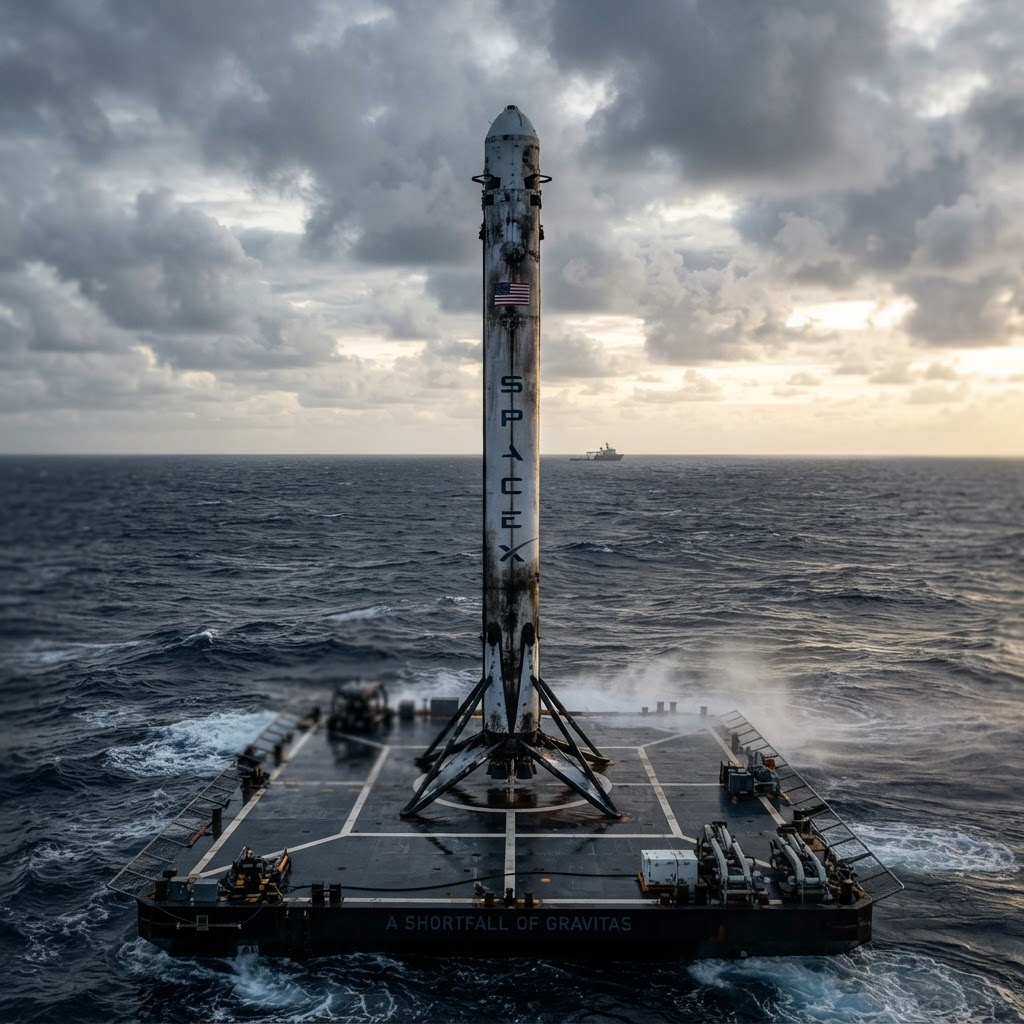
The Rocket That Pays for Itself
In an industry where a single launch vehicle was historically discarded after one use, SpaceX has fundamentally rewritten the financial rulebook. The Falcon 9 booster recovery program has turned what was once a $60 million piece of hardware into a reusable asset that lands itself back on a drone ship in the middle of the ocean. For manufacturing and industrial leaders watching from the sidelines, this is not just an aerospace story.
It is a masterclass in capital efficiency, process engineering, and long-cycle asset management.
SpaceX completed over 130 orbital launches in 2024 alone, with the vast majority of those missions using flight-proven Falcon 9 boosters. Some boosters have now flown more than 20 missions, a figure that would have seemed implausible to legacy launch providers just a decade ago. The cost implications of that milestone ripple far beyond the space industry.
For B2B manufacturers in heavy industry, aerospace supply chains, and capital equipment sectors, the Falcon 9 recovery model offers a direct analogy to how rethinking asset lifecycle can transform unit economics. This report breaks down the data, the engineering discipline, and the strategic lessons embedded in SpaceX's approach.
Manufacturing at the Speed of Reuse: SpaceX's Production and Launch Operations
SpaceX operates its primary Falcon 9 production facility in Hawthorne, California, where the company manufactures rocket engines, airframes, and avionics under one roof. This vertical integration strategy is a deliberate cost-control mechanism. By producing roughly 80 percent of components in-house, SpaceX avoids the markup and lead-time variability that comes with traditional aerospace subcontracting.
In 2024, SpaceX's launch revenue was estimated by industry analysts at Morgan Stanley to exceed $8 billion, driven in large part by its commercial manifest and Starlink deployment missions. The Falcon 9's cost per kilogram to low Earth orbit has dropped to approximately $2,700, compared to over $54,000 per kilogram on the legacy Space Shuttle program. That cost reduction did not happen by accident.
It was engineered deliberately through reuse.
SpaceX's Merlin engine production line is capable of producing engines at a rate that supports its aggressive launch cadence. Each Falcon 9 first stage carries nine Merlin 1D engines, and those engines are now routinely reflown without full overhaul between missions. Inspection cycles, not replacement cycles, now govern the maintenance rhythm, which mirrors the shift from scheduled to condition-based maintenance seen in advanced industrial manufacturing.
The company's launch pads at Cape Canaveral and Vandenberg Space Force Base are now capable of supporting turnaround cycles measured in days rather than months. In 2024, SpaceX demonstrated a booster turnaround of under 21 days on multiple occasions. That operational tempo is only possible because the recovery and refurbishment process has been standardized to an industrial level of repeatability.
The Engineering Architecture of Reusability
The Falcon 9's reusability is not a feature that was bolted on after the design was finalized. It was a foundational engineering constraint from the early development of the vehicle. The first stage is equipped with grid fins for atmospheric guidance, cold-gas thrusters for attitude control, and three to four engine relights to manage the descent profile.
Landing legs deploy just before touchdown, allowing the booster to return to either a land-based pad or one of SpaceX's autonomous drone ships operating in the Atlantic and Pacific Oceans.
Thermal protection is a critical manufacturing challenge in the refurbishment process. The first stage experiences extreme heating during reentry, and SpaceX has invested heavily in ablative coatings and structural inspection protocols to certify each booster for subsequent flights. According to SpaceX's own mission data published in 2025, boosters are now flying with minimal refurbishment between missions, with some flights requiring only engine inspection, fluid replenishment, and software validation before being declared flight-ready.
The drone ships, named "A Shortfall of Gravitas" and "Of Course I Still Love You," are engineering assets in their own right. Each ship is equipped with an automated leg-locking system, a motion-compensating platform, and rapid-response fueling infrastructure. The ships represent a capital investment that is only justified at the launch cadence SpaceX now maintains, where frequency drives down the per-mission cost of operating the recovery infrastructure.
SpaceX has also developed proprietary non-destructive testing protocols to evaluate booster health between flights. These protocols draw on data collected from hundreds of sensors embedded throughout the vehicle during each mission. The result is a digital health record for every booster, a concept that advanced manufacturers in sectors like gas turbines and industrial compressors will recognize immediately as condition-based asset management applied to a rocket.
What Industrial Manufacturers Can Learn from Booster Economics
The core economic insight from the Falcon 9 program is straightforward: the most expensive moment in a product's lifecycle is the moment it is discarded. SpaceX identified that the first stage represented approximately 70 percent of the total hardware cost of a Falcon 9 launch. By recovering and reusing that stage, the company effectively unlocked the ability to spread that capital cost across a growing number of revenue-generating missions.
For industrial manufacturers producing capital equipment, tooling, or production machinery, the analogy is direct. A CNC machining center, a large press, or an industrial compressor that is refurbished and redeployed rather than replaced generates a dramatically better return on the original capital investment. The challenge, as SpaceX discovered, is building the inspection, refurbishment, and certification infrastructure necessary to trust a used asset with a critical job.
SpaceX's approach to customer confidence is also instructive. Early in the reuse program, some commercial satellite customers were hesitant to fly on a previously flown booster. SpaceX addressed this by publishing flight history data, making refurbishment standards transparent, and offering pricing incentives for customers willing to fly on proven hardware.
That transparency-based trust-building strategy is directly applicable to industrial companies selling refurbished or remanufactured equipment into skeptical markets.
The reuse program also enabled SpaceX to compress its sales cycle. A customer evaluating launch options in 2025 is not just buying a rocket. They are buying into a demonstrated track record of 20-plus successful reflights, a published refurbishment standard, and a logistics infrastructure that can execute within weeks.
Industrial companies that can offer equivalent transparency around their remanufactured or serviced products will find the same sales cycle compression available to them. If your company is rethinking asset lifecycle strategy, now is the time to audit your refurbishment and certification capabilities and build the data infrastructure that makes reuse commercially credible to your customers.


