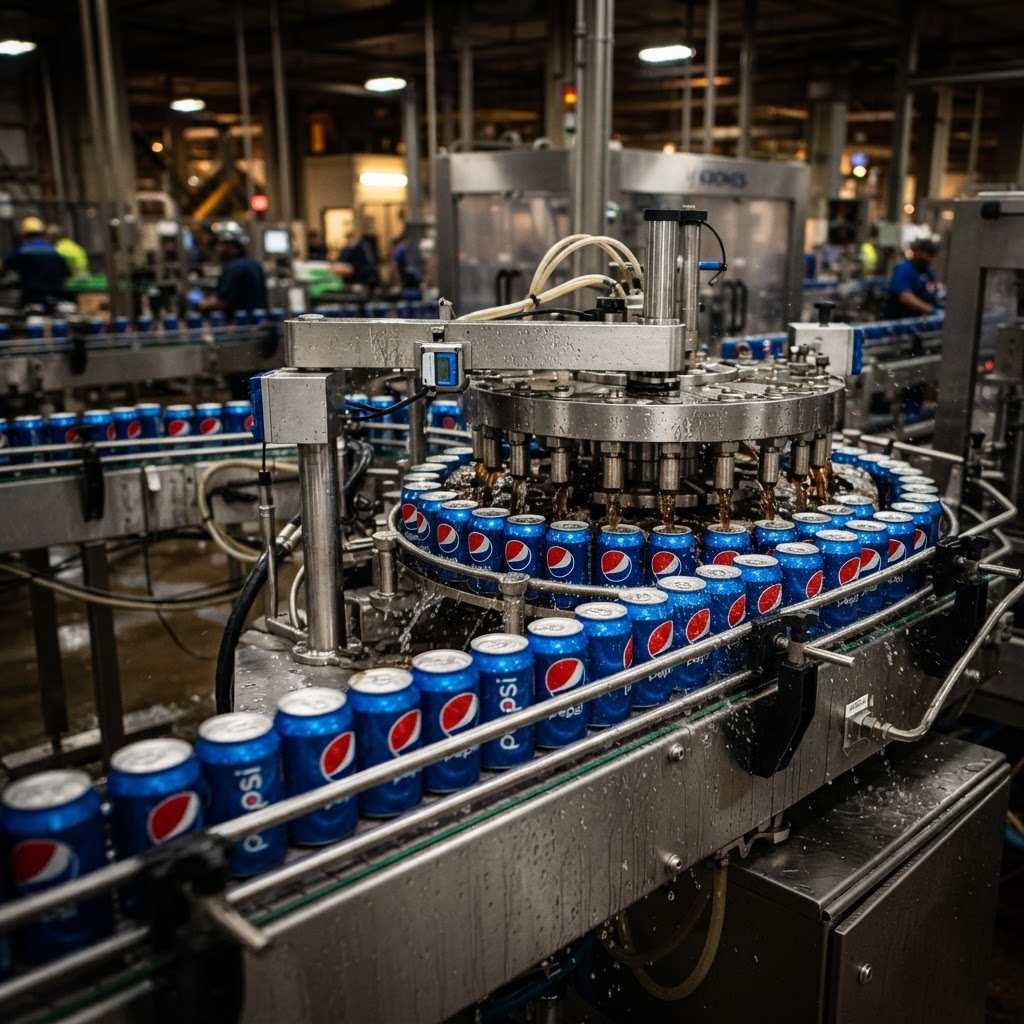
From Warehouse Floors to Digital Command Centers
PepsiCo is one of the most recognizable consumer goods companies on the planet, but behind every bag of Lay's and every bottle of Gatorade is a manufacturing operation of staggering complexity. With over 290 manufacturing facilities across more than 60 countries, PepsiCo has quietly become one of the most sophisticated industrial operators in the world. The company's ability to produce billions of units annually while maintaining consistency and speed is not accidental.
In recent years, PepsiCo has accelerated its push into automation, artificial intelligence, and digital supply chain management. These investments are not just about cost reduction. They represent a fundamental shift in how large-scale consumer goods manufacturing is organized, monitored, and optimized.
For B2B manufacturers and industrial companies watching from the sidelines, PepsiCo's transformation offers a detailed blueprint. Understanding how a global food and beverage giant rewires its operations at scale can reveal strategies that translate directly to factories, plants, and distribution networks of all sizes.
The Scale of PepsiCo's Global Manufacturing Footprint
PepsiCo reported net revenue of approximately $91.5 billion in its 2024 annual results, with a significant portion of that figure tied directly to the performance of its physical manufacturing infrastructure. The company operates across two primary divisions, PepsiCo Foods and PepsiCo Beverages, each with its own distinct production demands and logistical challenges. Managing these two worlds simultaneously requires a level of operational discipline that few companies can match.
The snack manufacturing segment alone, anchored by the Frito-Lay division, operates over 30 manufacturing plants in North America. Frito-Lay's facilities process millions of pounds of potatoes, corn, and other raw materials every single day. In 2024, Frito-Lay's North America segment contributed roughly $19.8 billion in net revenue, making it one of the most productive snack manufacturing operations globally.
On the beverage side, PepsiCo manages a hybrid model that combines company-owned production with a vast network of licensed bottling partners. This distributed model adds complexity to quality control and supply chain visibility. To address this, PepsiCo has invested heavily in digital integration layers that connect owned facilities with partner operations in near real time.
The company's capital expenditure for manufacturing and supply chain improvements reached approximately $4.7 billion in 2024. This level of investment signals a long-term commitment to physical infrastructure upgrades alongside software and automation deployments.
Automation, AI, and the Digital Supply Chain in Action
PepsiCo's pep+ (PepsiCo Positive) strategy, updated and expanded through 2025, integrates sustainability targets directly into its manufacturing automation roadmap. The company has deployed advanced robotics across multiple Frito-Lay plants for palletizing, packaging, and quality inspection. These systems reduce human error, increase throughput rates, and allow skilled workers to focus on higher-value tasks.
One of the most significant technology deployments has been PepsiCo's use of AI-driven demand forecasting tools integrated directly into its supply chain planning systems. The company partnered with technology providers to build predictive models that analyze point-of-sale data, weather patterns, promotional calendars, and logistics capacity simultaneously. Early results from 2024 pilots showed a reduction in forecast error rates by as much as 15 percent across key product categories.
PepsiCo has also rolled out digital twin technology across select manufacturing sites. A digital twin creates a virtual replica of a production line or facility, allowing engineers to simulate changes, identify bottlenecks, and test improvements without interrupting live production. This capability has meaningfully shortened the time required to implement process changes, with some facilities reporting changeover time reductions of 20 percent or more.
The company's investment in IoT sensor networks across its plants feeds real-time data into centralized dashboards. Plant managers can monitor equipment health, energy consumption, and production rates from a single interface. This connected infrastructure is a cornerstone of PepsiCo's broader push toward predictive maintenance, which aims to reduce unplanned downtime across its global facility network by 25 percent by 2026.
What Industrial Manufacturers Can Learn from PepsiCo's Playbook
PepsiCo's automation strategy carries lessons that extend well beyond the food and beverage sector. The company did not attempt to automate everything at once. Instead, it identified high-impact nodes in its supply chain, including palletizing, quality inspection, and demand planning, and deployed targeted solutions before scaling.
This phased approach reduced risk and allowed teams to build internal expertise organically.
For B2B manufacturers, the message is clear: automation success depends on selecting the right starting points. Companies that try to digitize an entire operation simultaneously often encounter cost overruns and employee resistance. PepsiCo's model demonstrates the value of piloting in one facility, measuring results carefully, and then replicating the approach across additional sites.
PepsiCo also invested heavily in change management alongside its technology deployments. Workforce training programs were expanded at Frito-Lay plants to ensure technicians could operate and maintain new automated systems. This investment in human capital is just as important as the capital expenditure on hardware and software.
Industrial companies that ignore the people side of automation often see their technology investments underperform.
Another lesson involves data governance. PepsiCo built centralized data platforms that standardize how production metrics, quality data, and supply chain signals are captured and stored. Without this foundation, AI tools and digital twins cannot function effectively.
B2B manufacturers looking to adopt similar technologies should prioritize data infrastructure before deploying advanced analytics. If your organization is ready to explore how these principles apply to your own facilities, now is the time to engage with automation consultants and technology partners who specialize in industrial transformation.


