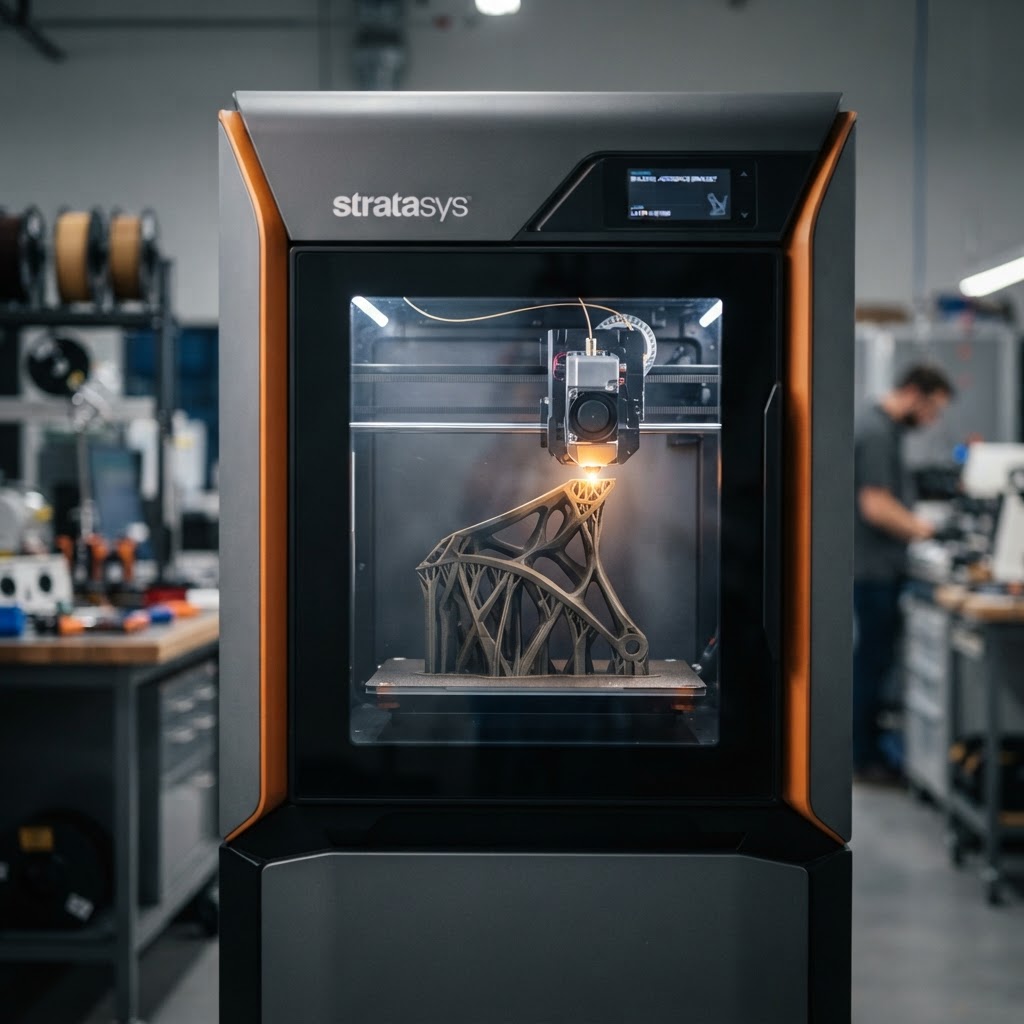
When the Factory Floor Meets the Future of Flight and Drive
The aerospace and automotive industries are under relentless pressure to reduce weight, cut lead times, and lower production costs without compromising safety or performance. Traditional subtractive manufacturing methods are hitting their limits, and companies that rely solely on legacy tooling and machining are falling behind. Stratasys has emerged as a defining force in solving these challenges through industrial-grade additive manufacturing.
Stratasys is not a startup experimenting with prototypes. It is a publicly traded company with decades of deployment history across some of the most demanding production environments on the planet. Aerospace giants and automotive OEMs are using Stratasys systems to manufacture end-use parts, not just concept models.
This guide breaks down how Stratasys technology works in real production settings, what results manufacturers are achieving, and what strategic lessons industrial companies can apply to their own operations.
Stratasys by the Numbers: Production Scale and Market Position
Stratasys reported revenues of approximately 606 million dollars in its 2024 fiscal year, with aerospace and automotive representing two of its largest and fastest-growing verticals. The company serves over 50,000 customers across more than 100 countries, with a product portfolio that spans FDM (Fused Deposition Modeling), PolyJet, and SAF (Selective Absorption Fusion) technologies.
The global additive manufacturing market for aerospace alone was valued at over 3.5 billion dollars in 2024, and Stratasys holds a significant share of the certified production systems deployed by major defense and commercial aviation programs. The company's F900 and Fortus platforms are qualified on programs including parts for Boeing and Airbus supply chains.
In the automotive sector, Stratasys systems are installed at facilities operated by Ford, BMW, and General Motors, where they are used for everything from jigs and fixtures to direct production components. BMW's Additive Manufacturing Center in Munich processed over 300,000 additive parts in 2024, with Stratasys FDM systems playing a central role in that volume.
Stratasys's SAF technology, powered by its H350 printer, is enabling high-volume production of polymer parts at unit economics that are increasingly competitive with injection molding for low-to-mid batch sizes. This positions Stratasys directly in the production pipeline rather than solely in the prototyping lab.
FDM, SAF, and the Technology Stack Driving Real Production
Stratasys FDM technology builds parts layer by layer using engineering-grade thermoplastics including ULTEM 9085, ULTEM 1010, and Nylon 12CF. ULTEM 9085 is certified to FAR 25.853 for aircraft interior flammability requirements, making it one of the few additive materials cleared for commercial aviation cabin components. This certification status is not incidental.
It is the result of years of qualification work that competitors cannot replicate overnight.
The Stratasys F3300 printer, launched for production environments in 2024, delivers a 50 percent improvement in throughput compared to its predecessor while maintaining the material certifications that aerospace primes require. Print speeds in the F3300 reach up to 420 cubic inches per hour, a meaningful leap for production scheduling and cost per part calculations.
In the automotive space, Stratasys's SAF technology enables isotropic part properties, meaning strength is consistent regardless of the direction the part was built. This is a critical distinction for load-bearing automotive components where anisotropic weakness in the Z-axis has historically limited additive manufacturing adoption. SAF parts produced on the H350 have demonstrated tensile strength values exceeding 48 MPa in PA11 material, competitive with injection-molded equivalents.
Stratasys also offers GrabCAD Print software, which integrates directly into existing CAD and PLM workflows used by aerospace and automotive engineers. Reducing the digital friction between design and production is not a minor convenience. It compresses the time from approved design to manufactured part from days to hours in many documented customer deployments.
Marketing and Growth Lessons from Stratasys's Industrial Strategy
Stratasys does not sell printers. It sells certified production outcomes. This reframing is the most important marketing lesson any industrial equipment company can take from Stratasys's B2B approach. Aerospace procurement teams do not want a machine. They want a qualified process that keeps them in compliance and on schedule.
Stratasys invests heavily in application engineering teams that sit alongside customer production teams during deployment. This embedded service model generates documented case studies, part qualification data, and process validation reports that become powerful sales tools for the next customer in the same vertical. Each successful deployment becomes a reference architecture others can follow.
The company also built its channel strategy around certified resellers who carry vertical-specific expertise rather than general-purpose distributors. An aerospace-focused reseller understands NADCAP requirements and AS9100 quality systems. That knowledge shortens the sales cycle dramatically because the reseller can speak the customer's language from the first call.
For industrial companies looking to grow in technical verticals, the Stratasys model suggests a clear playbook: lead with compliance credentials, invest in application expertise over marketing spend, and turn every successful deployment into a repeatable reference case. If your company is ready to move beyond brochure selling and build a technical credibility engine, the time to start is now.
The Road Ahead: Stratasys and the Future of Production-Grade Additive Manufacturing
The next frontier for Stratasys in aerospace is metal-polymer hybrid assemblies, where structural polymer components printed on Stratasys systems are integrated directly with metal substructures. This approach is gaining traction in satellite manufacturing and UAV airframe production, where weight reduction at every gram matters for payload and fuel economics.
In automotive, the shift toward software-defined vehicles and platform-based architectures is creating a new demand signal for additive manufacturing. As vehicle programs diversify and low-volume variants multiply, the economics of hard tooling become increasingly difficult to justify. Stratasys SAF and FDM systems offer manufacturers the ability to produce variant-specific components without retooling, a capability that aligns directly with the direction the industry is heading through 2026 and beyond.
Stratasys has also signaled investment in AI-driven process optimization, where machine learning models monitor print parameters in real time and adjust them to maintain part quality within specification. Early deployments of this capability in 2025 showed a reduction in out-of-spec parts of up to 30 percent, which translates directly to lower scrap rates and higher production yield for aerospace and automotive customers.
The strategic implication for industrial manufacturers is straightforward: additive manufacturing is no longer a technology to watch. It is a production capability to deploy. Companies that integrate Stratasys systems into their production planning today will have qualified processes, trained operators, and optimized workflows years ahead of competitors who wait for the technology to mature further.
Key Takeaways
- Stratasys generated approximately 606 million dollars in 2024 revenue, with aerospace and automotive among its highest-growth verticals.
- The Stratasys F3300 delivers up to 420 cubic inches per hour throughput, a 50 percent improvement over its predecessor for production scheduling.
- BMW's Additive Manufacturing Center processed over 300,000 additive parts in 2024, with Stratasys FDM systems central to that volume.
- SAF-produced PA11 parts on the H350 achieve tensile strength exceeding 48 MPa, competitive with injection-molded equivalents for automotive applications.
Key Quotes
"We are not just enabling prototyping anymore. We are qualifying production processes that go on aircraft and into vehicles at scale." — Yoav Zeif, Chief Executive Officer, Stratasys
"The ability to print ULTEM 9085 parts that meet FAR 25.853 changes the conversation entirely with our aerospace customers. Compliance is built into the material." — Rich Garrity, Chief Industrial Business Unit Officer, Stratasys
References
- Stratasys Investor Relations — Official source for Stratasys annual revenue figures and business segment reporting
- Stratasys Aerospace Solutions — Details on certified materials, qualified platforms, and aerospace customer deployments
- Stratasys Automotive Solutions — Overview of automotive production applications including BMW, Ford, and GM deployments