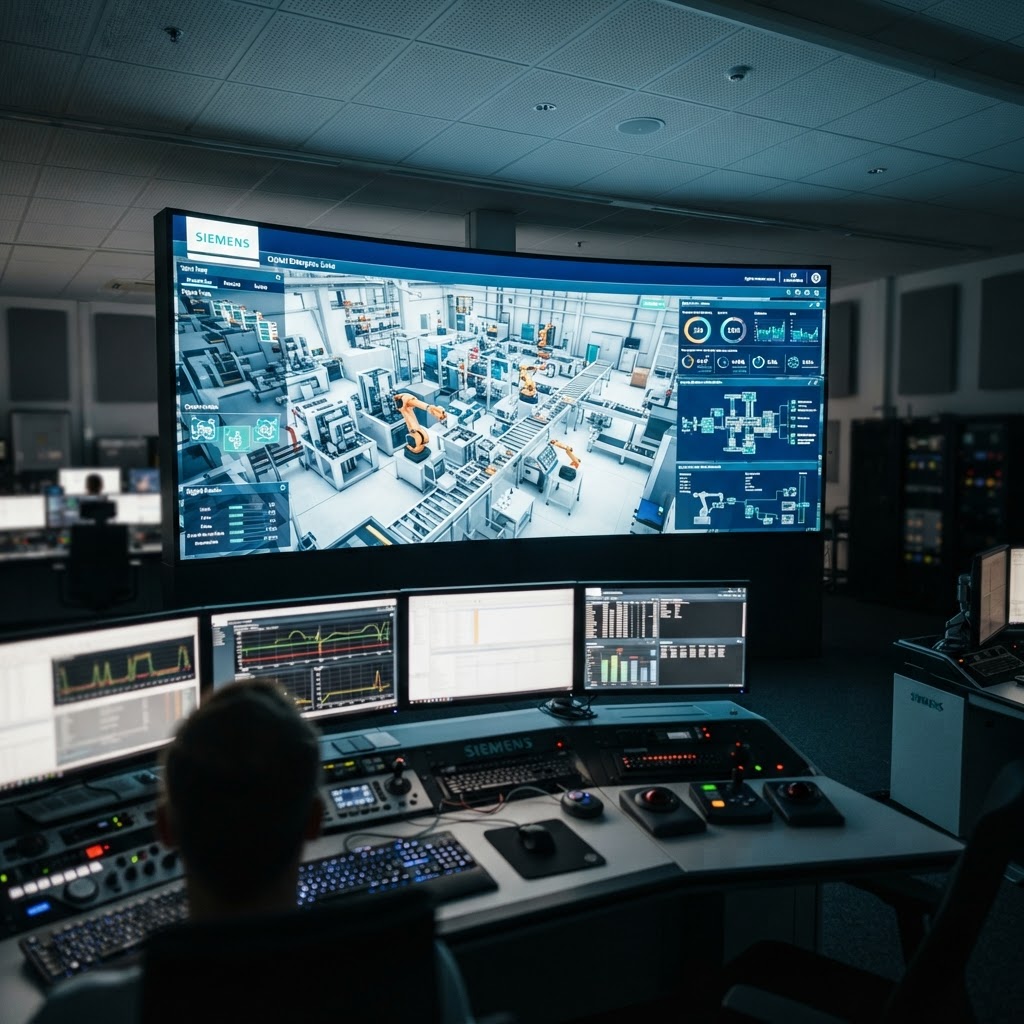
When the Factory Exists Before the First Brick Is Laid
Imagine commissioning a fully operational factory, running thousands of production simulations, and resolving bottlenecks before a single machine is installed. That is not a distant vision. For manufacturers partnering with Siemens, it is standard operating procedure in 2025.
Siemens has positioned itself as the definitive architect of the industrial metaverse, a convergence of digital twin simulation, AI-driven process optimization, and real-time operational data that mirrors physical manufacturing environments in precise virtual detail. The company's Xcelerator platform and its Tecnomatix suite are at the center of this transformation.
For B2B manufacturing leaders evaluating where to invest next, understanding how Siemens built this capability and what it means for competitive positioning is not optional. It is a strategic imperative.
Siemens Manufacturing at Scale: The Numbers Behind the Vision
Siemens reported revenue of approximately 78 billion euros in its fiscal year 2024, with its Digital Industries segment contributing around 20 billion euros. That segment, which houses the factory simulation and digital twin portfolio, grew at a rate that outpaced the broader industrial automation market.
The company operates more than 100 factories globally, with its Amberg Electronics Plant in Germany frequently cited as one of the most automated facilities on earth. At Amberg, automation handles over 75 percent of production steps, and the defect rate sits at roughly 11.5 defects per million opportunities, a benchmark that most manufacturers spend decades trying to approach.
Siemens employs more than 320,000 people worldwide and invests approximately 6 billion euros annually in research and development. That R&D intensity fuels a patent portfolio that spans industrial software, edge computing, AI inference at the machine level, and advanced simulation.
In 2024, Siemens completed the integration of Altair Engineering's simulation capabilities into select Xcelerator workflows, deepening its physics-based modeling capacity. This move signaled that Siemens is not just selling software licenses. It is building an ecosystem that locks in long-term enterprise relationships across the manufacturing value chain.
Digital Twins and the Industrial Metaverse: How the Technology Actually Works
A digital twin in the Siemens context is not a simple 3D model. It is a continuously updated, physics-accurate virtual replica of a machine, production line, or entire facility that receives live data from sensors and operational systems. Siemens's Tecnomatix Plant Simulation software allows manufacturers to model material flow, resource utilization, and throughput capacity across entire factories before physical buildout begins.
In 2025, Siemens reported that manufacturers using its digital twin solutions reduced commissioning time by up to 30 percent and cut engineering rework costs by as much as 25 percent in documented case deployments. BMW, a long-standing Siemens partner, used Siemens Xcelerator to virtually commission its new production lines, reducing physical trial runs significantly and accelerating time to volume production.
The industrial metaverse layer adds a collaborative dimension. Engineers in Munich, Detroit, and Singapore can enter the same virtual factory environment simultaneously, annotate production bottlenecks, test layout changes, and run scenario analyses in real time. Siemens's integration with NVIDIA Omniverse, announced and expanded through 2024 and into 2025, provides the rendering and physics engine that makes these shared virtual spaces photorealistic and behaviorally accurate.
Siemens also embedded generative AI into its NX CAD and Teamcenter PLM platforms, allowing engineers to query operational data conversationally and receive simulation-backed recommendations. This reduces the specialist knowledge required to run complex factory simulations, which is a critical unlock for mid-size manufacturers who lack dedicated simulation teams.
Marketing and Growth Lessons Every Industrial Company Should Steal
Siemens does not sell software. It sells certainty. The entire go-to-market narrative around digital twins is built on risk reduction: fewer physical prototypes, shorter commissioning timelines, lower rework costs. That framing resonates powerfully with procurement leaders and plant managers who are measured on uptime and cost per unit, not on technology adoption.
For industrial companies developing their own B2B marketing strategies, the Siemens playbook offers a clear lesson: lead with the operational outcome, not the technology feature. Siemens rarely opens a customer conversation with specifications. It opens with a quantified business problem, such as six weeks lost to commissioning delays or 3 percent of revenue lost to unplanned downtime, and then positions its platform as the solution.
Siemens also invested heavily in customer co-creation as a marketing engine. Its Xcelerator marketplace, launched and scaled through 2024, allows third-party developers to build applications on top of Siemens infrastructure. By 2025, the marketplace hosted over 300 partner solutions.
Every partner becomes a distribution channel and a proof-of-concept story, compounding Siemens's reach without proportional sales cost.
Content and community matter too. Siemens's annual Realize LIVE conference draws tens of thousands of engineers and manufacturing executives. It functions simultaneously as a product launch vehicle, a customer retention tool, and a pipeline generation engine.
Industrial companies of any size can replicate this logic by building practitioner communities around their core product value rather than relying solely on outbound sales.
If you are leading marketing or growth at a manufacturing company today, the first step is to audit whether your messaging leads with operational outcomes. If it does not, that is the place to start.
The Industrial Metaverse in 2026 and Beyond: What Manufacturers Must Prepare For
The industrial metaverse market is projected to reach 100 billion dollars by 2030 according to analysis from multiple research institutions tracking the space through 2025. Siemens is positioning to capture a disproportionate share by embedding its simulation and PLM tools as the connective tissue between physical assets and their digital counterparts.
Edge AI is accelerating this shift. As inference moves closer to the machine, digital twins can update in near real time rather than on batch cycles. Siemens's partnership with Intel and its own Simatic edge computing hardware give it a vertically integrated stack from the sensor layer to the enterprise software layer, a competitive moat that pure software vendors cannot easily replicate.
For manufacturers, the implication is that the window for piloting digital twin technology is narrowing. Companies that begin building virtual factory models now will have a data advantage in 2027 and 2028 that late adopters cannot quickly close. Historical production data, equipment behavior patterns, and process libraries take years to accumulate and validate inside simulation environments.
Siemens is also expanding into workforce training applications within the industrial metaverse. Virtual reality-based operator training, built on top of digital twin factory models, reduces onboarding time and improves safety compliance. As labor markets remain tight across skilled trades in North America and Europe, this capability is becoming a boardroom-level priority rather than an HR pilot project.
Key Takeaways
- Siemens Digital Industries generated approximately 20 billion euros in revenue in fiscal year 2024, reflecting the scale of demand for industrial software and automation.
- Manufacturers using Siemens digital twin solutions have reported up to 30 percent reductions in commissioning time in documented 2024 and 2025 deployments.
- The Siemens Xcelerator marketplace hosted over 300 partner solutions by 2025, demonstrating how platform ecosystems multiply go-to-market reach without proportional cost.
- Siemens invests approximately 6 billion euros per year in R&D, sustaining its lead in simulation, AI-integrated PLM, and edge computing for industrial applications.
Key Quotes
"The industrial metaverse is not about putting on a headset. It is about connecting every asset, every process, and every person in a living digital model that makes better decisions faster." — Roland Busch, President and CEO, Siemens AG
"With digital twins, we are moving from reactive manufacturing to predictive manufacturing. The factory of the future is already running virtually before it runs physically." — Cedrik Neike, Member of the Managing Board, Siemens AG
References
- Siemens Annual Report 2024 — covers Siemens fiscal 2024 revenue, R&D investment, and Digital Industries segment performance
- Siemens Xcelerator Platform Overview — details on the open digital business platform, partner ecosystem, and industrial metaverse applications
- Siemens and NVIDIA Omniverse Integration — covers the technical partnership enabling photorealistic factory simulation and collaborative industrial metaverse environments