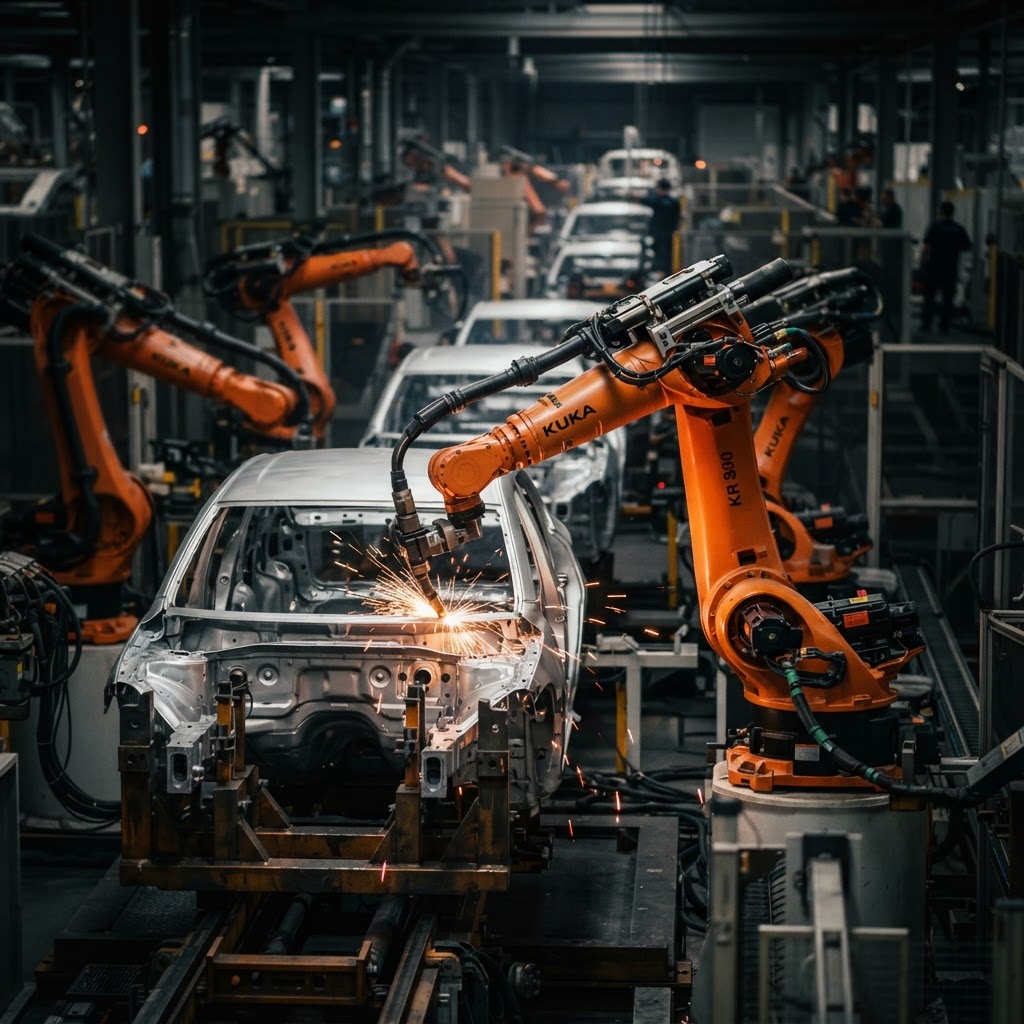
Where Steel Meets Intelligence: The KUKA Difference
In the modern automotive plant, the weld is no longer just a join between two pieces of metal. It is a data point, a quality signal, and a node in an interconnected manufacturing network. KUKA, the Augsburg-based robotics and automation giant, has positioned itself at the center of this transformation with a platform-first approach that fuses hardware precision with software intelligence.
Founded in 1898 and now operating as a subsidiary of China's Midea Group, KUKA serves over 50 industries globally, with automotive manufacturing remaining its single largest vertical. The company's installed base of industrial robots exceeds 40,000 units annually shipped, and its welding systems are deployed in virtually every major automotive production facility in Europe, North America, and Asia.
For B2B decision-makers in manufacturing and industrial sectors, KUKA is not simply a robot vendor. It is a case study in how industrial companies can scale through platform ecosystems, deep vertical integration, and data-driven service models. Understanding how KUKA operates reveals lessons that extend well beyond the automotive floor.
KUKA's Manufacturing Footprint and Financial Scale
KUKA reported revenues of approximately 3.9 billion euros in its 2024 fiscal results, reflecting steady demand recovery across automotive and general industry segments. The company employs more than 14,000 people globally, with major production and R&D hubs in Augsburg, Shanghai, and Detroit. Its manufacturing capacity supports delivery of complex robotic cells, automated guided vehicles (AGVs), and turnkey production systems.
Automotive customers account for roughly 45 percent of KUKA's total revenue, a figure that has remained resilient despite the broader EV transition disrupting traditional assembly workflows. KUKA has actively adapted its welding systems to support aluminum-intensive body structures and battery module assembly, both of which are critical requirements for electric vehicle platforms.
In 2024, KUKA expanded its Shanghai manufacturing campus by approximately 20,000 square meters to meet growing demand from Chinese domestic automakers including BYD, NIO, and Li Auto. This expansion positions KUKA at the epicenter of the world's largest automotive production market, where over 30 million vehicles are assembled annually.
KUKA's service and software segment, branded under iiQKA and KUKA Connect, now contributes a growing share of recurring revenue. Analysts tracking the company have estimated this segment growing at a rate of 12 to 15 percent year over year through 2025, signaling a successful pivot from pure hardware sales to platform-based monetization.
The Smart Factory Platform: iiQKA and Connected Welding Systems
KUKA's iiQKA operating ecosystem is the company's most strategically significant product launch of the past two years. Released progressively through 2024 and into 2025, iiQKA functions as a cloud-enabled robot operating system that allows manufacturers to program, monitor, and optimize KUKA robots through a standardized digital interface. The platform reduces integration time by up to 40 percent compared to traditional teach-pendant programming workflows.
For automotive welding specifically, KUKA's KR CYBERTECH and KR QUANTEC series robots are integrated with KUKA.Weld Tech software, enabling real-time adaptive welding parameter control. Sensors embedded in the welding torch communicate torch angle, wire feed rate, and arc voltage back to the central controller, where deviations are corrected within milliseconds. This closed-loop capability is critical for high-strength steel and advanced high-strength steel (AHSS) components, which dominate modern vehicle body structures.
KUKA Connect, the industrial IoT layer within the platform, aggregates operational data from multiple robot cells and presents it via a unified dashboard accessible from desktop or mobile. In pilot deployments reported in 2025, manufacturers using KUKA Connect achieved an average of 17 percent reduction in unplanned downtime compared to facilities without integrated monitoring. This directly translates to improved overall equipment effectiveness (OEE), one of the primary KPIs for automotive plant managers.
The iiQKA marketplace further allows third-party developers to offer certified application modules compatible with KUKA hardware. This app-store model mirrors strategies pioneered in consumer software but applied to industrial automation, creating a network effect that increases switching costs and deepens customer dependency on the KUKA ecosystem over time.
Marketing and Growth Lessons for Industrial Companies
KUKA's growth trajectory offers a clear lesson for B2B manufacturers: vertical depth creates pricing power. Rather than competing purely on robot unit cost, KUKA bundles its hardware with software, integration services, and lifecycle support, allowing it to command premium pricing while reducing customer churn. Industrial companies that commoditize their core offering leave significant margin on the table.
The company's content and thought leadership strategy is equally instructive. KUKA publishes detailed case studies, white papers, and video documentation of real customer deployments, particularly in EV battery assembly and body-in-white welding. This content serves dual purposes: it educates prospective buyers through complex sales cycles and reinforces KUKA's authority in high-value application niches.
Companies that document and share their deployment expertise consistently outperform peers in generating qualified inbound demand.
KUKA has also invested heavily in co-innovation partnerships with automotive OEMs, embedding its engineers directly within customer development teams during new platform launches. This approach, practiced with several European premium OEMs through 2024 and 2025, creates early specification lock-in that competitors cannot easily displace. For industrial B2B companies, this kind of deep customer integration is the highest-value form of account retention.
If your manufacturing company is evaluating how to compete in an increasingly software-defined industrial environment, the KUKA model offers a concrete blueprint: build the hardware foundation, wrap it in a proprietary software layer, enable an ecosystem of third-party value-adds, and embed your teams inside your best customers' innovation cycles. Start by auditing your current after-sale service and software capabilities today.
Strategic Implications and the Road to 2027
The next chapter for KUKA will be defined by how successfully it navigates the convergence of robotics, AI, and flexible manufacturing. The company has announced plans to integrate large language model (LLM)-assisted programming tools into iiQKA, enabling operators to configure robot tasks through natural language instructions. Early prototypes demonstrated at the Hannover Messe 2025 drew significant attention from plant engineering teams across Europe and Asia.
Electric vehicle production growth continues to shape KUKA's roadmap. As automakers shift toward gigacasting and structural battery pack architectures, welding volumes for traditional body-in-white applications may moderate. KUKA is responding by developing systems specialized for laser welding of battery enclosures, friction stir welding for aluminum chassis components, and robotic assembly of high-voltage connector systems.
These adjacencies ensure the company maintains relevance even as vehicle architectures evolve.
KUKA's parent company Midea Group has signaled continued capital investment in KUKA's European and North American operations through at least 2027, with a particular focus on expanding the software platform's capabilities and growing the certified integrator partner network. A larger partner network amplifies KUKA's reach without proportional increases in direct sales headcount, a capital-efficient growth model.
For industrial companies watching KUKA's strategic moves, the implication is clear: the manufacturers that will lead through 2027 and beyond are those investing now in platform infrastructure, AI-assisted operations, and partner ecosystems. Waiting for the technology to mature fully before acting is increasingly a losing strategy in markets where adoption cycles are compressing.
Key Takeaways
- KUKA generated approximately 3.9 billion euros in 2024 revenue, with automotive applications representing roughly 45 percent of total sales.
- The iiQKA platform reduces robot integration time by up to 40 percent, giving KUKA a measurable productivity advantage over legacy programming approaches.
- Manufacturers using KUKA Connect reported a 17 percent average reduction in unplanned downtime in 2025 pilot deployments, directly improving OEE metrics.
- KUKA's Shanghai campus expanded by 20,000 square meters in 2024 to meet demand from Chinese EV manufacturers producing across a market of over 30 million vehicles annually.
Key Quotes
"With iiQKA, we are making robotics accessible in a completely new way and creating an open ecosystem for our customers and partners." — Peter Mohnen, CEO of KUKA AG
"Automation is not the enemy of employment. It is the foundation for competitiveness that preserves manufacturing in high-wage economies." — Wilfried Eberhardt, Chief Marketing Officer at KUKA AG
References
- KUKA Official Newsroom — covers KUKA product launches, financial updates, and platform announcements including iiQKA developments
- Hannover Messe Official Site — documents exhibitor innovations including KUKA's 2025 AI-assisted robotics demonstrations
- International Federation of Robotics — provides global industrial robot shipment data and automotive sector adoption statistics