The Energy Storage Arms Race Has a New Epicenter
The global energy transition is no longer a distant ambition. It is a capital-intensive, factory-floor reality unfolding at unprecedented speed. At the center of this shift sits Tesla Energy, a division that has quietly grown into one of the most consequential industrial operations in the world.
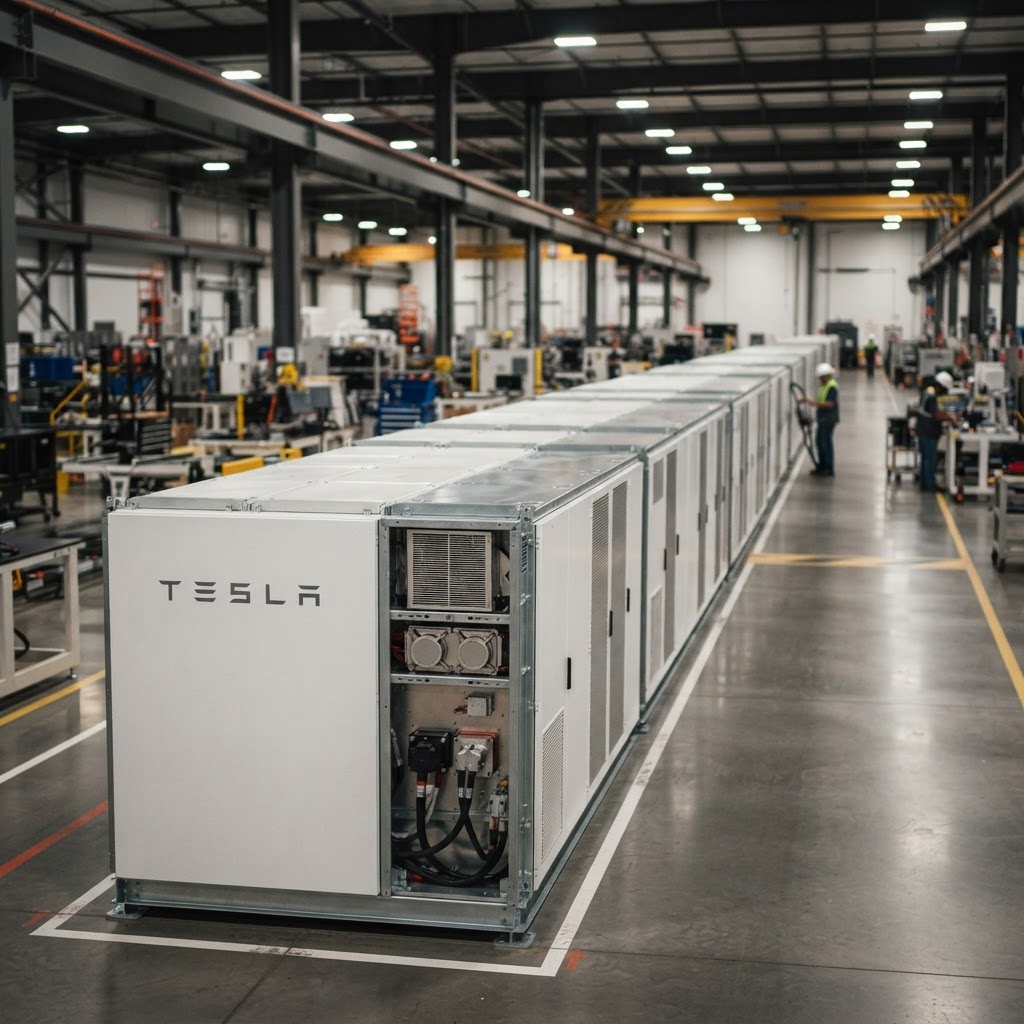
While much attention has focused on Tesla's electric vehicles, the company's energy storage business has emerged as a separate powerhouse. The Megapack product line, manufactured at the Lathrop Megafactory in California's Central Valley, represents one of the most ambitious manufacturing scale-ups in the history of clean energy infrastructure.
For manufacturing and industrial executives, the Lathrop facility is more than a factory. It is a case study in vertical integration, automated production, and demand-driven capacity planning that carries lessons far beyond the battery industry.
Inside the Lathrop Megafactory: Scale, Speed, and Output
The Lathrop Megafactory, also known as Megafactory 1, spans approximately 1 million square feet and is purpose-built to produce Megapack battery storage systems at industrial scale. By the end of 2024, the facility had achieved a production run rate exceeding 40 gigawatt-hours (GWh) of storage capacity annually. That figure represents a dramatic increase from the facility's initial ramp targets and positions Lathrop as one of the highest-output battery storage factories in the Western Hemisphere.
Tesla Energy's revenue reached approximately 10 billion dollars in 2024, a figure that reflected surging utility and commercial demand for grid-scale storage. Megapack deployments grew by more than 150 percent year-over-year in 2024, driven by contracts across North America, Europe, and Asia-Pacific. The Lathrop facility played the central role in fulfilling that backlog.
Each Megapack unit stores up to 3.9 megawatt-hours of energy and is designed for modular deployment in utility-scale projects. The Lathrop line can produce a Megapack roughly every 30 seconds at full throughput, a pace made possible by highly automated assembly sequences. This level of output density is comparable to automotive final assembly lines, not traditional energy equipment manufacturing.
The factory operates on a continuous production model with minimal human touchpoints on the core assembly line. Tesla has invested heavily in robotics, automated guided vehicles (AGVs), and machine vision systems throughout the Lathrop facility. These investments have contributed to a reported defect rate that is significantly lower than industry averages for battery enclosure and integration manufacturing.
Engineering the Line: Automation, Integration, and Process Innovation
Tesla's approach to Megapack manufacturing draws directly from its automotive playbook while adapting to the unique demands of large-format battery systems. The company uses a cell-to-pack architecture that eliminates intermediate module assemblies, reducing part counts by an estimated 30 to 40 percent compared to conventional battery pack designs. Fewer parts mean fewer assembly steps, lower labor requirements, and fewer potential failure points.
The Lathrop facility integrates battery cell procurement, thermal management assembly, power electronics integration, and firmware loading into a single continuous flow. This contrasts sharply with the fragmented supply chains that characterize most utility-scale storage projects, where components are sourced from multiple vendors and integrated on-site. Tesla's in-house integration model compresses lead times and gives the company tighter quality control over every subsystem.
Software plays a central role in the manufacturing process. Each Megapack is flashed with Tesla's proprietary energy management software before leaving the factory, and the unit undergoes automated functional testing that simulates real-world grid interaction scenarios. This factory-level commissioning means that site deployment time is dramatically reduced, a key competitive advantage for project developers working under tight interconnection schedules.
In 2025, Tesla began rolling out additional automation upgrades at Lathrop focused on the wiring harness and busbar installation stages, which had previously required more manual labor than other parts of the line. Industry observers noted that these upgrades were consistent with Tesla's stated goal of reducing per-unit manufacturing cost by more than 50 percent compared to its 2024 baseline. Cost reduction at that scale would further widen the company's pricing moat against competitors.
What Industrial and Manufacturing Companies Can Learn From Tesla Energy's Go-To-Market Model
Tesla Energy's commercial success with Megapack is not purely a function of technological superiority. The company has executed a B2B go-to-market strategy that manufacturing firms in adjacent sectors should study closely. Rather than relying on distributor networks or third-party integrators, Tesla sells Megapack directly to utilities, independent power producers, and large commercial customers.
This direct model gives the company full visibility into project pipelines and enables tighter alignment between sales forecasts and production scheduling.
The company's order backlog serves as a manufacturing planning tool as much as a sales metric. By the middle of 2025, Tesla Energy's Megapack backlog extended more than 18 months forward, allowing Lathrop to operate with exceptional production stability. For industrial manufacturers, the lesson is clear: a long-duration order book de-risks capital investment in factory capacity and enables the kind of automation investment that Lathrop exemplifies.
Tesla Energy has also leveraged project case studies and deployment data as a core marketing asset. Published performance data from large installations, including projects in Australia and Texas, has served as third-party validation that shortens enterprise sales cycles. Industrial companies that can produce credible, data-rich case studies from reference customers gain a significant advantage in complex, high-value B2B procurement processes.
For manufacturers looking to replicate elements of this model, the starting point is aligning production capacity decisions with contracted revenue rather than forecast revenue. Tesla's ability to justify Lathrop's capital expenditure rested on a foundation of signed contracts, not speculative demand projections. If your company is planning a capacity expansion in 2025 or 2026, consider how your sales pipeline can be structured to provide the same kind of demand certainty before committing to factory-floor investment.


