NEWS
Trilogy Machinery Welcomes New Operations Administrator and Service Technician — The FabricatorNew Drone Falls From Sky Like Maple Seed, Then Sails Like Boat — Manufacturing.netSMC AC Adapter Makes Bench Testing M12 Devices Easier for Techs — Control EngineeringGermany's Manufacturing Sector Sustains Upturn — ReutersBig-Box Retailers Automate Stockrooms to Keep Up With BOPIS Demand — Manufacturing TomorrowPandora Opens $150 Million Jewelry Factory Powered by Renewable Energy — Manufacturing.netXtalPi and Fangda Carbon Deploy Predictive AI in Graphite Manufacturing — Manufacturing TomorrowGüdel to Demonstrate Extended-Range Welding System at FABTECH — Manufacturing TomorrowUS Manufacturing Activity Little Changed in September — ReutersERP System Transforms Growing Injection Molder's Operations — PlasticsTodayEU Project Delivers Lightweight Biocomposites for Sustainable Transport — PlasticsTodayUS Trade Ministers Reject Calls to Curb Non-Market Policies — ReutersTrilogy Machinery Welcomes New Operations Administrator and Service Technician — The FabricatorNew Drone Falls From Sky Like Maple Seed, Then Sails Like Boat — Manufacturing.netSMC AC Adapter Makes Bench Testing M12 Devices Easier for Techs — Control EngineeringGermany's Manufacturing Sector Sustains Upturn — ReutersBig-Box Retailers Automate Stockrooms to Keep Up With BOPIS Demand — Manufacturing TomorrowPandora Opens $150 Million Jewelry Factory Powered by Renewable Energy — Manufacturing.netXtalPi and Fangda Carbon Deploy Predictive AI in Graphite Manufacturing — Manufacturing TomorrowGüdel to Demonstrate Extended-Range Welding System at FABTECH — Manufacturing TomorrowUS Manufacturing Activity Little Changed in September — ReutersERP System Transforms Growing Injection Molder's Operations — PlasticsTodayEU Project Delivers Lightweight Biocomposites for Sustainable Transport — PlasticsTodayUS Trade Ministers Reject Calls to Curb Non-Market Policies — Reuters
Report

Protein at Machine Speed: How Tyson Foods' Automated Processing Plants Are Leading the Smart Manufacturing Revolution

How Tyson Foods is deploying robotics, AI, and industrial IoT across 120+ facilities to lead the smart manufacturing revolution in protein processing.

Manufacturing UltraOctober 3, 20266 min read
Protein at Machine Speed: How Tyson Foods' Automated Processing Plants Are Leading the Smart Manufacturing Revolution

At a Glance

AI Summary

How Tyson Foods is deploying robotics, AI, and industrial IoT across 120+ facilities to lead the smart manufacturing revolution in protein processing.

Manufacturing UltraOct 3, 20266 min read

Key Takeaways

  • Tyson Foods reported approximately 53 billion dollars in revenue for fiscal year 2025, funding one of the largest plant modernization programs in North American food manufacturing history.

When the Protein Industry Meets the Age of Intelligent Machines

The food manufacturing sector is undergoing a seismic shift, and few companies illustrate this transformation more vividly than Tyson Foods. As one of the world's largest protein processors, Tyson has moved beyond incremental upgrades to embrace full-scale smart manufacturing across its sprawling network of facilities. The stakes are enormous: consumer demand, labor volatility, and margin pressure are forcing industrial food producers to rethink every step of the production process.

Tyson Foods processes millions of pounds of chicken, beef, and pork every single day. That scale creates both extraordinary complexity and extraordinary opportunity for automation, data integration, and intelligent process control. The company's recent investments signal a clear strategic intent: build the most technologically advanced protein processing infrastructure in North America.

For manufacturing and industrial decision-makers watching from adjacent sectors, Tyson's transformation is a masterclass in how legacy industrial operations can be rebuilt from the inside out. This report examines the technology, the strategy, and the lessons that B2B leaders in manufacturing can apply to their own operations.

The Scale and Scope of Tyson Foods' Industrial Operations

Tyson Foods reported approximately 53 billion dollars in annual revenue for fiscal year 2025, cementing its position as the second-largest food company in the Fortune 500. The company operates more than 120 production facilities across the United States, employing roughly 137,000 team members in plant operations alone. That footprint makes Tyson one of the most complex discrete manufacturing organizations on the planet.

The company's chicken segment alone processes more than 45 million birds per week across its domestic facilities. Beef and pork operations add tens of millions of additional pounds of throughput daily. Managing this volume with consistency, food safety compliance, and cost efficiency requires industrial systems operating at a level of precision that manual processes simply cannot sustain.

Tyson's capital expenditure program has averaged over 1.5 billion dollars annually in recent years, with a growing share directed toward automation, robotics, and digital infrastructure. In its 2025 annual report, the company highlighted plant modernization as a primary driver of long-term margin recovery. The goal is not just to reduce labor dependency but to build facilities capable of adaptive, data-driven production.

The company's diversified protein portfolio, spanning retail, foodservice, and international channels, creates a manufacturing scheduling challenge of enormous complexity. Automated systems capable of rapid line changeovers and real-time demand signal integration are no longer a competitive advantage for Tyson. They are an operational necessity.

Automation, Robotics, and the Digital Plant Floor

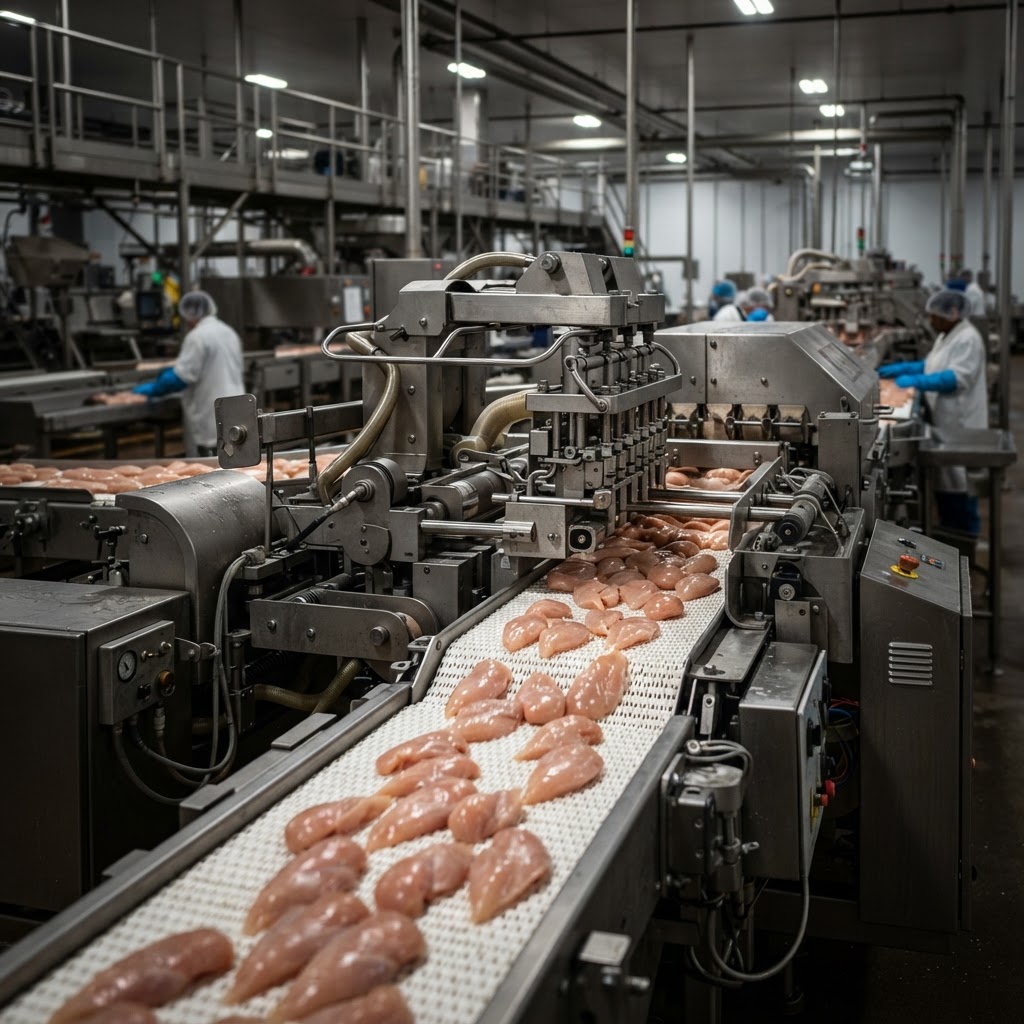
Tyson Foods has invested heavily in robotic deboning and cut-up systems across its poultry facilities. Traditional hand deboning is labor-intensive and subject to yield variability, while robotic systems consistently achieve tighter yield margins and faster throughput. The company's facilities in Kentucky and Arkansas have served as testbeds for next-generation robotic harvesting lines that reduce per-unit labor cost by an estimated 15 to 20 percent.

The company has also deployed computer vision inspection systems across multiple facilities to replace or supplement manual quality control. These systems use high-speed cameras and machine learning models to identify defects, foreign material risks, and weight deviations in real time. Early deployments have reportedly reduced quality-related line stoppages by double-digit percentages while improving USDA compliance documentation accuracy.

On the plant floor data side, Tyson has implemented industrial IoT sensor networks that monitor equipment performance, energy consumption, and throughput metrics continuously. These systems feed into centralized dashboards that plant managers use to identify bottlenecks and predict maintenance needs before equipment failures occur. Predictive maintenance alone is projected to save Tyson tens of millions of dollars annually by reducing unplanned downtime across high-utilization lines.

Tyson partnered with several leading automation vendors through 2024 and 2025 to accelerate deployment timelines. Rather than waiting for perfect technology readiness, the company adopted a phased pilot-to-scale model: deploy in one facility, measure outcomes rigorously, and roll out proven configurations across the broader network. This approach has compressed implementation cycles and reduced capital risk on large automation bets.

Marketing and Growth Lessons for Industrial Manufacturers

Tyson's transformation offers a critical lesson for B2B industrial companies: automation investment must be framed as a supply chain reliability story, not just a cost reduction story. Customers in foodservice and retail increasingly require guaranteed fill rates, consistent product specifications, and rapid responsiveness to demand changes. Automated facilities are far better positioned to deliver on those commitments than manually dependent ones.

For industrial manufacturers selling into supply chains, the ability to demonstrate operational reliability through data is becoming a procurement differentiator. Tyson has invested in customer-facing transparency tools that communicate production status and supply availability in near real time. This kind of operational visibility builds long-term contract relationships and reduces customer churn in ways that price competition alone cannot achieve.

Tyson also demonstrates the value of publicizing innovation milestones as part of a broader B2B brand strategy. Announcements about new automated facilities, food safety technology deployments, and sustainability achievements consistently generate trade press coverage that reinforces Tyson's position as a preferred enterprise supplier. Industrial companies of all sizes can replicate this approach by treating technology investment as a marketing asset, not just an operational one.

Finally, Tyson's segment-specific manufacturing capabilities allow it to serve highly differentiated customer needs from a shared infrastructure. This modular flexibility is a growth lever that B2B manufacturers should study carefully. If your production technology can be configured rapidly for new customer specifications, that capability belongs front and center in your sales and marketing messaging.

The Capacity Imperative — CNC machining cover
Free Industry Report

The Capacity Imperative

U.S. Advanced Manufacturing in 2027

The Future of Protein Processing and Strategic Implications for Industrial Leaders

Looking ahead to 2026 and beyond, Tyson Foods is expected to accelerate its investment in AI-driven production planning systems that integrate demand forecasting, raw material availability, and plant capacity into a single decision engine. These systems will allow the company to dynamically optimize which facilities produce which products on which lines, dramatically improving asset utilization across the network.

The labor market context makes this urgency even clearer. Processing plant labor has remained tight and expensive through 2025, with wage inflation in food manufacturing running well above the broader industrial average. Tyson's automation roadmap is explicitly designed to reduce the company's exposure to this structural labor challenge without reducing its total workforce precipitously, focusing instead on redeployment into higher-skill roles.

For industrial manufacturers in adjacent sectors, the strategic implication is direct: companies that delay automation investment are not standing still. They are falling behind peers who are compressing cost structures, improving quality consistency, and building customer confidence through technological capability. The window to modernize on a proactive rather than reactive basis is narrowing.

The smart manufacturing transformation at Tyson Foods is a living case study in industrial reinvention at scale. If your organization is evaluating where to begin or how to accelerate its own automation journey, the time to engage with technology partners, benchmark peer deployments, and build your investment case is right now. Connect with automation specialists, attend industrial technology forums, and begin mapping your own path from legacy operations to intelligent manufacturing.

Key Takeaways

  • Tyson Foods reported approximately 53 billion dollars in revenue for fiscal year 2025, funding one of the largest plant modernization programs in North American food manufacturing history.
  • The company processes more than 45 million birds per week in its poultry segment alone, a throughput scale that makes manual quality control economically and operationally untenable.
  • Robotic deboning and cut-up systems deployed at Tyson facilities have demonstrated per-unit labor cost reductions of 15 to 20 percent versus traditional hand-processing lines.
  • Tyson's capital expenditure program has averaged over 1.5 billion dollars annually, with an increasing share directed toward automation, robotics, and industrial IoT infrastructure.

Key Quotes

"We are investing in automation and technology to make our plants safer, more efficient, and more consistent for our customers and our team members." — Donnie King, President and CEO, Tyson Foods

"The future of food manufacturing is going to be defined by companies that can combine scale with precision, and that requires a fundamentally different kind of plant infrastructure." -- John R. Tyson, Chief Financial Officer, Tyson Foods

References

  • Tyson Foods Investor Relations -- Official source for annual reports, capital expenditure disclosures, and fiscal 2025 financial results
  • Food Engineering Magazine -- Covers automation trends, robotics deployments, and smart manufacturing developments in food processing
  • The Food Institute -- Industry analysis on protein sector labor trends, technology investment, and supply chain transformation through 2025 and 2026
The Capacity Imperative — CNC machining cover
Free Industry Report

The Capacity Imperative

U.S. Advanced Manufacturing in 2027

Newsletter

Stay in the loop

Get the latest insights on manufacturing marketing, industrial trends, and growth strategies delivered to your inbox.

We'll send you industry insights and manufacturing trends. No spam, unsubscribe anytime.

A massive modern industrial robot arm in a sleek manufacturing facility
Manufacturing Ultra

Marketing for the industrial economy. We help manufacturers, suppliers, and event organizers grow with modern, data-driven programs.

Explore

© 2026 Manufacturing Ultra. All rights reserved.