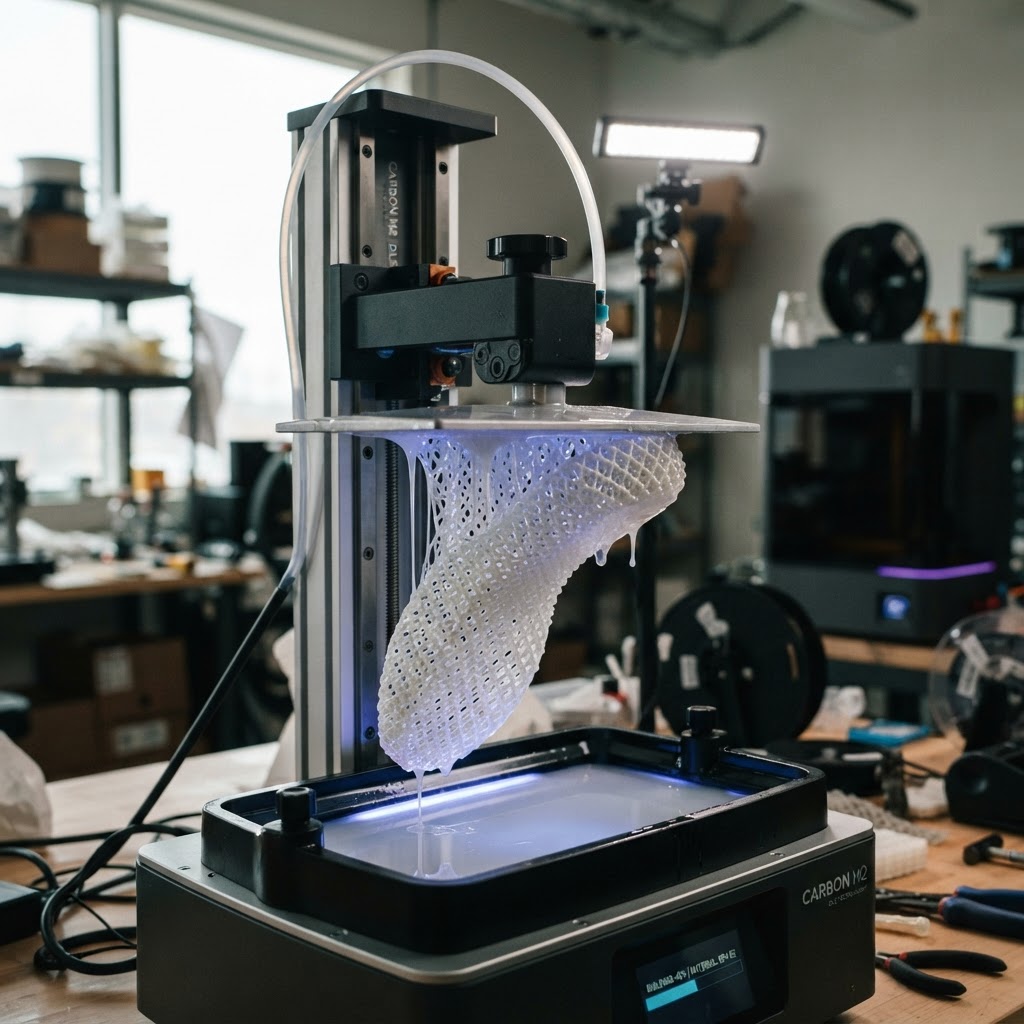
When a Sneaker Sole Changed the Rules of Advanced Manufacturing
In the competitive world of industrial manufacturing, breakthroughs rarely arrive with fanfare. But when Adidas and Carbon collaborated to produce the 4DFWD midsole using Carbon's Digital Light Synthesis (DLS) technology, the industry took notice. The result was not just a better running shoe.
It was proof that additive manufacturing could operate at commercial scale with the precision and repeatability that industrial buyers demand.
Carbon, founded in 2013 and headquartered in Redwood City, California, has positioned itself as more than a 3D printing hardware company. Its subscription-based model, proprietary resins, and software-driven production platform have attracted partnerships with some of the world's most demanding manufacturers. The Adidas 4DFWD collaboration remains the most visible demonstration of what Carbon's platform can deliver.
For B2B manufacturing and industrial decision-makers, the Carbon story offers a masterclass in how deep technology, smart positioning, and strategic partnerships can unlock entirely new categories of production. This case study breaks down exactly how Carbon did it and what lessons industrial companies can apply today.
Carbon's Manufacturing Platform: Scale, Subscription, and Precision at Volume
Carbon's business model is built on a subscription-based hardware and software platform. Manufacturers do not simply buy a printer. They subscribe to the entire Carbon ecosystem, which includes hardware, software updates, technical support, and access to Carbon's proprietary resin library.
This model creates recurring revenue and deep customer lock-in, two characteristics that make Carbon highly attractive to industrial partners evaluating long-term production commitments.
The Adidas 4DFWD midsole program demonstrated Carbon's ability to produce millions of units with consistent quality. Each midsole is printed using Carbon's EPU (Elastomeric Polyurethane) resin, engineered specifically for energy return and durability under athletic stress. The lattice geometry of the 4DFWD midsole contains structures that cannot be manufactured using traditional injection molding, making Carbon's DLS process not just a faster alternative but the only viable production method.
Carbon has reported that its platform can produce parts up to 100 times faster than traditional stereolithography processes. Production throughput improvements of this magnitude have direct implications for industrial buyers evaluating additive manufacturing as a genuine alternative to legacy production methods. For Adidas, scaling the 4DFWD line across global retail required confidence in Carbon's ability to meet volume targets without sacrificing quality tolerances.
As of 2025, Carbon's installed printer base spans customers across footwear, medical devices, automotive, and industrial components. The company's 2025 manufacturing partner network includes contract manufacturers on multiple continents, enabling geographically distributed production that reduces lead times and logistics complexity for global brands.
Digital Light Synthesis: The Technology Stack Driving Commercial Additive Manufacturing
Digital Light Synthesis is Carbon's proprietary process and the technical foundation of everything the company offers. Unlike traditional fused deposition modeling or selective laser sintering, DLS uses a combination of light and oxygen to precisely control the polymerization of liquid resins. The process draws parts continuously from a resin pool beneath a UV-transparent window, enabling far faster build speeds and superior surface quality compared to layer-by-layer methods.
The oxygen-permeable window, which Carbon calls the CLIP (Continuous Liquid Interface Production) window, creates a thin liquid interface that prevents the resin from sticking and allows continuous part growth. This innovation eliminates the mechanical separation steps that slow down conventional resin-based printers. The result is a process that can produce end-use quality parts with isotropic mechanical properties, meaning the parts perform consistently regardless of print orientation.
For the Adidas 4DFWD midsole, the DLS process enabled a lattice structure with over 20 percent improved forward energy transfer compared to previous generation designs, according to Adidas performance data cited in 2025 product documentation. The geometry complexity achievable through DLS is simply not replicable through injection molding or compression molding at any cost. This locks the Adidas-Carbon relationship into a long-term technical dependency that benefits both parties.
Carbon's resin portfolio now exceeds 30 materials, spanning rigid polyurethanes, flexible elastomers, dental-grade compounds, and high-temperature engineering resins. Each resin is engineered to work specifically within the DLS process parameters, ensuring predictable outputs at production scale. For industrial buyers, this material breadth means Carbon can address a wider range of component applications without requiring costly tooling changes or process revalidation.
Marketing and Growth Lessons for Industrial Companies Watching Carbon's Rise
Carbon's go-to-market strategy offers several transferable lessons for industrial manufacturers seeking to grow their customer base and differentiate on technology. The first lesson is the power of a flagship partnership. The Adidas 4DFWD collaboration gave Carbon a globally visible proof point that no marketing budget could have purchased.
One high-profile, technically demanding customer relationship became the company's most effective sales tool.
The second lesson is about positioning around outcomes rather than features. Carbon does not lead with printer specifications. It leads with production outcomes: faster time to market, design freedom unavailable through conventional manufacturing, and supply chain simplification through distributed digital production.
This framing resonates with procurement and engineering decision-makers who are evaluated on project delivery, not on machine specs.
Third, Carbon's subscription model transformed the customer acquisition conversation. Rather than asking industrial buyers to commit to a large capital expenditure upfront, the subscription approach lowered the barrier to entry and shifted the relationship from transactional to collaborative. Customers who integrate Carbon's software and workflows into their engineering pipelines face high switching costs, which drives retention and expands lifetime customer value.
For industrial companies seeking to apply these lessons, the core principle is that technology leadership must be made visible through strategic partnerships and outcome-focused messaging. If your manufacturing process delivers a capability that competitors cannot match, find the customer whose product will showcase that capability at scale, and build the partnership to prove it publicly. That is the Carbon playbook, and it works.
The Strategic Road Ahead: Digital Manufacturing at Industrial Scale
Carbon's trajectory points toward a future where digital manufacturing networks replace geographically fixed production lines. By 2026, the broader additive manufacturing market is projected by industry analysts to exceed 30 billion dollars globally, with industrial and production-grade applications accounting for a growing share of that total. Carbon is positioned to capture a disproportionate share of high-value, low-volume and medium-volume production contracts where DLS's speed and precision advantages are most pronounced.
The Adidas partnership also signals a broader shift in how consumer goods companies think about manufacturing. Brand owners increasingly want the ability to iterate on product geometry between production runs without retooling costs. Carbon's platform enables exactly this: design changes are implemented in software, not in physical tooling, compressing the product development cycle from months to days.
For industrial component manufacturers, the strategic implication is clear: companies that adopt digital manufacturing platforms early will have lower product development costs, shorter lead times, and greater design flexibility than competitors locked into legacy tooling. Carbon's customer data from 2025 shows that manufacturers using DLS for end-use parts report an average lead time reduction of 40 to 70 percent compared to equivalent injection-molded components.
The industrial companies best positioned to compete over the next decade will treat their manufacturing platform as a strategic asset, not a cost center. Carbon's growth demonstrates that investing in process technology at the platform level, not just the equipment level, creates durable competitive advantages that are extremely difficult for competitors to replicate. If your organization has not yet evaluated additive manufacturing as a production-grade option, the time to begin that assessment is now.
Key Takeaways
- Carbon's DLS process produces parts up to 100 times faster than traditional stereolithography, enabling commercial-scale additive manufacturing for demanding industrial applications.
- The Adidas 4DFWD midsole achieved over 20 percent improved forward energy transfer compared to prior generation designs, demonstrating that DLS enables performance gains unavailable through conventional manufacturing.
- Carbon's resin portfolio exceeded 30 materials as of 2025, giving industrial partners broad application coverage without process revalidation costs.
- Industrial manufacturers using Carbon's DLS platform for end-use parts reported average lead time reductions of 40 to 70 percent compared to injection-molded equivalents, according to 2025 Carbon customer data.
Key Quotes
"We are not building a 3D printing company. We are building a manufacturing platform that changes how the world makes things." -- Joseph DeSimone, Co-Founder and former CEO of Carbon
"The 4DFWD midsole represents a new chapter in how we think about performance footwear. The lattice structures Carbon enables are simply not possible any other way." -- James Carnes, VP of Design Innovation, Adidas
References
- Carbon3D Official Technology Overview -- Covers Carbon's DLS process, resin materials, and platform capabilities in detail
- Adidas 4DFWD Product and Technology Page -- Details on the 4DFWD midsole design, performance claims, and Carbon partnership context
- Wohlers Report 2025 Additive Manufacturing Market Data -- Industry benchmark report covering global additive manufacturing market size, growth rates, and production application trends