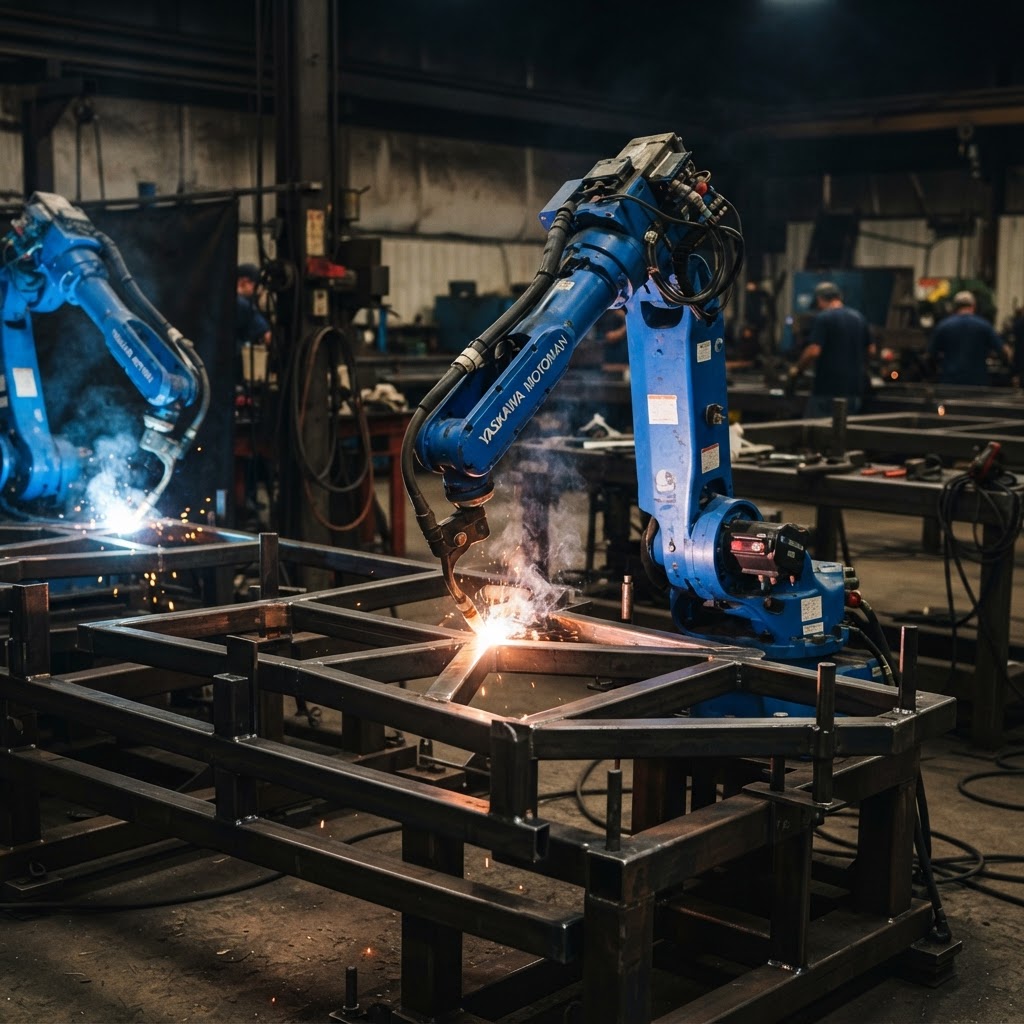
The Spark That's Changing Industrial Floors
In plants across North America, Europe, and Asia, a quiet revolution is underway. Arc welding torches are moving with millimeter precision, and heavy components are gliding across factory floors without a single human hand guiding them. Yaskawa Motoman is at the center of this transformation, delivering robotic solutions that are reshaping what modern industrial production looks like.
Yaskawa is not a newcomer to automation. Founded in 1915 in Japan, the company has spent over a century perfecting motion control and robotics technology. Its Motoman division has become one of the most recognized names in industrial robotics globally, serving manufacturers in automotive, aerospace, metal fabrication, and heavy industry.
For manufacturing and industrial decision-makers evaluating automation investments, Yaskawa Motoman represents a compelling case study. This guide breaks down how their arc welding and material handling systems work, what results industrial plants are achieving, and what B2B marketing lessons every industrial company can draw from Yaskawa's strategy.
Yaskawa's Manufacturing Footprint and Market Position
Yaskawa Electric Corporation reported net sales of approximately 560 billion Japanese yen in its fiscal year 2025 results, with its Robotics segment accounting for a significant and growing share of that revenue. The company has shipped over 700,000 industrial robots globally, a cumulative milestone that positions it among the top four robotics manufacturers worldwide alongside FANUC, ABB, and KUKA.
The Motoman product line includes more than 100 robot models covering payloads from under 1 kilogram to over 600 kilograms. This range allows a single vendor relationship to cover everything from precision welding on thin sheet metal to heavy-duty palletizing and press tending. For plant managers consolidating vendors, that breadth is a material operational advantage.
Yaskawa's North American manufacturing hub in Dayton, Ohio produces robotic systems and controllers for the North American market. The facility supports rapid delivery timelines that matter enormously in capital project planning. Lead times on standard configurations have been reduced through localized assembly, a factor that purchasing teams at large industrial OEMs consistently cite as a decision driver.
In the global industrial robotics market, which research firm IFR (International Federation of Robotics) valued at roughly 20 billion USD in 2024, Yaskawa holds an estimated 15 to 18 percent share in key segments including arc welding automation. That share reflects decades of application engineering investment and a deep installed base that generates recurring service and software revenue.
Arc Welding and Material Handling Technology That Delivers Results
Yaskawa Motoman's arc welding robots, including the AR series and the newer ArcWorld workcells, are engineered specifically for high-duty-cycle welding environments. The AR2010 and AR3120 models offer reach envelopes and wrist dexterity optimized for complex joint geometries found in structural steel, pipe, and heavy equipment fabrication. Repeatability specifications of plus or minus 0.08 millimeters ensure weld bead consistency that manual welders struggle to match across long shifts.
One of the most significant technology differentiators is Yaskawa's integration of its own YRC1000 controller with real-time weld process monitoring. The controller communicates directly with compatible welding power sources, adjusting voltage and wire feed speed in response to arc feedback. This closed-loop capability reduces spatter, minimizes rework, and improves first-pass weld quality rates.
Facilities that have deployed ArcWorld systems report rework reductions of 30 to 50 percent compared to prior manual or semi-automated processes.
On the material handling side, Yaskawa's GP series (general purpose) robots and its MH series handle everything from machine tending and press loading to palletizing and order fulfillment in industrial distribution. The GP180 and GP280 models, with payloads of 180 and 280 kilograms respectively, are widely used in automotive stamping plants and heavy fabrication shops. Cycle time improvements of 20 to 40 percent over manual handling are commonly documented in deployment case studies published by Yaskawa and its system integrator partners.
Yaskawa also offers its Cockpit software platform for fleet monitoring, providing OEE (Overall Equipment Effectiveness) dashboards that give plant engineers visibility into robot uptime, cycle counts, and maintenance alerts. In 2024 and 2025, Yaskawa expanded Cockpit's connectivity options to include cloud-based analytics, allowing multi-site manufacturers to benchmark performance across facilities. This shift toward software-as-a-service revenue mirrors broader trends in industrial automation where hardware margins are supplemented by recurring digital subscriptions.
B2B Marketing and Growth Lessons from Yaskawa's Industrial Strategy
Yaskawa's go-to-market model for Motoman robotics offers practical lessons for any B2B manufacturer selling complex capital equipment. Rather than relying solely on direct sales, Yaskawa built an extensive network of Authorized System Integrators (ASIs) that design, build, and commission turnkey robotic workcells. This channel strategy multiplies market reach without proportionally multiplying Yaskawa's own sales headcount.
The ASI model also shifts a meaningful portion of application risk to partners with deep domain expertise. A Tier 1 automotive supplier evaluating a new arc welding cell is more likely to trust a regional integrator with 20 years of automotive welding experience than a generalist robotics vendor alone. By co-branding with qualified integrators, Yaskawa gains credibility in vertical markets it could not penetrate as effectively through direct selling alone.
Content marketing plays a measurable role in Yaskawa's demand generation. The company produces detailed application videos, ROI calculators, and technical white papers targeting process engineers and capital equipment buyers. This content strategy addresses the long B2B buying cycles typical in industrial automation, where a single robot cell purchase can involve 6 to 18 months of evaluation before a purchase order is issued.
For industrial companies looking to replicate this approach, the key insight is specificity. Yaskawa does not publish generic automation content. Instead, it produces weld-process-specific guides, payload-specific selection tools, and industry-specific case studies.
If your company sells to metal fabricators, speak to metal fabricators in their language, with their metrics, and with proof from their peers.
The Road Ahead: Collaborative Robots, AI Welding, and the Next Industrial Frontier
Yaskawa is investing heavily in what it calls the next generation of human-robot collaboration for industrial environments. Its HC series cobots are designed to work alongside human welders and material handlers without hard safety guarding, using force-torque sensing to detect and respond to human contact. As labor shortages in skilled trades deepen through 2025 and 2026, the cobot value proposition in welding is shifting from cost reduction to workforce augmentation.
Artificial intelligence is beginning to reshape arc welding process optimization in ways that rule-based controllers could not achieve. Yaskawa has partnered with welding technology firms to pilot adaptive welding algorithms that use vision systems and machine learning to adjust parameters in response to joint fit-up variation. Early pilot programs in 2025 reported first-pass acceptance rate improvements of up to 15 percent on complex structural weldments where fit-up inconsistency had historically been a major rework driver.
In material handling, Yaskawa's integration of 3D vision and AI-based bin-picking software is enabling robots to handle previously unstructured tasks. Random bin picking, mixed-SKU palletizing, and flexible part feeding are application areas where traditional robots required expensive fixturing. The new vision-guided systems reduce changeover time and expand the range of parts a single robot can handle, which improves ROI calculations for smaller-volume manufacturers.
For industrial companies evaluating their automation roadmap, the strategic implication is clear: the window for gaining competitive advantage through early adoption is narrowing. Plants that deploy and optimize Yaskawa Motoman arc welding and material handling systems in 2025 and 2026 are building process knowledge, training data for AI systems, and workforce familiarity that late adopters will spend years trying to replicate. If you are ready to explore how Yaskawa Motoman can transform your welding or material handling operations, connect with a certified Motoman integrator or contact Yaskawa's application engineering team to schedule a facility assessment.
Key Takeaways
- Yaskawa has shipped over 700,000 industrial robots globally, giving it one of the largest installed bases in the world and a deep well of application data across arc welding and material handling.
- The global industrial robotics market reached approximately 20 billion USD in 2024, with Yaskawa holding an estimated 15 to 18 percent share in key welding automation segments.
- Facilities deploying Yaskawa ArcWorld systems have documented rework reductions of 30 to 50 percent compared to prior manual or semi-automated welding processes.
- AI-assisted adaptive welding pilots conducted in 2025 showed first-pass acceptance rate improvements of up to 15 percent on complex structural weldments, signaling a new era of process intelligence.
Key Quotes
"Our goal is to provide solutions that make our customers more competitive globally, and arc welding automation is one of the clearest paths to doing that in heavy industry." — Nobuhiro Aoki, President and CEO, Yaskawa Electric Corporation
"The combination of Yaskawa's motion control heritage and open software architecture gives system integrators the flexibility to build solutions that truly fit the customer's process, not the other way around." -- Chad Koehler, Director of Product Management, Yaskawa Motoman
References
- Yaskawa Motoman Official Site -- Covers Yaskawa's full Motoman robot lineup, ArcWorld workcells, application resources, and integrator finder tools
- International Federation of Robotics (IFR) World Robotics Report -- Annual report covering global industrial robot installations, market size data, and segment breakdowns including welding and material handling
- Yaskawa Electric Investor Relations -- Official source for Yaskawa fiscal year financial results, segment revenue data, and corporate strategy updates